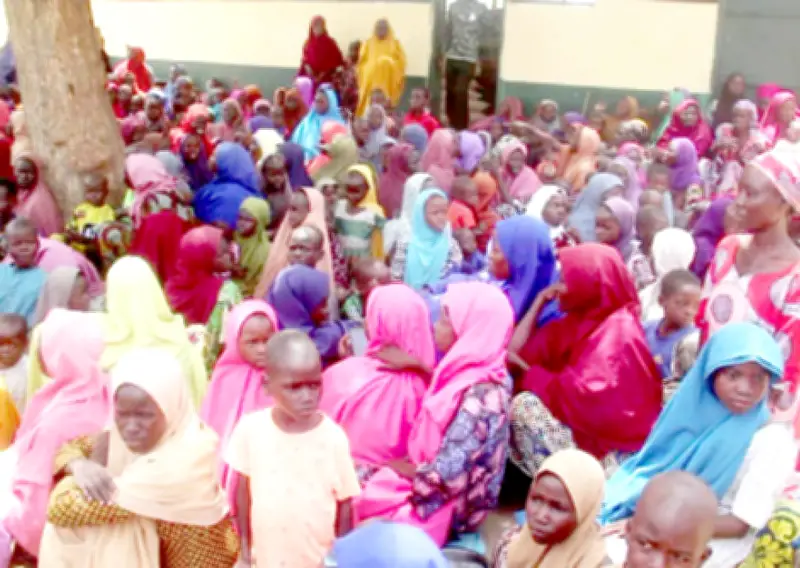
More than 350 individuals recently rescued from Boko Haram captivity in Borno State have begun recounting the harrowing experiences they endured while being held in the Mandara Mountains. The terrorist group launched an attack on Ngoshe town in Gwoza Local Government Area on March 3, abducting over 400 residents, predominantly women and young children. Security analysts describe this as one of the largest mass abductions recorded in the region in recent years.
Military personnel from Operation Hadin Kai successfully rescued 360 elderly men, women, and children on Sunday. The captives had been subjected to harsh conditions within the mountain range before soldiers reached them. The freed individuals are currently sheltered at the Pulka camp for internally displaced persons, located a short distance from Ngoshe village. Borno State Governor Babagana Umara Zulum visited them on Monday, June 8.
Aisha Bukar, a freed woman, told officials she spent three months and two weeks in captivity. "Throughout our stay, we survived on raw corn soaked in water, which we ate only once a day. That was how we lived for three months," she said. She added that her body has struggled to readjust to normal meals since regaining freedom. "My stomach is not accepting cooked food now. My children are also having stomach ache after eating some of the food in the camp," she said.
Another freed woman, Hafsat Musa, recounted losing her husband and three children while in captivity. She was beaten when initially taken from Ngoshe before being forced into the mountains. Musa explained that the group was eventually moved to a large cave, where they slept on hard ground with no food and no means to bathe. "We were kept there without food or bathing. We all suffered hunger and starvation. Sadly, in the three months and two weeks I spent there, I lost my three children and my husband," she said. She only learned of her husband's death after the rescue. "When the Boko Haram leader sent food, his subordinates often diverted it and shared it among themselves, leaving us hungry. Our clothes and hair became very dirty and full of lice," she said.
Musa expressed gratitude to God for her release and thanked the governor for helping secure their freedom. She mentioned that one of her neighbors also lost four of her seven children, only discovering their deaths upon arrival in Pulka. Zainab Abubakar, a mother of two also freed, said the captives received food just once daily. "We thank God for His mercies and pray that the remaining victims will be freed soon," she said.
Many of the freed individuals believe their experiences reflect the ongoing suffering of hostages still in terrorist hands. A male survivor, Idrissa Mustapha, said he was seized from his Ngoshe home in March while breaking his daily fast. Unlike most others, Mustapha stated that the insurgent leader treated him well. "I was taken to the Amir's house, and I used to eat food three times a day. The Amir saw me among several women, so he asked me to follow him to his house. We ate together and prayed together. I thank God and our security agencies for securing our lives," he said. "He treated me with respect, and I was not molested or mistreated throughout my stay, but I chose to leave the camp when I was given the option. Yes, some people stayed back," he added.
While speaking to the freed hostages in Pulka, Governor Zulum confirmed that 357 people had been released in this latest operation. He noted that roughly 82 others had regained freedom in smaller groups over the weeks following the initial abduction. The governor said he had released millions of naira to rehabilitate the Ngoshe community so residents could eventually return home. "So far, the work is nearly complete. We are also interfacing with the community about their return to Ngoshe; those who are willing to return, we are working with the Nigerian military to establish institutional arrangements that will ensure their safe and dignified return," he said.
Zulum described Ngoshe as a border town that came under attack from suspected Boko Haram insurgents earlier this year. He specifically praised President Bola Ahmed Tinubu for what he called personal intervention and dedication to restoring peace, saying that commitment helped speed up negotiations and the rescue process. "I want to express my deepest appreciation, on behalf of the government and people of Borno State and the Gwoza community in particular, to the President and Commander-in-Chief of the Nigerian Armed Forces, Bola Ahmed Tinubu, for all the efforts he has been making in ensuring the return of peace and stability not only to Borno State but to the entire country," Zulum said.
The governor also acknowledged the military, the Department of State Services, and other security agencies involved in the operation, praising their coordination and professionalism. "I also want to use this opportunity to commend the Nigerian Armed Forces, the Office of the National Security Adviser, the Department of State Services, and all other security agencies, including our gallant Civilian JTF, Forest Guards, vigilantes, and hunters, who have participated immensely in ensuring the release of these abducted men, women, and children," Zulum added.
He clarified that while 357 captives were freed in this latest push, others had been released in phases over the preceding months, bringing the total number of rescued individuals to 434. "We are here to felicitate with the Ngoshe community following the release of the abducted women and children, numbering about 434. What we saw this morning is about 360, released two days ago. But some two to three weeks ago, we also received other people, totalling about 434," Zulum explained.
Zulum also ordered the distribution of food and non-food supplies to all freed individuals as part of immediate humanitarian relief. The rescued hostages are currently receiving medical and psychological care at a government facility. Officials say they will be gradually reintegrated into their home communities once they are ready.