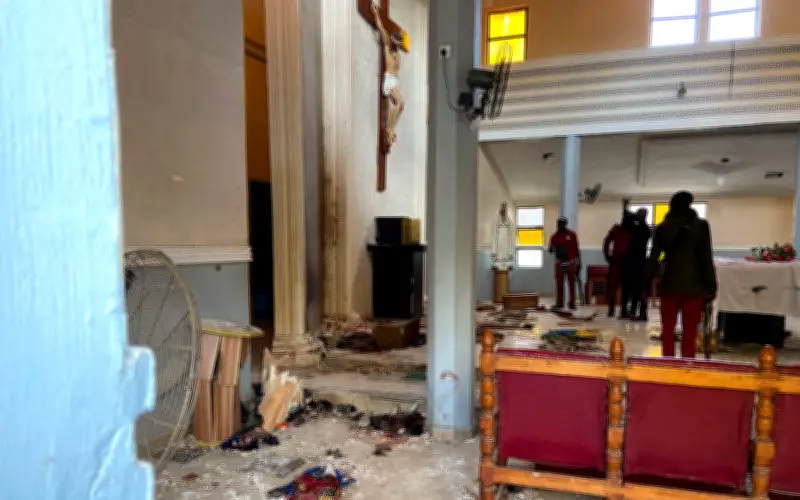
The Federal High Court in Abuja is set to deliver judgment on Wednesday in the trial of five defendants accused of carrying out the 2022 attack on St. Francis Xavier Catholic Church in Owo, Ondo State. The attack, which occurred on June 5, 2022, resulted in the deaths of approximately 40 worshippers and injuries to over 100 others.
The defendants standing trial are Idris Abdulmalik Omeiza (25), Al Qasim Idris (20), Jamiu Abdulmalik (26), Abdulhaleem Idris (25), and Momoh Otuho Abubakar (47). Justice Emeka Nwite is presiding over the case and is expected to deliver the judgment at 9:15 a.m. All defendants are present in court.
Background of the Trial
The court reserved judgment on May 26 after both the prosecution and defense adopted their final written addresses. The prosecution, led by Ayodeji Adedipe, urged the court to convict the defendants and impose the maximum penalty of death, citing the severity of the alleged offenses. In contrast, defense lawyer Abdullahi Mohammad requested the discharge and acquittal of his clients, arguing that the prosecution failed to prove its case beyond a reasonable doubt.
The Attack and Its Aftermath
The attack took place during a Pentecost Sunday Mass at St. Francis Xavier Catholic Church. Gunmen opened fire and detonated explosives inside and around the church, killing at least 41 worshippers and injuring more than 140 others. The incident sparked national outrage and drew condemnation from local and international organizations.
The defendants were arraigned in August 2023 on terrorism charges filed by the Office of the Attorney General of the Federation and Minister of Justice, Lateef Fagbemi. Prosecutors alleged that the suspects were members of an Al Shabaab cell operating in Kogi State and that they planned and executed the attack as part of a violent religious agenda. The defendants pleaded not guilty to all charges.
Key Developments During the Trial
In September, Justice Nwite dismissed the defendants' bail application, ruling that it lacked merit. He stated that bail could not be granted due to the gravity of the offenses and the strength of the prosecution's case, and that there was a likelihood the defendants could interfere with witnesses if released.
The prosecution applied for an accelerated hearing, which was granted. The trial formally opened in December 2025 with the prosecution calling its first witness, a Catholic priest who conducted the Mass on the day of the attack. Under a court-approved witness protection arrangement, many witnesses testified using coded identities.
Survivors of the attack, church members, Amotekun operatives, and State Security Service (SSS) investigators testified over several months. Some witnesses recounted how the attackers stormed the church and fired on worshippers attempting to flee. Others described the aftermath and efforts to track down the suspects. One witness identified two defendants in court as part of the attackers he saw inside the church. Another witness, who testified in a wheelchair, stated she lost both legs and one eye after explosives detonated during the attack.
The prosecution closed its case after calling 11 witnesses. The final witness, an SSS digital forensic expert identified as SSK, told the court that investigators used phone tracking, geospatial analysis, and cell tower triangulation to trace and arrest the suspects.
Defense Arguments
The defense opened its case and urged the court to reject the prosecution's evidence. The first defendant, Idris Abdulmalik Omeiza, testified on March 4, denying involvement in the attack. He claimed that SSS operatives arrested him at his residence in Kogi State on August 1, 2022, and later moved him to Ondo State, where they repeatedly asked him to confess. He alleged that operatives chained and beat him until he fainted and forced him to sign statements, which he insisted were not voluntary.
On March 26, another defendant, Jamiu Abdulmalik, also denied involvement. He testified that SSS operatives arrested him in 2022 while traveling from Ondo to Kogi State. He alleged torture in custody and forced signing of statements implicating him in the attack, maintaining he had no connection to the incident.
Defense lawyer Abdullahi Mohammad argued that the confessional statements should not be relied upon because they were obtained through torture and coercion. However, Justice Nwite admitted the statements as evidence after a trial within trial, ruling against the defense's objections.
Significance of the Attack
The Owo church attack occurred amid worsening insecurity in Nigeria. For over a decade, the northeastern part of the country has been plagued by insurgency. Splinter groups and terrorist cells have spread to the North-west and North-central regions, where armed criminals often referred to as bandits operate. Kogi State, in the North-central region, shares borders with Ondo State, where the attack took place. Observers believe the attack signaled the gradual spread of terrorist activities to the southern part of the country.