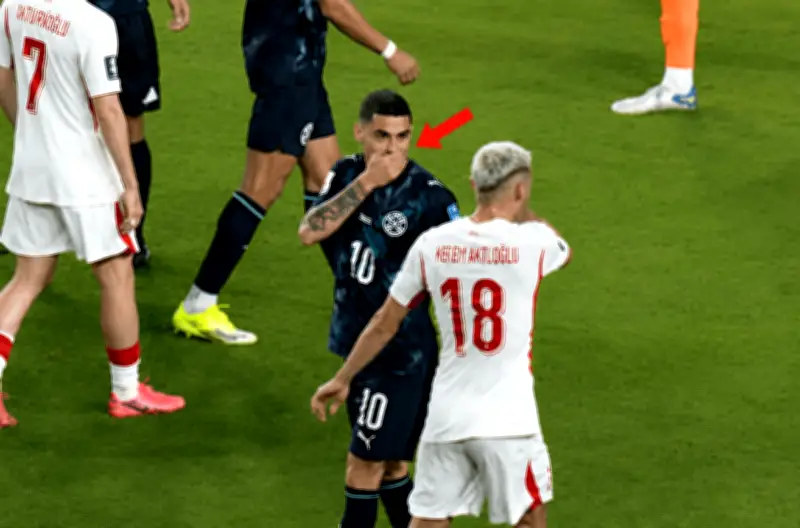
Paraguay midfielder Miguel Almiron has become the first player in football history to be sent off under FIFA's new rule prohibiting players from covering their mouths during on-field confrontations.
The former Newcastle United star was shown a red card during Paraguay's World Cup Group D match against Turkey in Santa Clara, California, on Friday, June 21. The incident occurred after Almiron appeared to cover his mouth while directing comments toward Turkish defender Mert Muldur.
The dismissal happened in first-half stoppage time with Paraguay leading 1-0. Following a VAR review, officials determined that Almiron had breached FIFA's newly introduced regulation and issued a straight red card. This marks the first enforcement of a rule introduced by FIFA in April as part of a broader campaign to combat racism and discriminatory behaviour in football.
Under the regulation, players who deliberately cover their mouths while engaging in confrontations or exchanges with opponents can face immediate dismissal. FIFA argues that such actions can obstruct investigations into potential abusive or discriminatory remarks.
Background of the rule
The rule was introduced following controversy during a Champions League match earlier this year involving Benfica winger Gianluca Prestianni and Real Madrid star Vinicius Junior. Prestianni was accused of racially abusing the Brazilian forward, allegations he denied. He was later sanctioned with a six-match suspension, three of which were suspended, for what authorities described as homophobic conduct.
FIFA President Gianni Infantino has been one of the strongest advocates of the measure. “If you do not have something to hide, you don’t hide your mouth when you say something. That’s it, as simple as that,” Infantino said when announcing the policy.
Impact on the match
Almiron’s dismissal significantly altered the balance of the contest. Despite the setback, Paraguay continued their World Cup campaign against Turkey, though the red card became one of the tournament’s most talked-about moments. The incident is likely to reignite debate over the implementation of the rule, with supporters and analysts expected to scrutinise how consistently it will be enforced throughout the tournament.