This piece examines the quiet revolution at Arsenal Football Club and how Mikel Arteta built a football institution capable of challenging Europe's elite. It argues that Arsenal's rise may have less to do with talent and more to do with culture, discipline, structure, and belief.
The Changing Perception of Arsenal
For years, Arsenal was admired but rarely feared. The club represented attractive football, technical elegance, artistic passing sequences, and attacking imagination. Yet behind that admiration lived a persistent criticism: when pressure intensified, Arsenal often appeared emotionally vulnerable, physically fragile, and structurally incapable of enduring elite competition. Beautiful, but not ruthless. Talented, but not complete.
That perception is changing, perhaps permanently. Today's Arsenal under Mikel Arteta increasingly resembles something different altogether: not merely a football team but a football institution. This distinction may explain why Arsenal's emergence continues to confuse critics, frustrate rivals, and attract growing respect across Europe. Arsenal no longer appears designed simply to entertain but apparently and increasingly built to control and ultimately to win.
Evidence of Evolution
Arsenal's rise is no longer accidental. One of the biggest mistakes football observers continue to make is treating Arsenal's recent performances as temporary momentum. Evidence increasingly suggests otherwise. Repeated competitiveness against Europe's elite indicates something deeper than form—it suggests evolution. Repeated resilience suggests culture. Repeated discipline suggests structure. These are not characteristics typically associated with temporary success; they are characteristics associated with institutions. And institutions endure.
The Arteta Revolution: Building a Football Operating System
Mikel Arteta's greatest achievement may not be tactical; it may be architectural. He appears to have built an operating system where every player increasingly functions inside a clearly defined collective structure. Defensive transitions are rehearsed, pressing triggers are coordinated, positional spacing is controlled, recovery movements are disciplined, and responsibilities appear deeply institutionalised. This explains why Arsenal often appears calmer under pressure. The players increasingly trust the process, and where trust exists, panic reduces. That may be Arsenal's greatest hidden advantage.
Lessons from the Transformation
Lesson One: Sustainable Excellence is Built on Systems
Sustainable excellence is built more on systems than isolated brilliance. This principle applies beyond football to business leadership, governance, project management, military organisations, and institutions. The strongest organisations eventually discover that systems outperform talent over long periods.
Meritocracy Over Reputation
One of the least discussed yet most revolutionary changes at Arsenal is cultural. Elite clubs often become prisoners of hierarchy: experience outweighs form, reputation outweighs performance, and transfer fees influence opportunity. Arteta increasingly appears unwilling to operate that way. The emergence of younger players such as Myles Lewis-Skelly demonstrates that at Arsenal, youth appears trusted when youth is ready. That sends a message throughout the squad: no position permanently belongs to anyone. Performance earns trust; suitability earns opportunity. The structure is bigger than status. This may ultimately become one of Arsenal's greatest strengths, as healthy competition sustains elite performance.
Lesson Two: Reward Competence Over Comfort
Sustainable institutions reward competence over comfort. Great organisations eventually become meritocracies, not based on sentiment, entitlement, or historical status. Meritocracy raises standards, standards shape identity, and identity sustains success.
Arsenal's Warrior Mentality
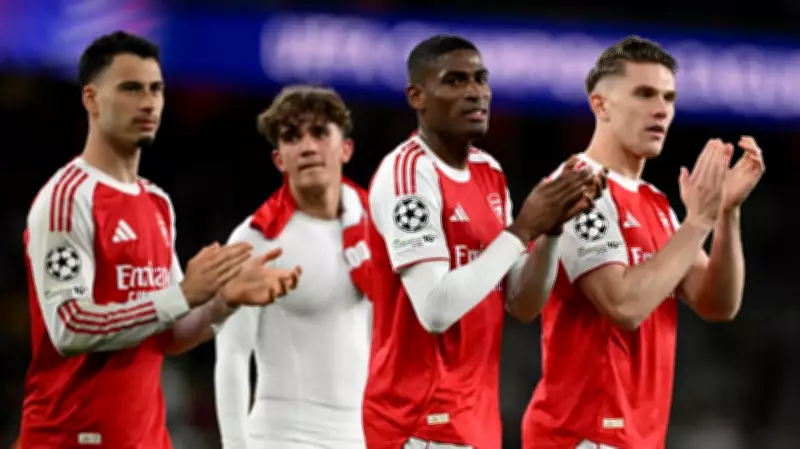
Statistics alone cannot explain Arsenal's improvement. Watch closely when Gabriel blocks a dangerous shot, Saliba wins a duel, Rice interrupts a counterattack, or defenders clear pressure late in games. Observe the reactions: the celebrations often resemble goals—passion, emotion, relief, collective aggression. This reflects something deeper: Arsenal increasingly defends with ownership. Preventing goals appears to matter as much as scoring them. That is culture, and culture often separates contenders from champions.
Lesson Three: Build Collective Identity Before Winning Trophies
Great teams build collective identity before they win trophies. Liverpool under Klopp built one, Manchester City under Guardiola institutionalised one, Real Madrid historically embodies one, and Arsenal increasingly appears to be constructing its own. Players no longer merely execute instructions; they increasingly defend identity. Teams defending identity become difficult to break psychologically.
Declan Rice and Structural Leadership
Every elite structure eventually requires stabilising leadership. Declan Rice increasingly represents that pillar. His influence extends beyond technical quality to emotional calm, midfield balance, defensive authority, leadership, and transition control. His arrival appears to have accelerated Arsenal's evolution from promising side to genuine contender.
Lesson Four: Talent and Leadership Must Coexist
Talent without leadership becomes unstable. Structure without leadership becomes rigid. Elite teams require both.
Why Arsenal's Football is Misunderstood
Ironically, Arsenal's increasing effectiveness may explain why some football fans dislike their style. Teams such as Real Madrid, PSG, Bayern Munich, Barcelona, and peak Manchester City often produce football rich in spontaneity and individual brilliance. Arsenal increasingly plays differently: measured, structured, disciplined, controlled. To some observers this appears robotic. Yet modern elite football increasingly rewards control over chaos, and Arsenal may be one of the clearest examples.
The Manchester City Influence and Arsenal's Emerging Identity
Arteta's education under Guardiola remains visible in positional discipline, pressing structures, tactical flexibility, and territorial control. Yet Arsenal increasingly appears to be evolving beyond imitation. Manchester City often dominates beautifully; Arsenal increasingly combines structure with physicality, resilience, and emotional aggression. City often seeks perfection; Arsenal increasingly appears willing to suffer. And teams capable of suffering intelligently frequently survive longest in Europe.
What Arsenal's Performances Against Europe's Elite Reveal
Repeated competitiveness against major European clubs suggests broader lessons:
- Lesson Five: Structure can neutralise superior individual talent.
- Lesson Six: Emotional maturity wins knockout football.
- Lesson Seven: Recruitment aligned with philosophy often outperforms celebrity recruitment.
- Lesson Eight: Institutional culture eventually becomes a competitive advantage.
These are not merely football lessons; they are leadership lessons.
Arsenal's Greatest Achievement May Not Be Tactical
Perhaps the greatest compliment one can now pay Arsenal is this: the club no longer celebrates effort alone; it increasingly expects results. Expectation changes institutions because excellence begins when standards become normal. Arteta's greatest achievement may therefore not be tactical innovation but cultural engineering. He appears to have created an environment where youth is trusted, hierarchy is challenged, defending is celebrated, accountability outweighs reputation, and collective discipline outranks ego. That is not merely coaching; that is institution-building.
Final Reflection: Why Europe Can No Longer Dismiss Arsenal
Football history celebrates superstars, but sustained dominance is often built differently: through standards, systems, culture, and belief. Perhaps that is the clearest lesson from Arsenal's evolution: in modern elite football, enduring structures increasingly defeat temporary brilliance. Arsenal's story may therefore represent more than a successful season; it may represent the emergence of a football institution designed to compete repeatedly at the highest level. And if that is true, Europe's biggest clubs may eventually stop asking whether Arsenal belongs and begin asking how long this structure can continue winning.
Ejidiran is a fellow of the Nigerian Institute of Quantity Surveyors, a certified project management professional (PMP), and the immediate past MD/CEO of WEMABOD Limited, a foremost Nigerian real estate company.