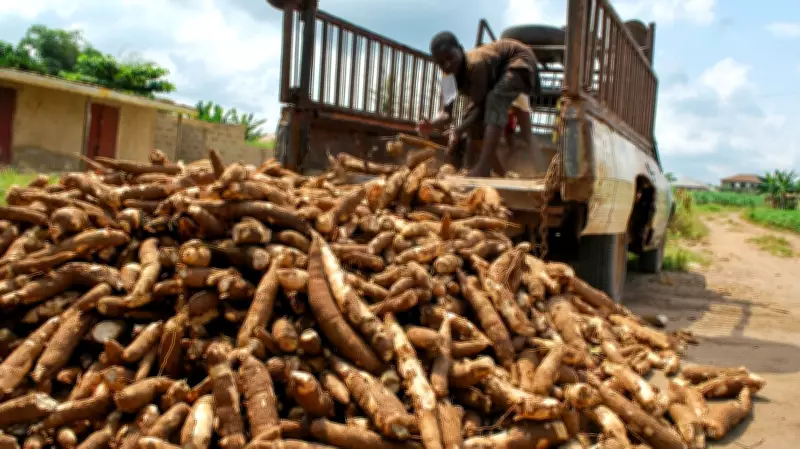
Unreliable Cassava Supply Cripples Nigeria's Processing Factories, NCIA Report Reveals
In recent years, Nigeria's cassava sector has witnessed reports of phenomenal growth, with new investments leading to the establishment of high-capacity processing plants aimed at transforming the tuber crop's fortunes. However, this progress appears largely theoretical, as physical examinations of these facilities paint a starkly different picture. Across the country, cassava processing plants are currently operating at a mere 30 to 40 percent of their installed capacity. This underperformance is not due to a lack of demand or faulty technology but stems from unreliable cassava supply, as highlighted by the Nigeria Cassava Investment Accelerator (NCIA) in a recent engagement.
The Core Challenge: Feedstock Reliability
Investigations reveal that the primary obstacle facing the sector is the unresolved issue of feedstock reliability. Without a consistent supply, returns on processing investments continue to disappoint. Reliable feedstock is not a secondary concern to be addressed after plant setup; it is the critical variable determining whether a plant functions as intended. Farmer networks serve as the infrastructure that either delivers or destroys this reliability, making their management paramount to operational success.
Insights from NCIA indicate that the consequences of unreliable cassava supply extend far beyond the farm gate. A plant operating at 40 percent capacity incurs the fixed costs of a full-capacity operation while generating only a fraction of the revenue, leading to collapsed unit economics and debt service problems. Operators become trapped in a vicious cycle where poor feedstock supply weakens their financial position, limiting their ability to invest in farmer relationships that could improve supply.
Downstream Disruptions and Market Volatility
The disruption cascades downstream. An operator unable to run consistently cannot serve buyers reliably, resulting in lost contracts and diminished commercial standing. At the market level, this instability causes volatility: when supply surges, prices plummet, reducing farmer income; when supply tightens, processors face input cost shocks. Neither condition supports effective planning, eroding confidence across the entire value chain.
NCIA notes that for investors, unreliable feedstock represents the primary execution risk, making cassava projects difficult to back. Even a well-structured processing asset with credible offtake can remain unattractive if feedstock supply is not demonstrably reliable. Many operators instinctively seek to minimize dependence on external farmers by owning land and controlling supply directly. Yet, findings from NCIA reveal a sobering truth: even the most vertically integrated plants still rely on smallholders for 60 to 70 percent of their supply.
The Farmer Network Imperative
According to NCIA insights, a mid-sized plant requires approximately 3,000 farmers delivering consistently to remain viable. Farmer networks can take various structural forms, such as aggregator-led models, out-grower schemes, or agent-based coordination. However, the specific model matters less than how it is managed. Managing these networks effectively is genuinely challenging, involving complex logistics, relentless coordination demands, and significant investment in systems to ensure reliable performance. This operational difficulty is where most farmer supply networks break down.
Since 2014, IDH (the Sustainable Trade Initiative) has been testing a "Block Farming Model" that treats farmer management as a rigorous science rather than an afterthought. This model organizes smallholders into managed production blocks with a focal farm at the center, supported by defined delivery schedules aligned to processor intake requirements, and access to inputs and finance on credit.
Insights from the IDH Block Farming Model
Dr. Dayo Ogundijo, IDH's Director of Programmes, explained that the Block Farming model succeeds because production is tightly organized, land is contiguous, planting is synchronized, inputs are controlled, and harvesting is supervised. However, scaling nationally introduces pressures in five key areas: land consolidation at scale, securing large contiguous land near processing facilities across states with varying tenure systems and community dynamics, land clarity, efficiency maintenance, and addressing side-selling of feedstock.
To combat side-selling, a major threat to processor stability, Ogundijo emphasized that beyond faster payments, innovative loyalty mechanisms are essential to bridge the trust gap between smallholders and industrial off-takers. Building loyalty requires strengthening trust and making farmers feel genuinely valued through factors such as bundled service dependency, transparent and predictable pricing frameworks, end-of-season performance incentives, input-credit recovery through structured deduction, and group-based accountability models.
Economic Implications and Future Prospects
NCIA notes that the economics of cassava processing are heavily fixed, with the difference between operating at 40 percent and 80 percent capacity often determining whether an operation is loss-making or viable. Reliable farmer networks represent the most direct path to closing this utilization gap. For investors, a cassava project with demonstrably reliable feedstock supply constitutes a different category of investment. Fixing farmer networks is faster than developing new processing technology, faster than policy reform, and far more within operators' control.
The infrastructure that enables farmer networks to perform effectively does not serve a single use case; it supports every industrial application cassava can offer, from garri and starch to high-quality cassava flour, glucose syrup, and bioethanol. Addressing the feedstock reliability issue is crucial for unlocking the sector's full potential and ensuring sustainable growth in Nigeria's agricultural landscape.