
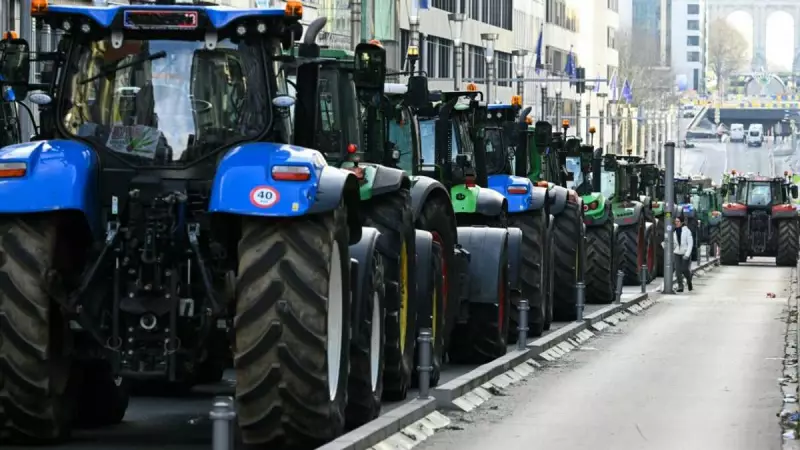
Central Brussels came to a grinding halt on Thursday as a convoy of more than 150 tractors, with hundreds more expected, blocked key streets. This dramatic demonstration was staged by farmers furious at the European Union's planned free-trade agreement with the South American Mercosur bloc, a deal that was a central topic as EU leaders gathered for a summit.
Farmers Decry "Dictatorship" and Fear Being Undercut
The protest, organized by farm lobby Copa-Cogeca, saw an estimated 10,000 demonstrators converge on the European quarter. Farmers from across the continent, particularly from France and Belgium, voiced their deep-seated anger. Belgian dairy farmer Maxime Mabille told reporters the protest was a clear message: "We're here to say no to Mercosur." He accused European Commission President Ursula von der Leyen of trying to "force the deal through," adding, "It's like Europe has become a dictatorship."
The core of their grievance lies in the fear of being undercut by a flood of cheaper agricultural products from Mercosur nations, primarily Brazil. Farmers argue the pact would facilitate easier entry into European markets for beef, sugar, rice, honey, and soybeans produced under less stringent environmental and health regulations than those required in the EU.
EU Summit in Disarray as France and Italy Demand Safeguards
The protest cast a long shadow over the EU summit, which was officially focused on funding for Ukraine. The fate of the Mercosur deal was thrown into serious doubt just a day earlier when Italy joined France in seeking a delay, jeopardizing von der Leyen's plans to fly to Brazil to sign the agreement over the weekend.
Arriving at the summit, von der Leyen stated she still hoped for an accord, calling it "of enormous importance" to get the green light. She claimed to have held a "good and productive" meeting with a farmers' delegation. However, French President Emmanuel Macron delivered a stark counter-message, vowing France would not support the deal without stronger safeguards for its agricultural sector. "We consider that we are not there yet, and the deal cannot be signed as it stands," Macron declared, promising to oppose any attempt to force it through.
A Divided Europe and a Stern Rebuke from Brazil
The last-minute opposition from Paris and Rome, along with Hungary and Poland, means critics now have enough votes in the European Council to potentially shoot down the deal. This internal European rift prompted a sharp response from Brazil's President Luiz Inacio Lula da Silva, who warned his EU partners that it was now or never to close the agreement.
The division within the EU is clear. While Germany, Spain, and Nordic countries strongly support the pact to boost exports amid global trade tensions, the agricultural heartlands are in revolt. Florian Poncelet of the Belgian farm union FJA summed up the protesters' frustration: "We've been protesting since 2024 in France, in Belgium and elsewhere. We'd like to be finally listened to."
The protest also highlighted broader farmer discontent with proposed overhauls to the EU's massive farming subsidy program, which many fear will reduce their financial support. The sight of tractors clogging the capital underscores the significant political clout the agricultural sector still wields as the EU attempts to navigate complex international trade negotiations.




