
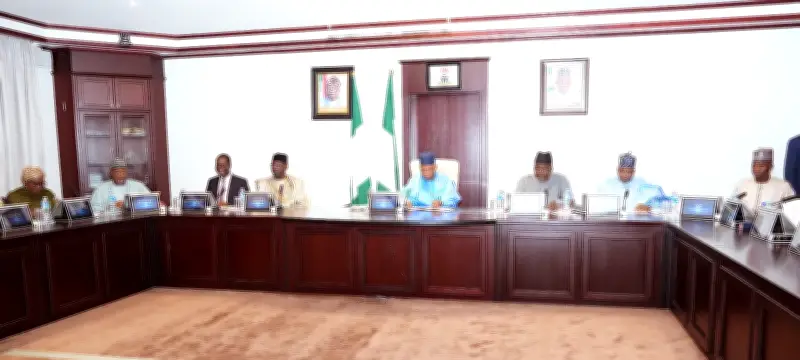
Vice President Kashim Shettima has received the final report of the National Technical Working Group on the World Bank-supported $500 million Sustainable Agricultural Value Chains for Growth Programme (AGROW), marking the transition from design to implementation. The event took place at the Presidential Villa in Abuja on Tuesday.
Transition to Implementation
Shettima noted that the receipt of the final report concludes the programme's design phase and signals its move to implementation. He said the government, through AGROW, is bridging the gap between farmers and national planning and policy-making decisions. The Vice President highlighted that the challenge in agriculture had been the distance between farmers and the systems that determine the value of their labour, and the government is now set to shorten that distance.
The $500 million World Bank-supported programme was developed through seven zonal consultations involving 32 states, reflecting the increasing commitment of subnational governments to agricultural development. It also indicates the states' readiness to assume greater responsibility for productivity, infrastructure, extension services, and market development.
Agriculture's Role in the Economy
Shettima described the AGROW report as the conclusion of a design process that restores the farmer to the centre of national economic reasoning. He maintained that the programme is targeted at developing a programme rooted in farmers' realities, delivered through Nigeria's states, and capable of attracting private investment to move agriculture from subsistence to scale.
The Vice President noted that agriculture accounts for 23 per cent of Nigeria's GDP and sustains 34 per cent of its workforce. He stressed that no other sector carries as many livelihoods or touches as many households. "When yields rise, food prices ease, rural incomes recover, industries receive raw materials, and the pressure on our cities and foreign reserves begins to relax. When yields fall, the entire economy discovers the price of hunger," Shettima stated. He added that productivity on the farm is a question of growth, employment, food security, and poverty reduction.
Implementation Details
Of the $500 million financing envelope, $355 million (71 per cent) will be implemented through participating states, placing State Governments at the centre of delivery. Shettima noted that while 32 states participated, $500 million cannot meet the scale of demand or close gaps accumulated over decades in extension services, infrastructure, technology, processing, and market access. "The appetite is evident. The resources are not yet sufficient," he explained.
He commended the National Technical Working Group for their expertise and commitment, and approved the formal dissolution of the group, with responsibility passing to the Federal Ministry of Agriculture and Food Security as Chair of the National Steering Committee and host of the Project Coordination Office. He also acknowledged the Presidential Food Systems Coordinating Unit for coordinating the design process.
Ministerial and World Bank Perspectives
Minister of Finance and Coordinating Minister of the Economy, Taiwo Oyedele, commended all partners, noting that the report presentation reflects what is possible when stakeholders work together. He said AGROW goes beyond food production, constituting an integral part of Nigeria's economic transformation, macroeconomic stability, and job creation.
Minister of Agriculture and Food Security, Abubakar Kyari, applauded Shettima's leadership and assured stakeholders of the ministry's commitment to implementation in line with the Renewed Hope Agenda. He said the next phase includes the borrowing plan, financing agreement, and legal opinion.
World Bank Programme Leader for AGROW, Bertine Kamphuis, briefed the Vice President on the outcome of the working group's assignment, initiated by President Bola Tinubu and the Vice President. She assured continued support, adding that with the final report, Nigeria can do more to improve food security and lift Nigerians out of poverty. She also backed the creation of right policies and an enabling environment for the private sector, highlighting the role of institutions like the Bank of Agriculture.
State Commitments
Nasarawa State Governor, Abdullahi Sule, informed Shettima of sub-nationals' commitment, stating that at a previous Nigerian Governors' Forum meeting, the World Bank briefed governors on the initiative's objectives. He commended the VP for the programme opportunity, allowing states to maximise the initiative.
Deputy Governor of Kaduna State, Hadiza Balarabe, expressed readiness to take advantage of the initiative and assured the VP that the state would establish a state-level coordination mechanism for timely implementation. She noted that Kaduna allocates more than 13 per cent of its budget to agriculture, underscoring its importance as a key driver of economic transformation.
Technical Working Group Achievements
Technical Advisor to the Vice President on Agriculture and Executive Secretary of the Presidential Food Systems Coordinating Unit, Marion Moon, highlighted that the National Technical Working Group developed an eight-indicator framework to identify priority agricultural value chains by adopting an agroecological approach matching crops and investments to Nigeria's soils, rainfall, and growing conditions. The group conducted seven zonal consultations involving 32 states and key stakeholders, and consolidated feedback informed the final AGROW programme design.




