
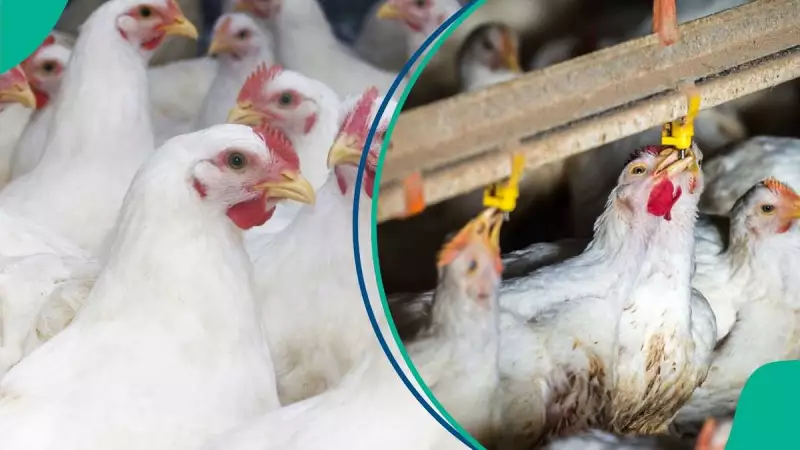
Nigerian families bracing for Christmas celebrations are facing a significant financial hurdle this year, as poultry farmers have released new, sharply increased prices for chickens. Market surveys indicate that the cost of both layers and broilers has skyrocketed, threatening to make the traditional festive meal a costly affair for many households.
Market Survey Reveals Sharp Price Increases
A recent market assessment shows a dramatic climb in poultry prices as demand builds towards the Christmas holiday. Adult layers are now selling for between N10,500 and N20,000, while adult broilers command prices from N18,000 to N30,000. This marks a steep rise from last year's rates, where layers sold for N8,000 to N15,000 and broilers ranged from N15,000 to N25,000.
The price surge isn't limited to live birds. Frozen chicken has also seen a steep climb, with one kilogram now costing N5,500 to N6,500. This compares to prices of N4,000 to N4,800 per kilogram around the same period in 2024. Retailers in markets like Ikorodu and Ketu report that the increases have been steady since October, with one trader warning that prices for layers, already at N12,500, may climb even higher as Christmas draws nearer.
Soaring Feed Costs and Other Pressures
Poultry farmers point to the exorbitant cost of feeds as the primary driver behind the price hikes. A 50kg bag of broiler starter now costs N140,000, with grower feed at N121,500 and finisher feed at N112,500. Farmers insist that selling at previous prices would result in a loss, given these input costs.
The financial strain on the industry extends beyond feed. Farmers also grapple with the high costs of powering their operations, transportation, staff salaries, and medication for the birds. Compounding the issue is the reliance of feed manufacturers on imported ingredients like wheat and maize, whose costs are inflated by the foreign exchange rate. Some farmers have even turned to exporting their stock to achieve better returns than the local market offers.
However, not all observers agree with this explanation. A poultry worker in Ibadan suggested that some operators might be capitalizing on the seasonal demand, noting that the price of corn has recently dropped without a corresponding decrease in chicken or egg prices.
Broader Challenges and Government Intervention
The poultry industry's woes are multifaceted. Insecurity in key food-producing regions disrupts farming activities and constrains supply. Furthermore, climate change has adversely affected yields of essential crops like maize and soybean, which in turn pushes feed prices higher.
In response to the growing food cost crisis, the Lagos State government has initiated the second phase of its food subsidy program, Ounje Eko Phase II. This initiative aims to support farmers with subsidized feed to help stabilize production costs, with the hope of reducing market prices in the coming weeks. Meanwhile, in a related development aimed at easing the festive burden, the Lagos State government has slashed the price of its Lagos Rice brand to N57,000 per 50kg bag, causing a noticeable dip in rice prices across the city.
As the countdown to Christmas continues, Nigerian households are confronting one of the most expensive festive seasons in recent memory. Whether state interventions will be enough to soften retail prices remains an urgent question for consumers nationwide.




