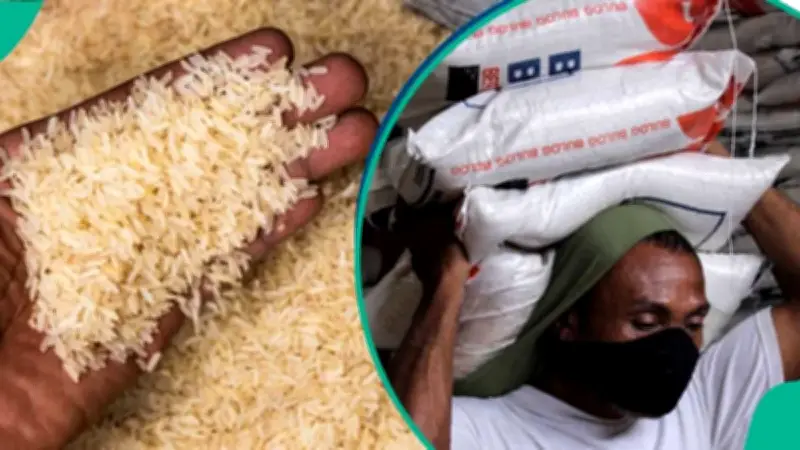
Nigerians could soon experience another wave of food price increases as industry experts warn that supplies of rice, tomatoes, and other essential staples may tighten significantly over the next three months. The looming shortage threatens to drive fresh inflation and deepen hardship for millions of households already struggling with high living costs.
The warning comes as dealers across major markets report fluctuating prices for basic food items, while stakeholders attribute the expected shortfall to declining farm output, insecurity, rising transport costs, and inadequate storage facilities.
Rice and Tomato Production Under Pressure
Alexander Isong, President of the Organisation for Technology Advancement of Cold Chain in West Africa (OTACCWA), stated that Nigeria's food supply chain is under increasing strain and could worsen before the end of the year without urgent intervention. Speaking in an interview with the News Agency of Nigeria (NAN), Isong projected that rice production would drop by six percent to approximately 8.3 million tonnes. The total area under rice cultivation could shrink by seven percent to around 4.2 million hectares.
According to Isong, data from the United States Department of Agriculture also indicates a five percent year-on-year decline in Nigeria's rice output. He warned that tomatoes face similar challenges, with shortages expected to persist until the late harvest season in October. Beyond rice and tomatoes, maize, sorghum, and millet may also experience supply constraints due to reduced planting activities recorded in 2025.
Dealers Release New Prices for Staple Foods
Food dealers continue to adjust prices amid supply concerns. Current average market prices include: local rice (50kg) at ₦85,000 to ₦105,000; foreign parboiled rice (50kg) at ₦110,000 to ₦135,000; fresh tomatoes (large basket) at ₦45,000 to ₦75,000 depending on location; onions (bag) at ₦70,000 to ₦95,000; and fresh peppers (bag) at ₦60,000 to ₦90,000. Traders say prices remain volatile and could climb further if supplies tighten over the coming weeks.
Rising Transport Costs Exacerbate Food Inflation
Isong blamed soaring logistics costs for adding further pressure on food prices. He noted that transporting one tonne of grain from Kano to Lagos now costs about ₦70,000, compared with roughly ₦45,000 previously. On several routes, transportation expenses have doubled or even tripled due to higher fuel and energy costs. He also mentioned that onions and peppers are already becoming scarce in major producing areas, leading to noticeable price increases in urban markets. Additionally, Nigeria will continue to rely heavily on imported wheat, with imports projected at about 7.2 million tonnes.
Insecurity and Poor Storage Fuel Food Crisis
Isong identified insecurity across major farming communities, especially in northern Nigeria, as one of the biggest threats to food production. He said thousands of farmers have been displaced, preventing them from accessing their farms and reducing overall agricultural output. He also highlighted Nigeria's poor storage infrastructure, revealing that between 30 and 50 percent of perishable agricultural produce is lost before reaching consumers because of inadequate cold chain facilities and post-harvest handling.
Experts Urge Government Intervention
To prevent a full-scale food shortage, Isong urged the Federal Government, state governments, private investors, and development partners to coordinate immediate interventions. He recommended expanding access to improved seeds, fertilisers, irrigation systems, and affordable credit ahead of the 2026/2027 planting season. He also called for stronger security in farming communities, improved rural roads, expanded rail freight for agricultural produce, investment in aggregation centres, cold rooms, and food processing facilities, as well as greater collaboration between governments, farmer cooperatives, logistics companies, and commodity associations.
According to Isong, Nigeria already produces substantial quantities of food, but poor storage, insecurity, and inefficient distribution prevent much of it from reaching consumers. Without swift action, he warned, Nigerians could experience fresh shortages of rice, tomatoes, peppers, onions, and other essential staples, triggering another wave of food inflation before the end of the year.
Food Inflation Already Rising
Data from the National Bureau of Statistics (NBS) shows that food inflation climbed to 16.96 percent in May 2026, up from 16.06 percent in April on a year-on-year basis. On a month-on-month basis, food inflation accelerated by 2.98 percent. The NBS attributed the increase to higher average prices of essential food items, including onions, maize, melon (egusi), water yam, cassava flour, crayfish, fresh pepper, tomatoes, wheat grain, cassava tuber, yam tuber, sweet potatoes, ginger, plantain, and cowpea (beans).