
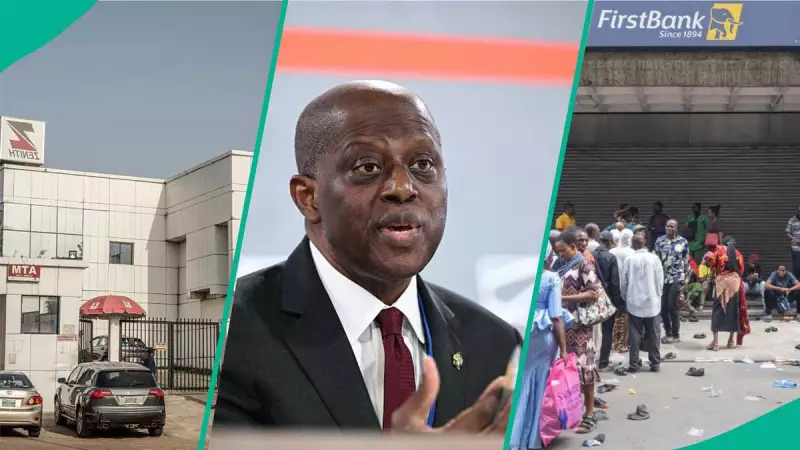
Nigeria's banking sector is undergoing a significant transformation as financial institutions scramble to meet a stringent new capital requirement set by the Central Bank of Nigeria (CBN). With a deadline of March 31, 2026, commercial banks are working collectively to raise approximately N4.14 trillion in fresh capital.
The Recapitalisation Drive: A Pillar for Economic Ambition
This massive capital-raising exercise, initiated by the CBN in April 2024, is far more than a regulatory checkbox. It is a strategic move designed to fortify the foundation of Nigeria's financial system. According to analysis from global professional services firm Deloitte, the primary goals are to strengthen financial stability, enhance the banking sector's resilience against economic shocks, and crucially, to position banks to support Nigeria's ambitious target of building a $1 trillion economy by 2030.
CBN Governor, Olayemi Cardoso, has emphasized that the current capital base of Nigerian banks would be insufficient to finance such a large-scale economy without these decisive reforms. He stated that a well-capitalised banking system is essential to fund major infrastructure projects, drive industrial expansion, and increase lending to micro, small, and medium-sized enterprises (MSMEs).
New Rules and the Rush for Fresh Funds
The CBN dramatically increased the minimum capital requirements across all bank categories. Commercial banks with international authorisation must now hold a minimum of N500 billion. National banks require N200 billion, while regional banks need N50 billion. For other categories, merchant banks must maintain N50 billion, and non-interest banks need between N10 billion and N20 billion.
A critical twist in the new guidelines is the CBN's tighter definition of what qualifies as capital. The regulator now limits it strictly to paid-up share capital and share premium, explicitly excluding retained earnings and other reserves. This move effectively compelled most banks to seek fresh capital injections from the market, even those that previously appeared to be well-capitalised on paper.
Deloitte highlighted that prolonged macroeconomic challenges, including high inflation, rising interest rates, and foreign exchange volatility, had already eroded banks' capital adequacy ratios. The revised thresholds are expected to empower banks to take on larger risks responsibly, improve overall liquidity, and expand their capacity to absorb potential losses.
Progress Report and Market Confidence
Despite the colossal sum required, progress has been encouraging. Governor Cardoso recently disclosed that, as of the latest updates, 27 banks have already raised funds through public offers and rights issues. Impressively, 16 commercial banks have fully met the new capital threshold ahead of the deadline.
Speaking at a Bankers' Dinner in Lagos, Cardoso explained that this recapitalisation aims to avoid the boom-and-bust cycles that followed previous exercises. To ensure robust oversight, the CBN has established a dedicated Compliance Department to supervise financial crime, market conduct, corporate governance, and ESG standards.
The regulator has also upgraded the Credit Risk Management System (CRMS), making it web-enabled for real-time borrower checks and return submissions, with plans for deeper integration into banks' internal systems.
Market analysts have expressed optimism. Muyiwa Oni, Regional Head of Equity Research, West Africa at Standard Bank Group, noted that the capital market has responded well, with systemically important banks making substantial efforts. He affirmed that the sector is in a good place, as many key players have already met the requirement.
Stability Reassurances and Long-Term Vision
Amidst this overhaul, the CBN continues to reassure the public of the banking system's stability. The regulator reports that the non-performing loan ratio remains within the five per cent prudential limit, and liquidity levels are comfortably above the 30 per cent regulatory minimum.
CBN Deputy Governor Emem Usoro has described recapitalisation as a key pillar of Nigeria's growth strategy. Echoing this sentiment, Oliver Alawuba, Group Managing Director of UBA, stated that the policy will strengthen banks' ability to withstand economic shocks and bolster long-term national development.
As the March 2026 deadline approaches, the race for capital is intensifying. This strategic recapitalisation is poised to reshape Nigeria's financial landscape, creating a more robust banking sector capable of driving the country's next phase of economic growth.




