Cement Price Surge Deepens Nigeria's Housing Crisis, Homeownership Becomes Distant Dream
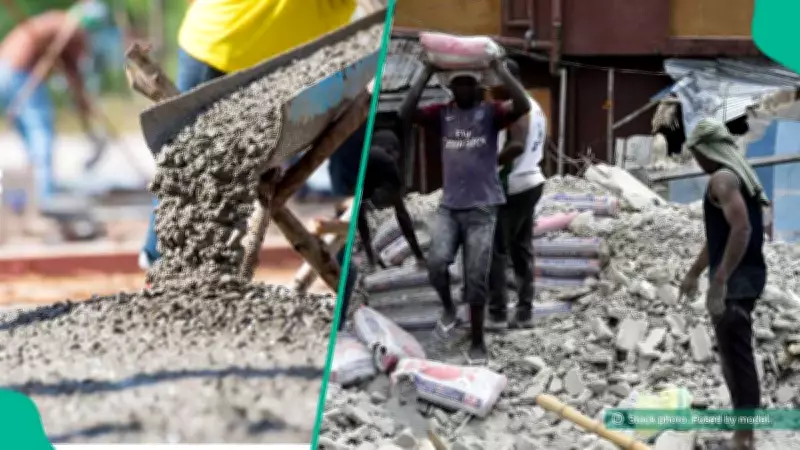
The price of a 50kg bag of cement in Nigeria has experienced a dramatic surge, reaching between N10,500 and N15,000 as of March 2026. This represents a significant increase from the previous average range of N5,000 to N8,500, intensifying the nation's already severe housing affordability crisis and placing the dream of homeownership further out of reach for millions of low- and middle-income Nigerians.
Volatile Market and Government Concerns
Cement prices have remained highly volatile in recent months, driven by a combination of rising demand, persistent inflationary pressures, elevated fuel costs, and expensive transportation logistics. The federal government has expressed serious concerns about this trend. In 2024, the Minister of Housing and Urban Development, Arc. Ahmed Musa Dangiwa, summoned cement manufacturers to a meeting at the Ministry headquarters in Abuja, stating that the government would not accept a situation where the price of essential building materials like cement continues to rise uncontrollably.
Dangiwa highlighted that the incessant price hikes have overtaken the country in the past few months, with prices rising by over 100%. He described the situation as particularly troubling for a product that is largely produced from local raw materials, suggesting that domestic factors are contributing significantly to the cost escalation.
Impact on Construction and Homeownership
Rising cement costs are making it increasingly difficult for Nigerians to build their dream homes, slowing construction activity across the nation. Aliyu Oroji, immediate past president of the Real Estate Developers Association of Nigeria (REDAN), emphasized that rising building costs are pushing property prices beyond the reach of average citizens. He explained that developers are being forced to increase prices, and ultimately, it is the end user who bears the burden, creating a situation where only a small fraction of Nigerians can afford to own homes.
Housing experts note that cement prices play a critical role in determining overall housing costs. As input costs rise, developers inevitably pass on these increases to buyers, making even modest homes increasingly unaffordable. This growing mismatch between wages and housing costs is trapping many Nigerians in a cycle of lifelong renting with little hope of ever achieving homeownership.
Market Concentration and Structural Issues
Analysts point to structural issues within the cement industry that may be contributing to the sustained high prices. A report by Agora Policy indicates that a few major manufacturers control about 95% of the market, severely limiting competition. Economist Ifeoma Nwoye commented on this concentration, stating, "When a few companies dominate the market, there is little incentive to reduce prices, and those at the bottom are the first to be excluded."
This market dominance has translated into substantial profits for the major cement companies. Nigerian cement makers defied broader economic troubles in 2024 to post stunning profits, buoyed by strategic price hikes. A breakdown of Dangote, BUA, and Lafarge's unaudited financials reveals that the firms' profits after tax rose to N677.48 billion in 2024, representing a 17.6% increase from the previous year's N675 billion.
Record Profits Amidst Affordability Crisis
The profit surge was driven by robust revenue growth resulting from price increases implemented in response to rising operational costs and inflationary pressures. Dangote Cement posted the highest profit at N503.4 billion, followed by Lafarge at N100.1 billion, and BUA at N73 billion. While these companies cite increasing operational costs as justification for price hikes, the simultaneous record profits raise questions about the balance between corporate profitability and social responsibility in addressing Nigeria's housing deficit.
The cement price surge threatens to deepen Nigeria's already substantial housing deficit, estimated to be in the millions of units. As construction becomes more expensive, fewer new homes are built, exacerbating the shortage and driving up rental and purchase prices across the board. This creates a vicious cycle where affordability decreases even as demand continues to grow due to population increases and urbanization trends.
The situation calls for urgent intervention from both government and industry stakeholders to find sustainable solutions that balance market dynamics with the critical need for affordable housing. Without such intervention, the dream of homeownership will remain elusive for the majority of Nigerians, with profound social and economic consequences for the nation's development and stability.