
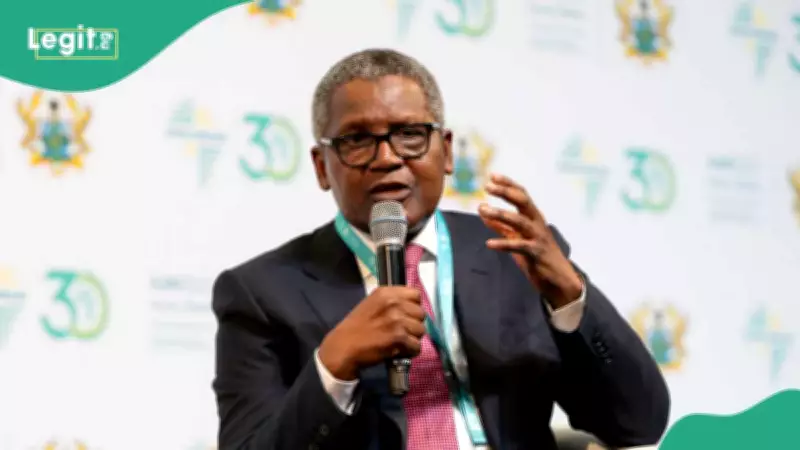
Dangote Industries Inks $4.2 Billion Gas Supply Agreement With Chinese GCL Group For Ethiopian Fertiliser Complex
Dangote Industries Limited has finalized a groundbreaking $4.2 billion natural gas supply agreement with China's GCL Group to fuel a massive fertiliser expansion project in Ethiopia, representing one of the most significant industrial collaborations between Africa and China in recent years. The 25-year contract will ensure a stable natural gas supply for Dangote Group's upcoming fertiliser complex located in Gode, within Ethiopia's Somali Region.
Transforming East Africa's Agricultural Landscape
The fertiliser plant itself carries an estimated construction cost of $2.5 billion and will be developed through a 60:40 equity partnership between Dangote Industries and Ethiopian Investment Holdings, which serves as Ethiopia's sovereign investment arm. Construction planning is already underway, with commercial operations scheduled to commence in 2029.
Upon completion, this facility is projected to become East Africa's largest fertiliser production hub, boasting an annual capacity of three million tonnes of urea. The plant aims to substantially reduce Ethiopia's dependence on fertiliser imports while simultaneously enhancing agricultural productivity across the entire East African region.
Integrated Gas-to-Fertiliser Value Chain
The natural gas required for the fertiliser complex will be sourced from the Calub Gas Field situated in Ethiopia's Ogaden Basin. A dedicated 108-kilometre pipeline will transport the gas directly to the plant, guaranteeing a consistent and efficient supply for fertiliser manufacturing.
This integrated approach connects upstream gas extraction, midstream transportation, and downstream fertiliser production into a single industrial chain, aligning with Africa's broader initiative to transform natural resources into finished products rather than exporting raw materials.
Strategic Vision For African Industrial Development
Aliko Dangote, President and Chief Executive Officer of Dangote Industries Limited, emphasized the critical importance of industrial transformation across the African continent during discussions about the partnership. He stressed that Africa must cease exporting raw resources while importing finished goods, instead developing integrated industrial systems that add substantial value locally.
Dangote explained that the collaboration with GCL would establish a seamless "gas-to-fertiliser" value chain, enabling Africa to utilize its abundant natural gas resources to enhance food production and achieve greater economic independence.
Strengthening China-Africa Industrial Cooperation
GCL Group Chairman Zhu Gongshan characterized the agreement as a significant advancement in strengthening industrial collaboration between China and Africa. He noted that the project would combine GCL's extensive experience in energy and chemical industries with Dangote Group's substantial manufacturing presence across Africa.
Gongshan added that this collaboration would expand Ethiopia's energy, chemical, and agricultural sectors while creating a new ecosystem of industrial development throughout the region. Both companies acknowledged the Ethiopian government for providing robust support and leadership in facilitating this ambitious project.
Economic Impact And Regional Development
Industry analysts highlight that the project carries substantial economic benefits extending far beyond fertiliser production. The development is expected to generate thousands of direct and indirect employment opportunities, stimulate infrastructure development in Ethiopia's Somali Region, and accelerate industrialisation across East Africa.
By utilizing natural gas as the primary feedstock, the fertiliser plant also aligns with global trends toward lower-carbon industrial production. The initiative is widely regarded as a flagship project connecting energy development to food security across the African continent.
Once operational, the facility could potentially position Ethiopia as a major fertiliser export hub in Africa while strengthening regional agricultural productivity and fostering sustainable economic growth throughout East Africa.




