
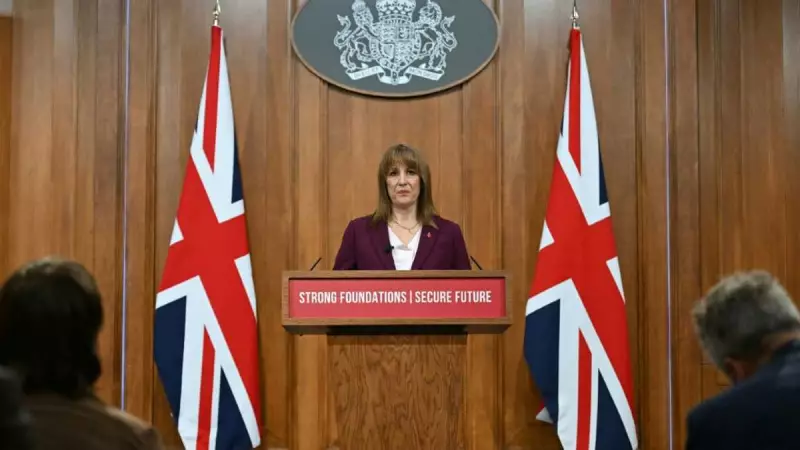
Britain's centre-left Labour government is set to unveil its crucial annual budget this Wednesday, facing a major test of its credibility as it attempts to balance voter expectations with harsh economic realities.
Economic Challenges and Political Pressure
Finance Minister Rachel Reeves confronts the difficult task of finding approximately £20 billion ($26 billion) to stabilize the country's finances while maintaining Labour's core values. The government grapples with a deficit hovering near five percent of GDP, persistent inflation, and economic stagnation as unemployment continues to climb.
Prime Minister Keir Starmer has promised what he calls a 'Labour budget with Labour values', committing to reduce National Health Service waiting times and alleviate the ongoing cost-of-living crisis that has burdened British households.
Taxation Strategies and Political Risks
The government has reportedly abandoned plans for an income-tax increase that would have broken campaign promises, instead opting for a series of smaller tax rises. Economists estimate that Reeves must navigate carefully to avoid political backlash while addressing the fiscal gap.
According to James Wood, professor of political economy at the University of Cambridge, 'There isn't that much room to manoeuvre without facing a political backlash.' He noted that balancing the budget would ideally require increasing the tax burden on middle-income households, who represent Labour's core support base.
The government is expected to implement several measures including:
- Further freezing income tax thresholds, pushing more workers into higher brackets
- Raising levies on luxury properties
- Increasing taxes on gambling activities
- Implementing higher charges on banks
Economic Performance and Business Impact
Since returning to power in July 2024 after fourteen years of Conservative rule, the Labour party has struggled to achieve consistent economic growth. The situation has been complicated by Reeves' decision to hike business taxes in her inaugural budget last year, a move that many analysts blame for Britain's current weak economic performance.
Recent economic indicators show concerning trends:
- UK gross domestic product slowed to 0.1% in the third quarter
- This represents a decline from 0.3% in the second quarter
- First quarter growth stood at 0.7%, showing a steady deterioration
The uncertainty has made employers hesitant to hire additional staff. Craig MacLeod, owner of the Innes Bar in Inverness, Scotland, told AFP that 'Normally, we have taken on extra staff over the Christmas period. We've held off on that at the moment to find out what happens in the budget.'
Spending Priorities and Market Concerns
Under pressure from within its own ranks, the government has backtracked on plans to cut disability benefits and fuel payments to pensioners. Prime Minister Starmer emphatically pledged in parliament last week that 'What we won't do is inflict austerity on the country.'
The budget is widely expected to include several spending measures:
- Lifting the cap on family benefits
- Reducing taxes on energy
- Expanding certain social spending programs
Jonathan Portes, an economics professor at King's College London, suggested that 'There are unlikely to be any large spending cuts,' and that the government would likely 'avoid hitting lower and middle income workers, so most of the burden will fall on higher income workers, better off pensioners and business.'
Market response remains a critical concern, as a negative reaction could trigger investors selling UK debt, making government borrowing more expensive and complicating spending plans. The yield on 30-year UK government bonds this year reached its highest level since 1998, reflecting growing concerns about soaring state debt.




