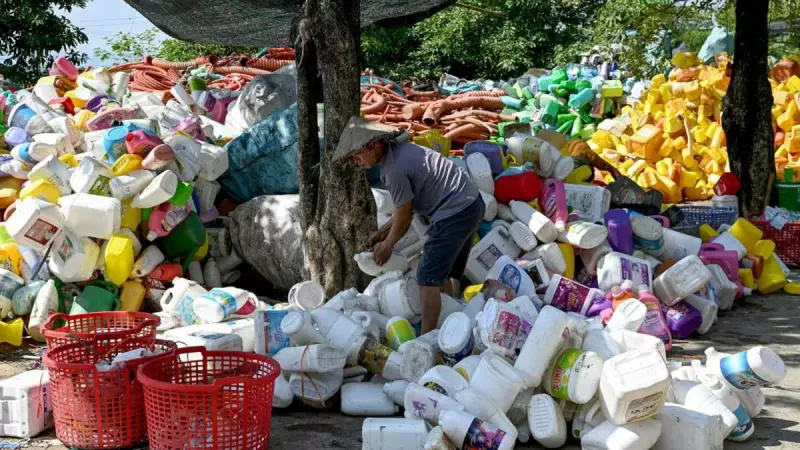
Nestled among towering piles of discarded plastic, workers in villages surrounding Vietnam's capital, Hanoi, perform a vital yet deadly task. They sort, shred, and melt the nation's plastic waste, enabling reuse but at a horrific cost to their health and environment. This is the dirty, unregulated business of 'craft' recycling, a sector caught between economic necessity and toxic consequences.
The Paradox of Pollution and Prosperity
In villages like Xa Cau and Minh Khai, daily life revolves around mountains of plastic waste. Workers like Lanh, 64, spend their days stripping labels from bottles of Coke, Evian, and local drinks so the plastic can be melted into pellets. More waste arrives constantly, piling up like colourful snowdrifts along roads and rivers.
These villages present a stark contradiction. On one hand, they enable the reuse of a portion of the 1.8 million tonnes of plastic waste Vietnam generates each year, providing crucial wages in a fast-growing economy. Many residents, like 58-year-old Nguyen Thi Tuyen, credit the business for their newfound wealth, noting the shift from farming to brick houses.
However, this recycling is conducted with minimal regulations. Experts and workers alike report severe environmental pollution and dire health threats. "This job is extremely dirty. The environmental pollution is really severe," said Lanh, who asked to use only her first name.
A Toxic Environment and a Health Crisis
The rudimentary methods used in these villages produce dangerous emissions and expose workers to a cocktail of toxic chemicals. Hoang Thanh Vinh, a United Nations Development Programme analyst, states that air pollution control is effectively zero in such facilities. Untreated wastewater is often dumped directly into waterways.
The health impact is devastating. A 2008 environment ministry study found life expectancy in these villages was a full decade shorter than the national average. While comprehensive cancer data is scarce, sediment analysis in Minh Khai revealed very high contamination of lead, dioxins, and furan—substances linked to cancer.
Lanh believes the toxic environment in Xa Cau gave her husband blood cancer. She continues sorting rubbish to pay his medical bills, describing a village "full of cancer cases, people just waiting to die." AFP spoke to more than half a dozen workers who reported colleagues or family members with cancer. Xuan Quach of the Vietnam Zero Waste Alliance says sustained exposure makes higher health risks inevitable.
Local Waste and Global Imports
Most recycled waste originates domestically, but Vietnam's capacity is overwhelmed. The country only recycles about one-third of its own plastic waste. Consequently, it has become a major importer, accepting thousands of tons annually from Europe, the United States, and Asia, especially after China's 2018 ban on plastic waste imports.
US and EU trade statistics show shipments to Vietnam exceeded 200,000 tonnes last year. A plant owner in Minh Khai, 23-year-old Dinh, explained the need for imports, stating domestic supply "is not enough" to feed the machinery. Despite recent government moves to tighten regulations and phase out imports, the flow continues.
The core problem is systemic. Most domestic waste isn't sorted at source, making it difficult to recycle efficiently. Efforts to improve the industry, including bans on burning waste and building modern facilities, have seen limited success. Burning and dumping of unusable waste in empty lots persists.
Hoang Thanh Vinh advocates for a fundamental shift, suggesting the government should help recyclers relocate to industrial parks with proper environmental safeguards. This would formalise a sector that handles a quarter of the country's recycling. "The current way of recycling in recycling villages... is not good to the environment at all," he concluded. The conundrum remains: how to balance economic survival with the basic right to a safe and healthy life.