
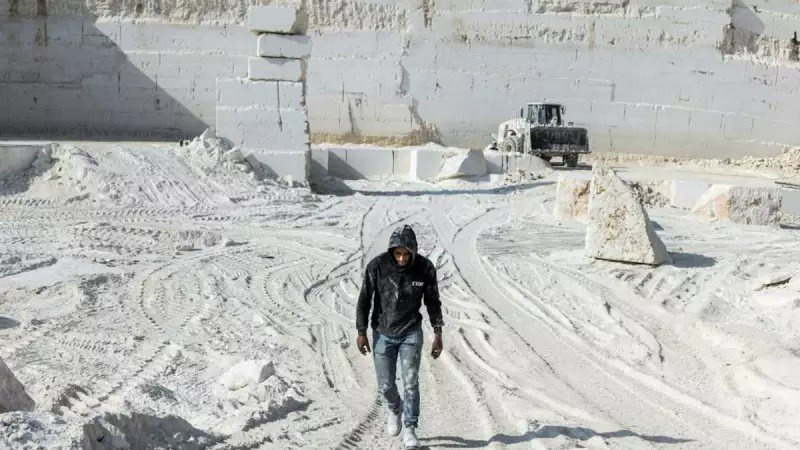
In the heart of the occupied West Bank, where the Palestinian economy faces its most severe crisis on record, the grinding machinery in limestone quarries continues to operate. These sites, producing the famed pale Jerusalem stone, represent a crucial but threatened economic pillar for a territory grappling with war, restrictions, and financial collapse.
The 'White Gold' in a Wilting Economy
Near the town of Beit Fajjar, close to Hebron, quarry operator Faraj al-Atrash surveys an armada of machines cutting into vast walls of dusty white rock. "This here is considered the main source of revenue for the entire region," Atrash stated. This stone, used for millennia across the Holy Land, gives Jerusalem and much of the region its distinctive architectural look, earning it the local nickname "white gold."
However, the operator, in his fifties, voiced a deep-seated fear: "Our livelihood is constantly under threat." He believes the Israeli occupation has intensified economic pressure, with risks including equipment confiscation, settlement expansion, and the broader Palestinian financial crisis. The Palestinian Authority, exercising partial control in parts of the West Bank, is on the brink of bankruptcy, causing public services to deteriorate and fixed costs like water and electricity to soar.
War, Checkpoints, and a Strangled Market
The war in Gaza, triggered by Hamas's October 2023 attack on Israel, delivered a devastating blow to an already fragile Palestinian economy. A late November 2023 UNCTAD report confirmed the territories are enduring their worst-ever recorded economic crisis. Israel's establishment of hundreds of new checkpoints across the West Bank has paralysed commercial transport, while a halt in work permits for Palestinians in Israel has removed a critical income source.
For the quarrying sector, market access has become a major hurdle. "We used to export most of the stone to Israel, and after October 7, we ran into difficulties," explained Ibrahim Jaradat, whose family has owned a quarry near Sair for over 40 years. This is significant because around 65% of the stone exports are destined for Israel, where some municipalities mandate its use. The people buying stone for resale to construction sites are mostly Israelis, said 65-year-old operator Abu Walid Riyad Gaith, who also lamented a perceived lack of solidarity from Arab nations in purchasing the material.
Physical Toll and an Uncertain Future
Despite the overwhelming challenges, quarrying has shown resilience. The sector accounts for 4.5% of Palestinian GDP and employs nearly 20,000 workers, according to the Hebron Chamber of Commerce. Yet, the work is brutally tough. "We are working ourselves to death," said Atrash, pointing to labourers coated in a perpetual film of white dust. Workers reported widespread health issues, including back, eye, and throat problems.
For many, there are no alternatives. One former geography teacher, his salary from the Palestinian Authority cut off due to the budget crisis, now labours in a quarry, blinking and coughing through the dust. The future is clouded with further political threats. Most of the West Bank's roughly 300 quarries lie in Area C, under full Israeli control. Israeli settlements, considered illegal under international law, are expanding at their fastest rate since at least 2017, and some Israeli government members openly discuss annexation plans.
"People have no money, and those who do are afraid to build," concluded Laith Derriyeh, employed by a stonemason. The stone may still be cut, but the economic and political landscape surrounding it has become as hard and unforgiving as the rock itself, leaving a vital industry and its workers in a state of precarious survival.




