
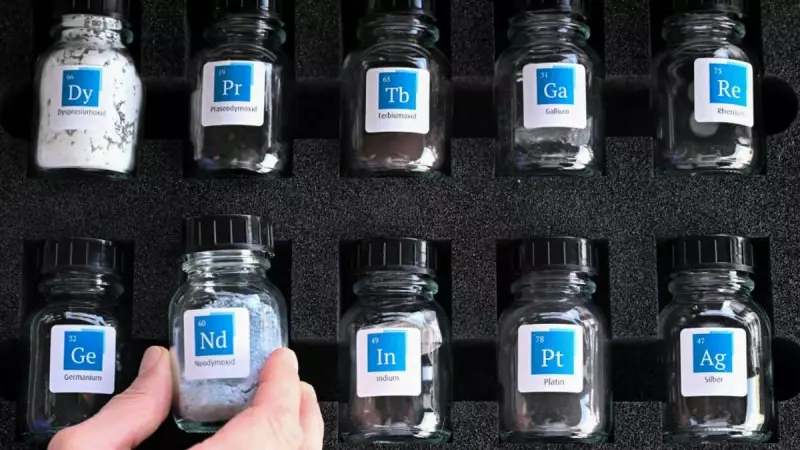
In a significant move to secure its technological and green energy future, the European Union is pushing to boost its own production of critical raw materials known as 'rare earths.' This initiative, unveiled on Wednesday, aims to reduce the bloc's heavy reliance on China, the world's dominant supplier, which introduced export restrictions on these elements earlier this year.
What Exactly Are Rare Earths and Why Are They So Vital?
Despite their name, rare earth elements are relatively abundant in the Earth's crust, but extracting them in usable form is complex and often environmentally challenging. These 17 metals have become indispensable to modern life and high-tech industry. Global production surged by 77 percent in just five years, jumping from 220,000 tonnes in 2019 to 390,000 tonnes in 2024, according to a report by French research group Cercle CyclOpe.
The economic heart of the sector lies in four key magnetic elements: neodymium, praseodymium, dysprosium, and terbium. Their unique properties make them irreplaceable in a vast array of applications.
Powering Green Tech and Modern Defence
These magnetic rare earths are primarily used to manufacture super-strong permanent magnets. Neodymium-iron-boron magnets, for instance, are about ten times more powerful than conventional magnets. As Damien Ambroise, an energy manager at French consultancy Bartle, explains, using these elements maximises performance while reducing the size and weight of components.
This is crucial for the green transition. A single offshore wind turbine can contain up to one tonne of these magnetic rare earths. They are equally critical for modern defence; each advanced F-35 fighter jet requires over 400 kilograms of rare earth materials, as noted in a US Congressional Research Service report. The US aerospace giant Lockheed Martin is a major user of samarium for magnets that withstand extreme heat.
Beyond magnets, scandium is used to create light, strong aluminium alloys for aerospace and even high-end sports equipment like golf clubs and bicycles.
In Your Pocket and On the Road
Every smartphone relies on rare earths to enhance screen colour and enable the vibration function. With 1.24 billion devices sold globally in 2024, this translates to over 3,700 tonnes of these metals used in handsets alone, each containing about three grams.
The automotive industry is another massive consumer. Each battery and motor in a hybrid or electric vehicle contains between 1.2 and 3.5 kilograms of rare earths, estimates France's Bureau of Geological and Mining Research. They are also found in small motors, like those that automatically fold car wing mirrors. Even traditional combustion engines use them in catalytic converters, where lanthanum and cerium help reduce harmful fine particle emissions.
Diverse Uses From Industry to Medicine
The utility of these elements stretches far beyond electronics and transport. In the chemical industry, cerium is vital for oil refining and glass polishing. Erbium has important applications in medical fields such as dentistry and dermatology.
Furthermore, erbium and neodymium are key components in industrial lasers used for cutting and engraving. "Adding different rare earths alters the wavelength of the laser, and thus its use and colour," said Ambroise. "It makes for pretty colours in sound-and-light shows."
The EU's new strategy highlights a global recognition: rare earths are not just commodities but strategic assets for national security, economic competitiveness, and the clean energy revolution. Reducing dependency on a single source has become a paramount priority for Western economies.




