
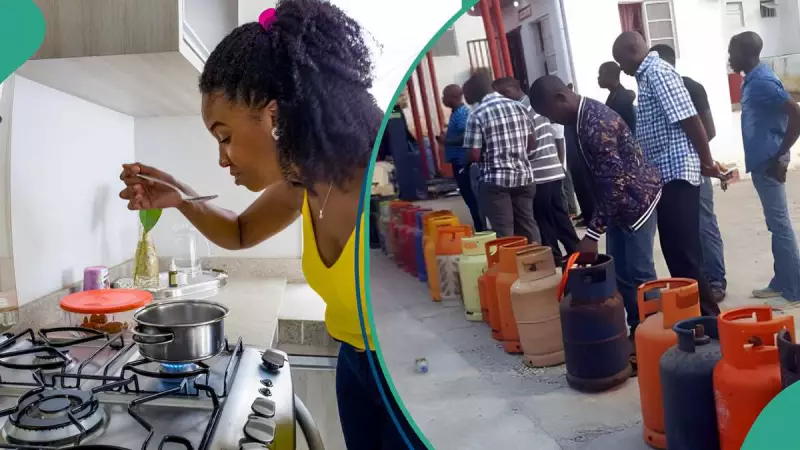
In a move that is set to increase the cost of living for many Nigerian households, the Dangote Refinery has announced an increase in the price of Liquefied Petroleum Gas (LPG), commonly known as cooking gas. The adjustment, which took effect on December 1, 2025, has immediately triggered a chain reaction of price hikes by retailers across major cities.
Price Hike Details and Immediate Market Reaction
The refinery raised its ex-refinery price from N800 per kilogram to N820 per kilogram, according to data from the fuel pricing platform PetroleumPriceNG. This seemingly modest increase at the source has rapidly cascaded down the supply chain, leading to significant jumps at the retail level, especially in urban centres.
A market survey conducted in the wake of the announcement found retailers swiftly aligning their prices. In Lagos, for instance, outlets like Gasland in the Iju Ishaga area increased their rate from N1,150 to N1,200 per kilogram. Similar adjustments were reported in Abuja, Kano, and Port Harcourt, putting additional financial pressure on families as the Christmas season approaches—a period when energy consumption traditionally rises.
Dealers explained they had no choice but to pass on the cost. Olawale Ojo, a retailer based in Lagos, detailed the squeeze on margins, stating, "We used to buy at N800 per kg and sell at N950, but recently we purchased at N850 and now resell at N1,150 per kg." He emphasized that even a N50 increase per kilogram has a substantial cumulative effect on business and consumers.
Analysts Question Hike Amid Favourable Global Trends
Energy experts have expressed surprise at the price increase, arguing that it contradicts current global market fundamentals. They point to two key factors that should, in theory, be pushing prices lower: a dip in global crude oil prices and relative stability of the Naira in the official foreign exchange market.
Adeola Yusuf, an energy policy analyst, noted that Brent crude was averaging around $60 per barrel over the past weekend. "Right now, crude sells for an average of $60 per barrel and refineries globally should adapt to the fall," Yusuf stated, highlighting that international refiners typically adjust output prices in response to such movements.
The hike is particularly notable as it comes just one day after the same Dangote Refinery announced a reduction in the price of petrol, a move that had been widely welcomed in the downstream petroleum sector.
NBS Data Reveals Existing Regional Price Disparities
The new increase adds to an already burdensome landscape for household energy expenses. Recent data from the National Bureau of Statistics (NBS) for October 2025 painted a clear picture of the high costs and regional variations.
The report showed that the average cost of refilling a standard 12.5kg cylinder stood at N17,731.25 nationwide. Rivers State recorded the highest average price at N17,895.00, followed by Osun and Benue States. Katsina State had the lowest average at N14,725.00.
On a zonal level, the South-South region led with an average of N17,114.67, while the North-Central remained the least expensive at N16,411.19. This data underscores the significant pricing disparities that continue to define Nigeria's LPG market, disparities that are now being exacerbated by the latest refinery-led increase.
As the festive season kicks into high gear, the impact of this price adjustment is already being felt by families and small businesses who rely on cooking gas. The move marks another volatile turn in Nigeria's domestic energy market, highlighting how sensitive retail prices are to shifts at the refinery level and broader industry fluctuations.




