
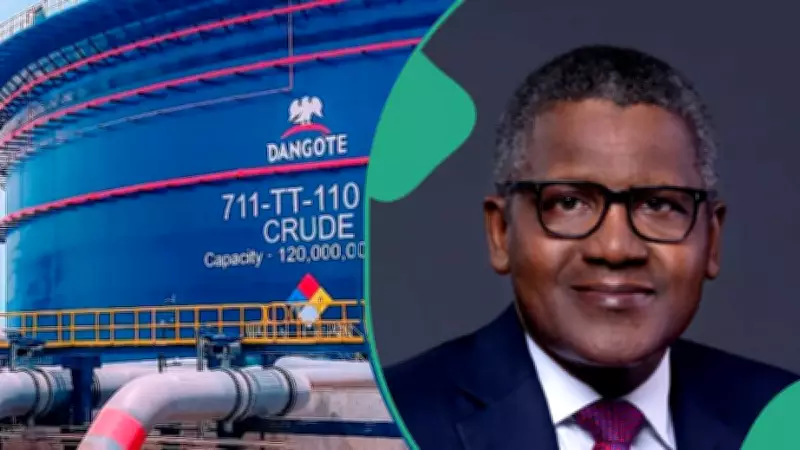
Dangote Refinery Seizes Control of Nigeria's N14.4 Trillion Fuel Market Following Import License Suspension
Nigeria's petroleum sector is experiencing its most significant transformation in decades after the federal government suspended all petrol import licenses, effectively positioning the Dangote Petroleum Refinery as the dominant player in the country's fuel supply chain. This policy shift has granted the refinery control over a market valued at approximately ₦14.4 trillion annually, fundamentally altering Nigeria's energy landscape.
Local Refining Now Supplies 92% of National Petrol Demand
According to data from the Nigerian Midstream and Downstream Petroleum Regulatory Authority (NMDPRA), domestic refining now accounts for the overwhelming majority of petrol supplied across Nigeria. The regulator's February 2026 market fact sheet reveals that local refineries delivered about 36.5 million litres of petrol daily, while imports accounted for only three million litres per day.
This brings Nigeria's total petrol supply to roughly 39.5 million litres daily, meaning domestic production now represents approximately 92 percent of the country's supply. Currently, the Dangote refinery stands as the only facility producing petrol locally on a large scale, with several smaller modular refineries focusing primarily on diesel and related petroleum products.
Using a conservative estimate of ₦1,000 per litre, Nigeria's daily petrol consumption translates to an annual market value exceeding ₦14.4 trillion, establishing it as one of Africa's largest fuel markets.
Experts Raise Concerns Over Market Concentration and Monopoly Risks
Despite celebrating the milestone in domestic refining capacity, energy analysts, economists, and labor groups have expressed serious concerns about the risks associated with relying heavily on a single supplier for such a critical commodity.
Energy economist Wumi Iledare described the suspension of petrol imports as a strong policy signal in Nigeria's downstream oil sector but cautioned that abrupt regulatory shifts could encourage strategic behavior among market players. "Such signals could lead to precautionary stockpiling, opportunistic pricing, or competition for logistical advantages within the distribution network," Iledare warned.
He emphasized that regulators must provide clear guidance and ensure that local refining, distribution infrastructure, and pricing mechanisms are robust enough to consistently meet national demand.
Regulatory Authority Defends Policy While Acknowledging Competition Concerns
Energy law expert Dayo Ayoade believes Nigeria's heavy reliance on the Dangote refinery reflects structural gaps in refining capacity rather than deliberate market control by the company. He explained that regulators retain legal authority under the Petroleum Industry Act to monitor competition and intervene if necessary.
"If a dominant supplier is found to be abusing its market position, authorities can impose sanctions or corrective measures," Ayoade noted, expressing optimism that the market could become more competitive as additional refining projects gradually come online.
The NMDPRA has defended the decision to suspend petrol import licenses, arguing that the move is necessary to consolidate Nigeria's progress in domestic refining. The regulator's chief executive, Saidu Mohammed, stated that the country must sustain gains achieved through local fuel production rather than returning to large-scale petrol imports.
Labor Organizations and Economists Call for Consumer Protection Measures
The Nigeria Labour Congress has warned that dominance by a single supplier in such a strategic sector could expose consumers to price pressures if regulators fail to maintain strong oversight. According to the union's Assistant Secretary-General Christopher Onyeka, competition remains essential in preventing excessive pricing power in any economy.
Economist Aliyu Alias echoed similar concerns, noting that limited participation from other refiners reduces competitive pressure within the downstream sector. Industry stakeholder Jeremiah Olatide suggested that a balanced supply structure—with about 70 percent of petrol demand met locally and 30 percent through imports—might provide greater stability during Nigeria's energy transition.
Global Market Volatility and Domestic Price Adjustments
The transformation of Nigeria's petrol market is unfolding amid significant turbulence in global energy markets. The International Energy Agency recently announced plans to release 400 million barrels of oil from emergency reserves to ease supply disruptions linked to tensions around the Strait of Hormuz, a key shipping route responsible for nearly 20 percent of global oil and gas shipments.
Crude oil prices have hovered around $90 per barrel, reflecting ongoing uncertainty in international markets. Following recent reductions in refinery gantry prices, several filling stations across Nigeria have adjusted retail fuel prices, with petrol selling between ₦1,130 and ₦1,150 per litre at many outlets.
Dangote Petroleum Refinery's managing director and chief executive officer, David Bird, has indicated that petrol prices may not decline even as the refinery operates at full capacity, citing volatility in global oil markets and rising supply chain costs. Bird explained that the refinery operates within the international commodities market, which directly influences the cost of crude oil and refined products.
As Nigeria's downstream sector enters this new phase, industry observers emphasize that the long-term success of the policy will depend on how regulators balance support for domestic refining with measures that encourage competition and protect consumers from potential market abuses.




