
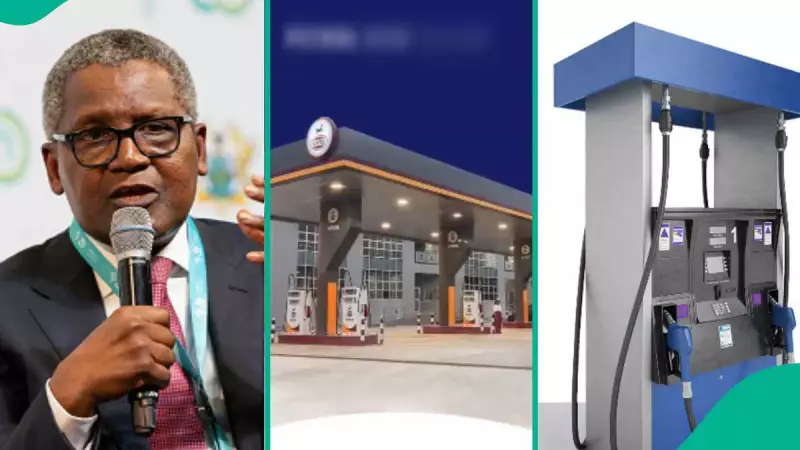
Nigerians have been thrown into a state of excitement following a major announcement from the Dangote Refinery concerning the price of Premium Motor Spirit (PMS), commonly known as petrol. The refinery has significantly reduced the cost at its own dispensing gantry in Lagos, offering a glimmer of hope for cheaper fuel across the country.
A Welcome Relief for Consumers
In a move celebrated by many, the Dangote Group declared that a litre of petrol will now be sold for N699 at its refinery. This announcement, made public on Friday, December 20, 2025, is seen as a direct intervention to ease the economic burden on Nigerians who have been grappling with high fuel costs. The company also introduced a supportive measure for bulk buyers: a 10-day credit facility, backed by bank guarantees, with a minimum purchase of 500,000 litres.
The news quickly spread across social media, where citizens expressed their approval. One X user, Christ Chiedu, captured the prevailing sentiment, arguing that Nigeria no longer has an excuse to rely on expensive fuel imports. "We can't continue to buy or import fuel from the far western world when we have all it takes here in Nigeria," he stated. "The crude oil is here, the refinery is here." His post reflects a strong nationalistic pride and a belief in domestic industrial capacity.
Mixed Reactions and Calls for Wider Impact
While the announcement from the Dangote Refinery was met with widespread optimism, it also prompted immediate scrutiny of retail prices at filling stations. Many Nigerians took to social media to report that the promised price reduction had not yet trickled down to the pumps in their localities.
Complaints specifically targeted MRS filling stations in various states. For instance, users reported prices as high as N820 in Ajah, Lagos, N940 in the Federal Capital Territory (FCT), and above N850 in Benin City, Edo State. These reports highlight the gap between the refinery's ex-depot price and the final retail cost paid by consumers, raising questions about distribution and markup.
Some commentators offered strategic advice, suggesting that the Dangote Group needs to partner with more retail stations to ensure its cheaper product reaches the masses effectively. Others pointed out specific stations displaying lower prices but not actually selling petrol, calling for investigations.
Broader Context and Allegations
The price reduction comes amidst a broader controversy involving the refinery and the industry regulator. Earlier, billionaire industrialist Aliko Dangote had called for a probe into the Chief Executive Officer of the Nigerian Midstream and Downstream Petroleum Regulatory Authority (NMDPRA), Farouk Ahmed. Dangote alleged that Ahmed paid about $5 million in foreign school fees for his children and urged the federal government to investigate to allow the official to clear his name.
In the same vein, Dangote had previously assured Nigerians of further reductions in petrol prices, projecting that PMS could sell for no more than N740 per litre in Lagos. The new price of N699 at the refinery gantry not only meets but exceeds that projection, reinforcing the potential of local refining to stabilize the market.
The development underscores a critical moment for Nigeria's energy sector. With the Dangote Refinery now operational and setting competitive prices, the long-standing narrative of total dependence on imported refined products is being challenged. The public reaction shows a strong desire for this domestic capacity to translate into tangible, nationwide relief at fuel stations.




