
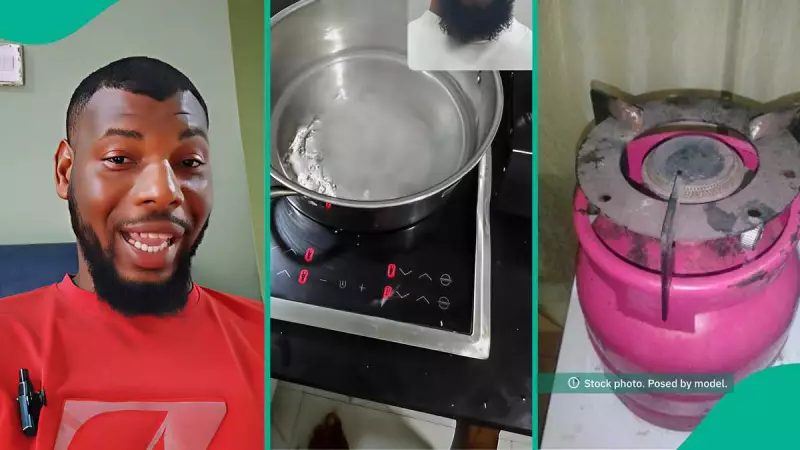
A Nigerian man's practical comparison of cooking appliances has sparked a significant conversation online, especially as the cost of cooking gas continues to rise beyond the reach of many households.
The Solar-Powered Induction Experiment
In a video that went viral, a Nigerian DIY solar expert, who goes by the TikTok handle @diy_fortress, presented a compelling case for using an induction cooker connected to a solar power system. He argued that this method is more economical than relying on liquefied petroleum gas (LPG). The core of his demonstration showed water boiling noticeably faster on the induction cooker compared to a gas burner, with the gas kettle still simmering as the induction-brought water reached a rolling boil.
The man detailed the wattage of his four-burner induction cooker, noting that one burner is rated around 3,000 watts. He explained that a more common single-burner model typically runs at about 2,000 watts, making it compatible with a medium-sized solar setup. He emphasized that he often cooks at a power setting of around 1,000 watts. This consumption equals one unit of grid electricity, which he estimated costs between N30 and N50.
Cost Analysis: Induction with Solar vs. Cooking Gas
The expert took his analysis further by comparing the economics directly. He highlighted that a 1kg cylinder of cooking gas, priced at approximately N1,200, would be used up for everyday cooking needs. In contrast, the energy drawn from a personal solar system for the induction cooker presents a potentially lower long-term cost, especially with the high initial investment in solar panels and batteries already made.
In a separate update, another Nigerian man with a substantial 16kVA solar installation in his home reported successfully cooking beans on an induction cooker at a medium power setting. Remarkably, even while running the cooker alongside two 1.5HP air conditioners and other appliances, his total power draw did not exceed 3kW.
Mixed Reactions from the Public
The video elicited a wide range of responses from Nigerians, reflecting the diverse realities of the country's power situation and awareness of alternative technologies.
Some users were enthusiastic adopters. User adeolasilver commented, "Am using my induction cooker with inverter, the thing too fast." Violet Nwankwo added, "I bought induction cooker because of your videos and truly it's worth the hype. It's very fast, energy efficient and sweet." Another user, lakukulala, praised it saying, "Baba, induction na baba o... Veeery fast and e no dey chop power cos it's fast and e no dey cause heat for kitchen."
However, others pointed out critical limitations. SidneeJames raised a common concern: "We've not had light for 3 days now, as good as an induction cooker is, I can't recommend it for places with unstable electricity." This underscores that a reliable solar or inverter backup is a prerequisite.
There was also surprise about the technology itself, with user mobiletek252 noting, "Bro I was shocked when you placed your palm on the induction cooker, and was not hurt." The creator clarified that the cooker works by emitting magnetic energy and only heats ferromagnetic cookware. Another user, Badvibes, expressed amazement that induction cooking was being presented as new, stating, "How come people are just knowing of induction cooker in 2025, something I have been using since 2011."
The demonstration, shared online on December 5, 2025, arrives at a time when many families are grappling with the soaring cost of traditional cooking fuels. It presents a viable, though infrastructure-dependent, alternative for those seeking to leverage renewable energy for daily domestic tasks.




