Pontius Pilate's Handwashing: A Reflection on Truth and the Trial of Jesus Christ
The humiliation and shocking gruesome murder of the Lord Jesus Christ, the Prince of Peace, continues to reverberate in human souls across the universe, gnawing at our conscience, especially on the anniversary of this dastardly event marked today in Christendom and among those who study the Life and Times of the Son of God. Humanity failed to protect their Lord, and to this day, many Christians mistakenly say He came to die for our sins, when in truth, He died because of our sins, as people walled themselves in and failed to recognize their Messiah sent by God Almighty.
The Political and Religious Backdrop
The political and priestly establishments of the time found the Teachings of Jesus irksome and a threat to their influence, earthly hold, and power over the people of Israel. The priests had taught incorrectly in temples and synagogues, but Jesus, coming from the Highest Luminous Heights of Eternal Truth, sought through His Teachings to draw attention to wrong ways of living and show the path to salvation. His words exposed the emptiness of priestly doctrines and the arrogance of their leadership claims, relentlessly branding hypocrisy and errors for what they were.
With their power threatened and seething with hatred, the political and priestly leaderships schemed to eliminate Him, inciting the people to rise against the Lord. Today, we feature an exhaustive exposition by guest contributor Dr. Seye Aluko, an engineer and music maestro, who reminds us of the tribulations Jesus suffered at the hands of humanity.
Pilate's Dilemma and the Mob's Fury
Pontius Pilate, the Roman Governor of Israel, never wished to crucify Jesus, but felt inwardly urged to release Him. Meditating on the cruel actions by the hostile Jewish mob, one wonders at human bestiality—how could such criminality as the crucifixion be justified? Thousands of enemies wanted Jesus killed due to His massive influence over the people, but death by crucifixion required Roman sanction, which only Pilate could provide.
After Jesus' arrest, He was taken, badly bruised and tormented, to Pilate's palace to persuade the governor to approve His crucifixion. Pilate, an experienced and meticulous leader, was unwilling to condemn without proper trial, as Jesus was innocent of all accusations. Seeing the maltreated Jesus and the howling mob baying for His blood, Pilate developed great loathing for the Jews' wickedness.
In a dilemma, Pilate sensed Christ was no ordinary person—the Son of God, famous in Israel and beyond. He cross-examined Jesus, asking the mob for accusations, to which they replied with a litany of charges: healing on the Sabbath, seducing the people, disturbing peace, offending Caesar, and claiming to be a king. They brought paid false witnesses and bribed informants, transforming into a furious crowd that beat, spat at, grilled, scourged, and mocked Christ cruelly.
The Interrogations and Pilate's Struggle
Before reaching Pilate, Jesus was tugged to High-priests Annas and Caiaphas, accused of blasphemy and subjected to further maltreatment. At Pilate's palace, the governor's loathing increased as he marveled at Christ's regal poise despite the abuse. Pilate asked again for accusations, and the mob claimed Jesus called Himself the "Son of God," was from obscure lineage yet a king, healed on the Sabbath, planned insurrection against Rome, and claimed to destroy and restore the Temple in three days.
Stunned, Pilate summoned Jesus to an inner chamber, asking if He was a king and what He had done. Jesus answered, "My kingdom is not from hence. I was born to bear witness to the truth." Pilate queried, "Truth, what is Truth?" highlighting the fluid concept many leaders hold, resorting to cunning to safeguard interests. Pilate had to take chameleonic decisions, trying to please the people while grappling with Christ's unwavering stance.
Declaring, "I find no fault in this man," Pilate enraged the mob further, leading to more false accusations. Learning Jesus was from Galilee, Pilate sent Him to Herod, the ruler there, hoping for a Jewish law judgment. Herod was glad to meet Jesus, hoping for miracles, but disturbed by His pitiable state. After interrogation where Jesus remained silent, Herod, fearing guilt from past actions like beheading John the Baptist, sent Jesus back to Pilate without condemnation.
The Final Decision and Handwashing
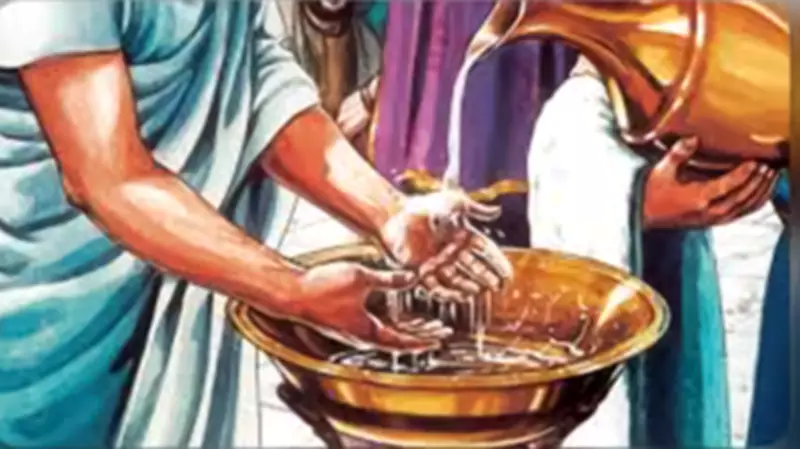
Back with Pilate, the governor had endearing discussions with his wife Claudia Procla, who urged Jesus' release due to disturbing dreams. Pilate assured her he would not condemn, finding no cause for death. However, realizing he could not save Jesus amid the tumult, Pilate took water and washed his hands before the multitude, saying, "I am innocent of the blood of this just person. See ye to it." The mob responded, "His blood be upon us and on our children."
Reflections on Truth and Modern Revelations
This account draws from "The Life Of Jesus Christ And Biblical Revelations," based on visions of Anne Catherine Emmerich. Today, a monumental revelation titled "In the Light of Truth, The Grail Message" by Oscar Ernst Bernhardt, pen-named Abd-ru-shin, explains that Truth-Bringers like Jesus, Mohammed, Krishna, and others faced hostility from religious establishments. Abd-ru-shin's work, translated into over 16 languages, emphasizes that Jesus was strong, not weak, and His mission was to fulfill, not destroy, the law.
As Abd-ru-shin warns, humanity stands at a brink, with the Cosmic Clock demanding account for actions, including the murder of the Son of God. Over 2,000 years later, the world remains in turmoil, entangled in spiritual indolence, as the Voice of God calls for reckoning. Dr. Seye Aluko's piece from Lagos invites deep reflection on these eternal truths.