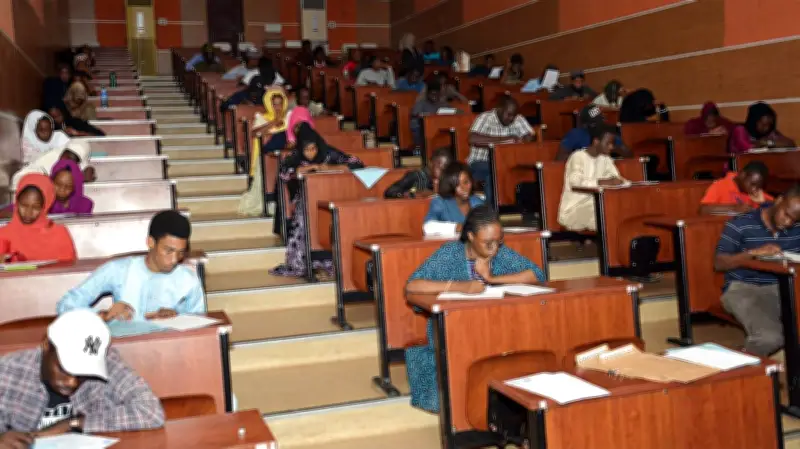
There was a time in the past when university and polytechnic certificates obtained in Nigeria were equally ranked, if not ranked higher, than degrees from foreign countries. That was a golden era when Nigerians returning home with foreign degrees found it difficult to gain employment, especially those returning from India and Pakistan. The general perception at the time was that students who could not compete for limited spaces traveled abroad where there was no competition for admission. It was just like walking in with ordinary or advanced level certificates, paying fees, and registering to study.
Using myself as a typical example, I gained admission to the University of Nigeria Calabar Campus in 1973. There were only six universities in Nigeria at that time. I was one of the 154 pioneer undergraduates who commenced studies on a campus that was Duke Town Secondary School, Akim Qua Town Calabar. I was admitted to read Chemistry in the faculty of Physical Sciences. We had 2500 students competing for 25 chances in each of the four departments in the faculty. I was number 24 in the Department of Chemistry and was offered provisional admission on the condition that I obtained credits or higher grades in Physics, Chemistry, Mathematics, English, and any other science subject in the May/June 1973 West African School Certificate Examination. That is how competitive gaining admission into the university was. Admission into polytechnics was equally competitive.
Tertiary education in Nigeria had quality, and anyone holding a certificate from Nigerian universities was given automatic admission into foreign universities, and they did not disappoint. But in the present era, the quality of universities and university graduates has dropped. Media reports have it that a popular digital bank claims that they have 500 unfilled vacancies because Nigerian graduates are unemployable. To avoid unnecessary arguments, let us agree with them. We shall return to this later.
While establishing the University of Nigeria Nsukka, the late sage Dr. Nnamdi Azikiwe said, “By education I do not mean simply learning. I mean training…the head, hand and heart. Training in mind, in morals, and in hand that helps make one socially efficient.” To a very large extent, that is the principle on which the University of Nigeria, established in 1960 as the first autonomous indigenous university, is anchored. With time, other universities established in 1962 and thereafter adopted that education philosophy when pioneer graduates of the University of Nigeria Nsukka excelled in competitive Public Service Recruitment Examinations.
If the claim by the digital bank (name withheld) that 500 vacancies exist because graduates of Nigeria’s tertiary institutions are unemployable is correct, where did we get it wrong? I am asking this question because graduates of the 1960s, 1970s, up to the middle 1980s were good to go upon graduation. My well-considered answer is that all of us, including the digital bank, got it wrong. Let me start with them before I move to the standard of education in tertiary institutions.
The 500 vacancies exist because they do not want to invest money in training the graduates. For instance, with my BSc Accountancy degree, I joined the United Bank for Africa Ltd (UBA) in August 1979 as a Special Trainee after NYSC at the Central Bank of Nigeria, Maiduguri, Borno State. UBA designed a 12-month training programme for all the graduates they employed. We were trained in all aspects of commercial banking—savings accounts, current accounts, cash and teller, clearing and reconciliation, bills for collection, letters of credit, lending, and securities for lending. We capped it up with Head Office training, linking branch and head office operations. By the time we completed the training, we were all-round bankers, ready to be posted to any branch or head office department. Unfortunately, this is no longer the case. That is why I hold the view that the digital bank that claimed they have 500 vacancies because Nigerian graduates are unemployable is part of the problem. Needless to say, if they embark on staff training, a substantial part of the training cost is recoverable from the Industrial Training Fund. Why then the apathy in training the fresh graduates they employ?
Let us now address the issue of the quality of graduates being produced by the universities and polytechnics. First, is the quality of teaching materials. I don’t want to go into the quality of the teaching staff themselves. It is a matter of “what you give is what you get; garbage in, garbage out.” In my university years, 1973 to 1978, we used prescribed textbooks, which are products of intensive research, to study. Not anymore. University and polytechnic lecturers have commercialized education. They now package “handouts” and sell them to students at exorbitant prices. These handouts are not products of rigorous and extensive research as they were. The lecturers download materials from the Internet, package them, and sell them to students. With all due respect, this writer, who is a published author of two professional banking books, considers it an academic fraud. The lecturers are not even ashamed that their students browse the Internet and see these same materials they packaged and sold.
That is the root cause of the low quality of university and polytechnic graduates being produced. The only way to raise the quality of tertiary education in Nigeria is for the regulators of tertiary education—the National Universities Commission and its counterpart in polytechnic education—to ban lecturers from churning out and selling handouts to students going forward. Unlike standard textbooks, which are products of intensive research, evaluated by experts in the subject area, and approved for publication, these handouts are products of self-publishing. There is no independent review and valuation. Standard textbooks may be expensive, but that is part of the cost of education. As the saying goes, if you think education is expensive, try ignorance. The difference will become clear.
The value and importance of quality education cannot be overemphasized. What we have these days in the labour market is quantity, not quality. That is why, unlike in the 1960s, 1970s, up to the middle 1980s when home-grown graduates were preferred to returning foreign graduates, there is now a role reversal. Foreign-trained graduates are preferred to home-trained graduates by employers in the labour market. No country achieves greatness by producing half-baked graduates of home tertiary institutions. According to Thomas Scott, “A man cannot leave a better legacy to the world than a well-educated family.” Need we say more?