Until recently, many traders participating in the Lagos State University of Science and Technology's Digital Literacy for Ikorodu Trades programme relied almost exclusively on walk-in customers. They sold to people who knew them, lived nearby, or passed their shops daily. Business was built on physical presence and familiar faces. For four weeks, that routine changed. Twenty participants from various trades gathered at LASUSTECH to learn how digital tools could help them market products, create content, promote services, and reach customers beyond their immediate environment.
By the time the maiden training ended on May 2, some participants had created logos for their businesses, produced promotional videos, and begun using social media in ways many had not explored before. A perfume seller who previously operated without a defined brand left with a logo, fresh designs, and a clearer online identity. A phone and gadgets dealer who relied mostly on walk-in customers said the training showed him how to use his phone more productively for business. A barber who mainly depended on familiar customers started using digital tools to present his work to a wider audience.
Vice-Chancellor's Vision for Digital Transformation
At the closing ceremony, the Vice-Chancellor of LASUSTECH, Professor Olumuyiwa Omotola Odusanya, stated that the programme was designed to help traders become more profitable, reduce manual effort, and compete beyond their physical location. He noted that business has changed due to the speed at which information now travels. “No one needs to stay under the sun forever to advertise, to make money,” he said. For Odusanya, the training was not about temporary support but about practical knowledge that participants could continue to use after the programme.
Over four weeks, selected participants were shown how to do business with less labour, less manual effort, and stronger visibility. He illustrated the point with a simple example: a woman selling food with only a signboard outside her shop may be noticed mainly by passersby, limiting her market to foot traffic. However, with an online presence, customers can see products online, place orders, and request delivery without visiting the shop. “Whether it is shoemaking, financial services, or cloth, it provides an avenue for them to do well,” he said. “What we have done is to impact the lives of people who have been in this programme to do better and to be a blessing to themselves, their communities, and their households.”
Programme Structure and Selection Process
The university stated that the selection process was handled jointly by LASUSTECH and the community. Interested participants applied and were screened. One basic requirement was access to a phone that could support online engagement. The programme was designed as practical training, not just a theoretical exercise. Participants were tasked to create, test, and apply what they learned during the sessions. They received lessons in content creation, advertising, business promotion, strategies, and business analytics. They were also introduced to video production, social media marketing, and digital tools that could improve business visibility.
Odusanya described the maiden edition as version 1.0 and said the university plans to organise another edition later this year, intending to make it an annual programme. Beyond organising future sessions, LASUSTECH also plans to monitor what participants do with the skills they have acquired. Since the businesses now have digital pathways, the university intends to observe whether participants can create content, carry out social media marketing, and drive traffic to their businesses.
Addressing Geographic Limitations
Most traders already work long hours and know their products well. The difficulty is that many businesses remain tied to geography. A trader may be skilled, but if visibility depends only on people who pass the shop each day, growth can remain limited. That was one of the questions the training sought to address. Instead of relying only on physical presence, participants were introduced to digital presence. The sessions also focused on practical business communication. Participants learned how to create short adverts, produce videos, develop simple brand identity, and use available tools, including artificial intelligence tools, to improve the quality of what they present to customers.
Recognition of Top Trainees
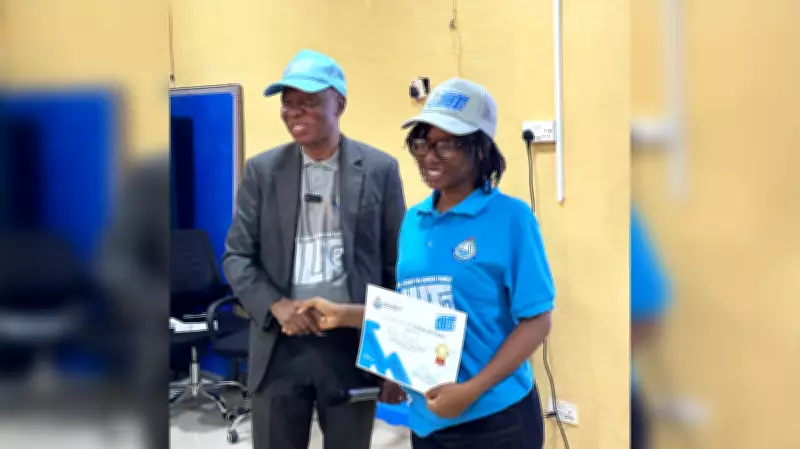
At the end of the programme, organisers announced the best trainees based on presentations made during the training. Dr Stephen Aderibigbe said winners were selected based on quality of image, quality of video, voice-over, and ability to use the provided tools, including artificial intelligence tools. Atobajaye Bolaji Taiwo emerged first. William Abigail came second. Oke Samson Olumide placed third. The Vice-Chancellor advised participants to use the knowledge they had gained to excel. He also asked them to keep their email addresses functional, improve their graphics and branding, build strong networks, use data productively, and work within the law.
Participant Testimonials
One winner, Taiwo, founder of BJ Phone and Tech, said the four-week training sharpened something he already carried in his hand every day. “This programme has been fabulous,” he said. He explained that one of the most useful parts of the training was learning how to use his phone differently. Because he works in gadgets, the device had always been central to his daily business. What changed during the training was his understanding of how that same device could become a business tool rather than only a communication tool. According to him, the immediate lesson was visibility. Before the programme, most of his customers were walk-ins, so he did not do much online. His customer base was built around direct contact, familiar faces, and existing relationships. “Normally, most of my customers were just walk-in customers,” he said. “I know my customers, they know me.” That pattern is common among small traders. Many businesses survive because of repeat buyers and neighbourhood recognition, but they also depend heavily on location. Sales rise or fall with foot traffic, and the business remains tied to the immediate environment.
For Atobajaye, the training introduced another possibility. With social media platforms such as Facebook and other digital channels, he now sees a path towards taking his business online. “With the help of this, I think my business would be able to go digital,” he said. Although his business is based in Ikorodu, he already has a wider target. “Once visibility improves, the distance between seller and buyer becomes smaller,” he said. Atobajaye hopes the university continues with the programme. “I think this is the first,” he said. “So probably there will be 2.0, 3.0. They should just keep it up and do more of it.”
William Abigail, who came second, runs Edits Collection, selling perfumes and scented products. Her range includes perfume, diffuser, body spray, roll-on, and related fragrance items. Like many small traders, she entered the programme with a business but without a fully developed brand. She was already selling, and customers already bought from her. During the training, she learned how to create designs herself rather than depending on someone else. That mattered because design is one of the first visible signs of identity in digital business. A customer scrolling through a phone screen may first notice an image, colour, or layout before reading a word. For a small trader like Abigail, paying others for that work can be expensive. Being able to do it independently changes the economics. “We learned how to create our own designs by ourselves without the help of somebody,” she said. She also learned how to create videos and adverts for her business, allowing her to produce promotional material without waiting for outside support. Beyond content creation, she said the programme introduced her to more practical aspects of digital communication.
According to William, the effect of the training was not only theoretical. It had already begun to produce results. “Last week, I got a call from somebody because of the posts we’re making,” she said. For a small business owner, that is often the first proof that digital effort can translate into commercial opportunity. “Obviously this programme has impacted us positively,” she said. Her experience also points to something: for many small traders, the first barrier is not access to the internet itself. Phones are already in their hands, and social media platforms are already familiar. The bigger challenge is understanding how to use those spaces deliberately for business. That gap between casual use and strategic use was one of the spaces the LASUSTECH training tried to fill. By the time the programme ended, participants were already testing what those tools could do for their businesses.
Another participant, Oke Samson Olumide, found that the digital literacy training offered a way to take a familiar business into a wider space. The barber and hairstylist runs Genesis Corp in Ikorodu. Like many small business owners, much of his work had been built around people who already knew him. Most of his customers were walk-ins, coming because of proximity, familiarity, or recommendations. That was the pattern before the four-week training. With the programme, he began to understand how digital tools could help him present his work beyond the people who already knew where to find him. “I have been able to learn how to use the digital space to advertise my business,” he said. He was introduced to different artificial intelligence tools, video editing, and content creation. For a barber, presentation matters: a haircut is visual, style is visual, and the quality of work is mostly first judged by what people see. That makes the business naturally suited to digital platforms where images and short videos can travel quickly.
Before the training, Olumide said he was already using social media platforms such as WhatsApp and TikTok, but the use was limited, “not as advanced as what I have learned so far from this programme.” Being present on a platform is not the same as using it with intention. Many traders already post pictures of their products or services online, but what changes outcomes is how content is created, how it is presented, and whether it reaches the right audience. The programme introduced those practical layers. According to Olumide, one immediate change was the ability to create content that showed his work more clearly. “When I started, first week, second week, with the training I have undergone, I’m able to create content, putting up my work outside there for people to see,” he said. For service businesses, visibility often comes before trust. A person who has never entered a barbing salon may still decide to make contact after seeing consistent images or videos of previous work. The customer arrives already familiar with the style, quality, and identity of the business. Olumide believes that is where growth may come from. “I’m sure this training is bringing more customers, because now I can use social media spaces to advertise my business,” he said, adding, “it has been a kind of improvement to my business.”
His experience reflects a pattern among participants. The digital literacy programme did not place traders into entirely new industries. It did not ask them to abandon what they already knew. Instead, it focused on helping them do familiar work differently. For some, it brought clearer branding. For others, it meant stronger presentation. For others still, it meant understanding that customers no longer need to encounter a business only by passing a physical shop. That idea ran through much of what the Vice-Chancellor of LASUSTECH, Professor Olumuyiwa Omotola Odusanya, said at the closing ceremony. He described digital literacy as the language of business today. According to him, the university’s goal was to help participants become more profitable, use less manual effort, and compete beyond their immediate physical environment. The university sees the programme as the beginning rather than the end. Odusanya described the maiden edition as version 1.0 and said another edition is expected later this year.