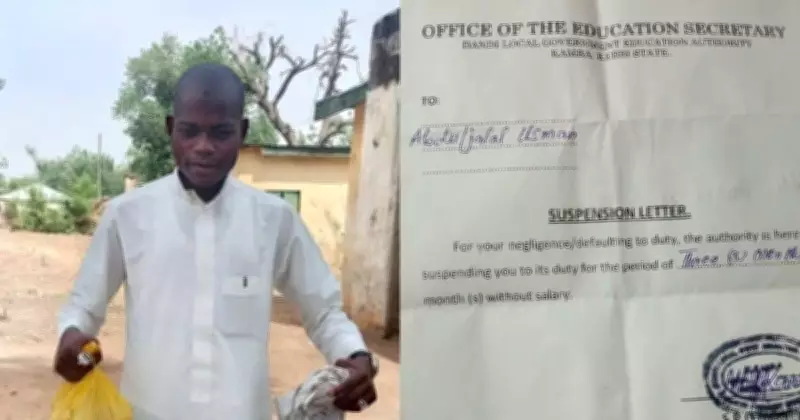
Kebbi Teacher Suspended for Rejecting Ramadan Palliative of One Bowl of Rice
A classroom teacher in Kebbi State has been handed a three-month suspension without salary after authorities deemed his refusal of the government's Ramadan palliative package as an act of insubordination. The incident has ignited widespread criticism and drawn attention to the nature of government aid during the holy month.
Suspension Letter Cites Negligence and Duty Default
Mr. AbdulJalal Usman received the suspension in a letter signed by the office of the Education Secretary for Dandi Local Government in Kebbi State. The letter accused Usman of negligence and defaulting to duty, leading to the three-month suspension without pay. It stated, "For your negligence/defaulting to duty, the authority is hereby suspending you to its duty for a period of three months without salary."
Video Rejection Leads to Punishment
According to the Foundation for Investigative Journalism (FIJ), the suspension serves as punishment for Usman's act of recording a video where he rejected the Ramadan palliative package distributed by the government. In the video, which circulated online, Usman expressed dissatisfaction with the state's offering of one bowl of rice and millet, criticizing authorities for being unconcerned about the plight of the poor.
Usman, who works morning to evening as a teacher in Kebbi, highlighted that his monthly salary is only ₦35,550. He was rewarded with just a bowl of maize, millet, and rice as a Ramadan palliative, which he deemed inadequate given the economic hardships faced by many.
Online Reactions and Sympathy Support
The suspension has quickly drawn strong reactions online, with observers labeling it as authoritarian, incompetent, and callous. Many expressed outrage over the government's response to a teacher speaking out against what he perceived as insufficient support.
In a heartening turn, Usman's situation garnered sympathy, and a good Samaritan reportedly sent him 150,000 naira as support for the Ramadan season, pending his return to work. This act of kindness underscores the community's support for the teacher amid the controversy.
Broader Context of Ramadan Palliatives in Nigeria
Since the start of the 2026 Ramadan season in February, state governments, particularly in Northern Nigeria, have distributed foodstuffs as palliatives to support Muslim adherents affected by the country's harsh economic reality. However, the nature of these palliatives has faced massive criticism.
For instance, in Sokoto State, the distribution of cassava flakes (garri) with groundnut, sugar, and water as palliatives sparked backlash, especially after the state budgeted 1 billion naira to provide 34,000 meals. This has raised questions about the efficiency and adequacy of government aid programs.
In other regions, such as the South West, Ramadan packages have been distributed by support groups of President Tinubu, including foodstuffs and basic groceries. This has divided public opinion, with some observers suggesting it may be an attempt to influence poor Nigerians ahead of the upcoming January 2027 elections.
The case of AbdulJalal Usman highlights ongoing debates about governance, welfare, and freedom of expression in Nigeria, as citizens grapple with economic challenges during religious observances.