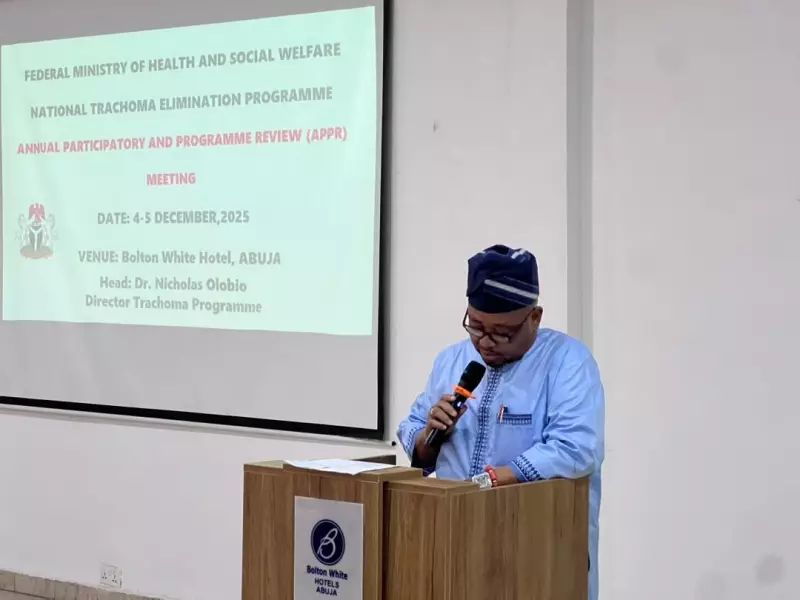
The Federal Government of Nigeria, in partnership with the international development organisation Sightsavers, has strongly reaffirmed its commitment to completely eliminate the blinding disease Trachoma from the country by the year 2030. This renewed pledge and the strategies to achieve it were the focal point of a high-level review meeting held in Abuja.
Significant Progress in the Fight Against Trachoma
During the recent Trachoma Quarterly Review Meeting, officials presented compelling data showcasing Nigeria's substantial advancement. Dr. Fatai Oyediran, the National Coordinator for Neglected Tropical Diseases (NTDs) at the Federal Ministry of Health and Social Welfare, provided a detailed breakdown of the achievements.
He revealed that initially, 463 Local Government Areas (LGAs) across the nation were mapped for the elimination programme, with 134 identified as endemic for Trachoma. Mass Drug Administration (MDA) campaigns were successfully scaled up to cover all endemic LGAs, with the exception of those in Borno State due to security challenges.
The most striking success is that MDA interventions have now been halted in 116 of the original 134 endemic LGAs, indicating that the disease is no longer a public health threat in those areas. This represents an impressive 87% reduction in the disease burden.
"At the inception of the programme, about 41 million Nigerians were at risk of going blind from Trachoma," Dr. Oyediran explained. "That figure has now been drastically reduced to less than four million. We have redeemed about 36 million people from the risk of this disease. We are on the verge of eliminating Trachoma in Nigeria." He projected that complete elimination could be achieved between 2028 and 2029.
Collaborative Efforts Driving Success
The Chairman of the National Trachoma Task Force, Professor Adamu Mohammed, attributed the progress to robust collaboration. He emphasised the joint efforts between the Federal Government, endemic State Governments, and supporting Non-Governmental Organisations (NGOs).
"We are progressing, we are really making progress," Professor Mohammed stated. "From inception to now, we have achieved almost 90% reduction in the prevention of blindness from Trachoma. Since it is a blinding disease, achieving a 90% reduction in prevention is quite a significant milestone."
He highlighted that the comprehensive strategy goes beyond drug administration. It includes surgical interventions for advanced cases and crucially, works to improve access to clean water and environmental sanitation, which are key to preventing the spread of the bacterial infection.
Sightsavers' Pivotal Role and Future Focus
Representing Sightsavers Nigeria, Technical Manager for Trachoma Grace Ajege, standing in for Country Director Professor Joy Shuaibu, commended the collective efforts. She outlined the organisation's 24-year journey in supporting Nigeria, starting with interventions in two northern states and eventually scaling up to 16 states.
"Nigeria is looking to eliminate this disease in the next four years, and we are hopeful that we will achieve this," Ajege said. Due to the remarkable progress, Sightsavers' work is now concentrated in only two remaining endemic states.
The organisation has supported the nationwide mapping of all 463 LGAs and provided services across approximately 116 LGAs. Sightsavers has also been a core member of the National Trachoma Task Force, providing essential technical and financial support to government partners.
"Trachoma is one of the low-hanging fruits in terms of delivering the elimination targets for NTDs in Nigeria," Ajege noted. With the finish line in sight, the focus is now on expediting plans, putting necessary systems in place, and conducting infection testing to guard against antimicrobial resistance or disease resurgence. Sightsavers remains committed to supporting Nigeria's goal of eliminating Trachoma by 2029.
The meeting concluded with a unified resolve to review 2025 activities and strategically plan for 2026, ensuring all momentum is maintained to finally rid Nigeria of this ancient scourge of blindness.