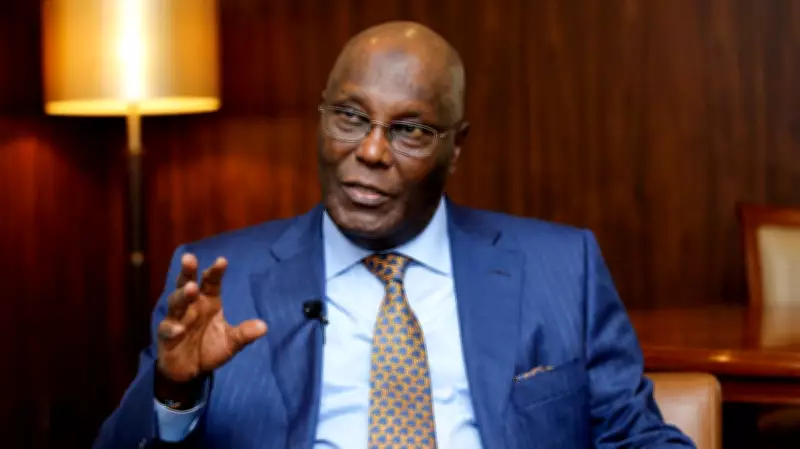
Atiku Rallies Opposition for 2027 Elections, Labels Tinubu Administration a Disappointment
Former Vice President Atiku Abubakar has issued a strong call to Nigerians, urging them to vote out the ruling All Progressives Congress (APC) and President Bola Tinubu in the upcoming 2027 general elections. In a recent interview on Arise TV, Atiku warned that failure to remove the APC from power would lead to disaster for the nation.
Atiku's Final Bid and Critique of Tinubu
Atiku disclosed that his expected participation in the 2027 presidential election may mark his final attempt at securing the nation's top office. He cited rising political stakes and the need to consolidate his extensive experience. "The stakes are higher because I believe that it will be my last... I think that's a fact," he stated.
Reflecting on his political journey, Atiku argued that his blend of experience and historical perspective uniquely positions him to lead Nigeria at this critical juncture. "I represent both the past and the future," he noted, emphasizing that while Nigeria has seen leadership across generations, expectations of younger leaders have often fallen short. He stressed that emerging politicians require mentorship and guidance from more experienced figures.
In a sharp critique of the current administration, Atiku described President Tinubu's tenure as deeply disappointing, particularly in economic management. "Tinubu has been a very bad president, to be honest with you. I didn't expect that from him... the way he governs the country, whether economically or otherwise, it's a disappointment," he said. Atiku added that any coalition candidate contesting against Tinubu would prevail, asserting, "The President is dead on arrival. Everything is wrong with Tinubu. I've not seen a government that is as bad as that of Tinubu."
Broad Opposition Coalition and Generational Mix
Atiku confirmed his role as a key initiator of a broad opposition coalition that includes members from multiple political parties. He argued that such alliances are essential to strengthen electoral viability and democratic competition. According to him, the coalition is driven by a shared vision and a collective resolve to challenge the Tinubu administration.
Addressing concerns about internal rivalries within the alliance, Atiku expressed confidence in the maturity of its members and the possibility of reaching consensus on a presidential candidate. He affirmed his willingness to support any candidate who emerges through either consensus or a democratic process, stating, "I will step aside for any candidate who emerges."
The coalition reflects a deliberate generational mix designed to ensure leadership continuity and provide a pathway for future political succession. On the issue of allowing the South to complete eight years in power, Atiku remarked, "You cannot balance the deficit. The North is behind for eight years."
Security Priorities and Corruption Allegations
If elected president, Atiku stated that his top priority would be security and law and order. He attributed Nigeria's persistent insecurity to an inadequate number of well-trained, well-funded, and properly equipped security personnel.
Responding to long-standing corruption allegations, Atiku dismissed them as politically motivated. He recounted, "Former President Obasanjo, under whom I served as vice president, set up a panel to probe me, knowing fully well that I had immunity. Despite that, I waived my immunity, and the trio of Bayo Ojo, then Minister of Justice, Nasir el-Rufai and Nuhu Ribadu came to my office. But at the end of the day, nothing was found against me." He added that his position on restructuring remains unchanged.
APC Defends Internal Processes, Rejects Blame for Opposition Crises
Meanwhile, the All Progressives Congress has pushed back against criticisms from opposition figures, with its leadership defending the party's internal processes and governance record. The National Chairman of the APC, Nentawe Yilwatda, and the party's National Secretary, Ajibola Basiru, asserted that the party's internal democratic processes remain intact and rejected suggestions that it is responsible for challenges within opposition parties.
APC's Stance on Opposition Instability
During a media chat, the APC leadership criticized what it described as recurring instability among some politicians, noting that individuals who secure electoral mandates on one platform sometimes defect to another amid internal disputes. Yilwatda said such actions point to weak ideological commitment and can undermine the broader political system.
He maintained that the APC remains focused on strengthening its structures and delivering governance rather than intervening in the affairs of rival parties. "As a political party, we cannot set up a department to manage opposition parties or prevent them from experiencing crises," he said, adding that political organizations should take responsibility for their internal cohesion and discipline.
Consensus-Building and Governance Record
On internal processes, Basiru emphasized that consensus-building remains central to the APC's decision-making framework, describing it as a "high expression of democratic participation" that accommodates a wide range of views. He explained that decisions are typically reached through consultations at the highest levels, including the National Executive Committee (NEC), with representation drawn from across the country.
The APC leadership also reaffirmed its commitment to periodic elections, internal reviews, and conventions as mechanisms for renewing mandates and sustaining competitiveness. Addressing broader governance concerns, the officials acknowledged socio-economic challenges affecting vulnerable populations, including access to healthcare and education, while pointing to ongoing government interventions aimed at expanding social protection and health insurance coverage.
They reiterated the party's position as a leading political force and urged opposition parties to strengthen their internal systems rather than attributing their difficulties to external factors.