
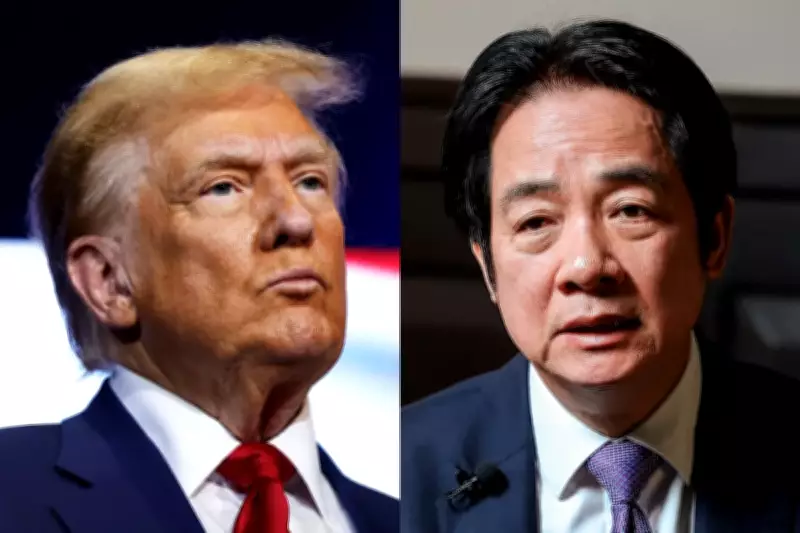
US President Donald Trump has signaled he is willing to speak directly with Taiwan's President Lai Ching-te, a move that would break decades of diplomatic precedent between Washington and Taipei. US and Taiwanese leaders have not held official presidential-level conversations since 1979, when the United States switched diplomatic recognition from Taipei to Beijing.
Trump's Remarks at Joint Base Andrews
Trump made the remarks while speaking to reporters at Joint Base Andrews, saying he would 'speak to him' when asked about a potential call with Lai, particularly in relation to a major US-approved arms sale to Taiwan. 'I'll speak to him,' Trump said, adding that his administration was managing the situation carefully and would 'work on that Taiwan problem.'
Context of the Comments
The comments come shortly after Trump's recent visit to Beijing, where Chinese President Xi Jinping reportedly warned about rising tensions over Taiwan, which Beijing considers part of its territory. Under the long-standing 'One China' policy, the United States acknowledges China's position on Taiwan but maintains unofficial relations with the island and is legally bound under the Taiwan Relations Act to provide defensive military support.
Diplomatic Implications
Any direct call between Trump and Lai would be viewed as a significant diplomatic shift and is likely to draw strong criticism from Beijing, which has consistently opposed any form of official contact between US and Taiwanese leaders. Taiwan, however, has continued to strengthen its defence ties with the United States amid increasing military pressure from China, including frequent air and naval activity near the island.
Trump's Description of Xi Meeting
Trump also described his recent meeting with Xi in Beijing as 'amazing,' while referring to Taiwan as a 'problem,' though he did not provide details on how his administration intends to proceed with pending arms sales. The US Congress has already approved a multi-billion-dollar arms package for Taiwan, underscoring Washington's continued security commitment to the island despite diplomatic constraints.
Taiwan's Response
In Taiwan, President Lai has maintained that communication channels with Washington remain open and has emphasized the need for continued military preparedness in response to regional tensions. China has condemned Lai's position, accusing him of pushing separatist views and attempting to alter the status quo in the Taiwan Strait.
The development highlights growing geopolitical tensions between the United States and China, with Taiwan remaining one of the most sensitive flashpoints in the relationship between both global powers.




