
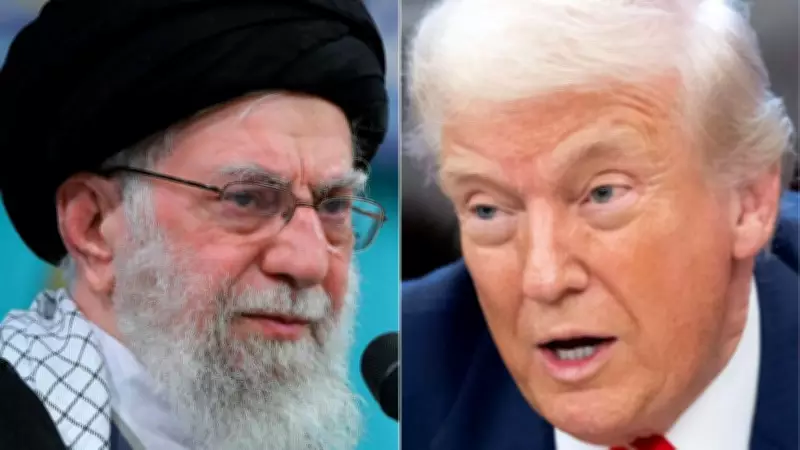
In a stark escalation of rhetoric, United States President Donald Trump has issued a direct warning to Iran's Supreme Leader, Ayatollah Ali Khamenei, stating he should be 'very worried' as the two nations edge toward their first formal diplomatic engagement since a U.S. military strike targeted Tehran's nuclear program last year. The high-stakes talks, scheduled for Friday in Muscat, Oman, come against a backdrop of sharply heightened military posturing and conflicting agendas that threaten to derail the fragile diplomatic process.
A Tense Prelude to Negotiations
Tensions between Washington and Tehran have intensified dramatically in recent weeks. This follows a deadly crackdown by Iranian security forces on widespread anti-government protests, which prompted President Trump to deploy a U.S. military 'armada' to the region and openly threaten retaliatory strikes. In an interview with NBC News on Wednesday, Trump was unequivocal in his message to the Iranian leadership: 'I would say he (supreme leader Ayatollah Ali Khamenei) should be very worried. Yeah, he should be.' The President framed his aggressive stance as support for the Iranian protesters, despite refraining from direct military intervention thus far.
Divergent Agendas and Deep-Seated Grievances
The upcoming talks, set to involve Iranian Foreign Minister Abbas Araghchi and U.S. Special Envoy Steve Witkoff, reveal a fundamental clash of priorities. U.S. Secretary of State Marco Rubio has outlined a broad American agenda, demanding negotiations cover not just Iran's nuclear ambitions but also:
- The development and proliferation of ballistic missiles.
- Iran's sponsorship of terrorist organizations across the Middle East.
- The Iranian government's treatment of its own citizens.
In stark contrast, reports from Iran's state-affiliated Tasnim news agency indicate Tehran intends to focus the discussions narrowly on its nuclear program and the lifting of crippling international sanctions as its primary objective. This disconnect echoes the collapse of previous indirect nuclear talks in mid-2025, which were abandoned following an Israeli strike on Iran and a subsequent U.S. bombing campaign.
Military Brinkmanship and Regional Fears
As diplomats prepare to meet, military incidents continue to raise the risk of open conflict. The U.S. military reported that an American aircraft carrier shot down an Iranian drone that 'aggressively approached' the vessel in the Arabian Sea on Tuesday. Hours later, two gunboats from Iran's Islamic Revolutionary Guard Corps threatened to board and seize a U.S.-flagged tanker in the strategic Strait of Hormuz. Iran's military has consistently warned that any attack would be met with an immediate and decisive response, targeting U.S. forces and assets throughout the region.
President Trump, reflecting on the 2025 U.S. strike, asserted its necessity for regional stability: 'If we didn't take out that nuclear, we wouldn't have peace in the Middle East... They were very, very afraid of Iran. They're not afraid of Iran anymore.' He further claimed intelligence indicated Iran sought to revive its nuclear program at alternative sites, vowing severe consequences if such efforts proceeded.
The Shadow of Protest and Digital Repression
The current crisis is deeply intertwined with Iran's domestic unrest. Trump first threatened military action last month as mass protests swept the nation, accompanied by a near-total nationwide internet blackout lasting nearly three weeks. While connectivity has been partially restored, digital rights experts warn that the outlook for Iranian internet freedom remains profoundly bleak, with the regime maintaining tight control over information flows.
Neighboring countries, fearful that a U.S.-Iran conflict could rapidly spread and destabilize the entire Middle East, are actively mediating to avert a catastrophic war. The talks in Muscat represent a critical, yet precarious, opportunity to de-escalate a situation marked by mutual distrust, military provocations, and fundamentally incompatible demands.




