
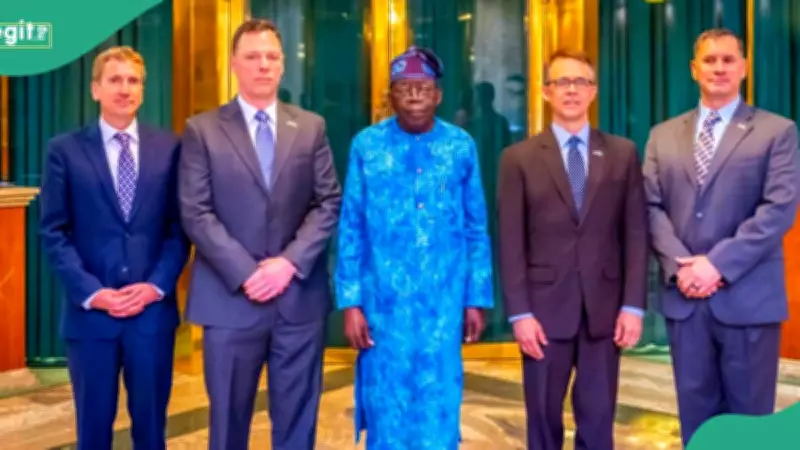
US AFRICOM Commander Engages in High-Level Security Dialogue with Nigerian Leadership
In a significant diplomatic and security engagement, General Dagvin Anderson, the Commander of the United States Africa Command (AFRICOM), conducted an official visit to President Bola Ahmed Tinubu and Nigeria's top security officials at the State House in Abuja. This strategic meeting, which took place on Sunday, February 8, 2026, underscores the ongoing military cooperation between the two nations amid Nigeria's complex security challenges.
Delegation Composition and Meeting Participants
The high-profile delegation from the United States included several key officials alongside General Anderson. Notable among them were Keith Heffern, the Charge D'Affairs at the U.S. Embassy in Nigeria, Ambassador Peter Vrooman, who serves as the Senior Foreign Policy Adviser for AFRICOM, and Command Sergeant Major Garric M. Banfield, the Command Senior Enlisted Leader at United States Africa Command. Their presence highlights the multifaceted nature of the bilateral security partnership.
On the Nigerian side, the meeting brought together the nation's foremost security and intelligence figures. Participants included Mohammed Mohammed, the Director-General of the National Intelligence Agency, Tosin Ajayi, Director General of the Department of State Services, and Nuhu Ribadu, the National Security Adviser. The military representation was equally robust, featuring General Christopher Musa (Rtd), the Minister of Defence, General Olufemi Oluyede, Chief of Defence Staff, Lieutenant-General Waidi Shaibu, Chief of Army Staff, and Lieutenant-General Emmanuel Uandiandeye, Chief of Defence Intelligence.
Official Documentation and Public Disclosure
The Special Adviser on Public Communication to the President, Bayo Onanuga, officially documented the visit by sharing photographs through his social media platform on X, formerly known as Twitter. This public disclosure provided visual confirmation of the engagement, showing President Tinubu and General Anderson in discussions alongside the assembled security chiefs. The images quickly circulated online, drawing immediate reactions from the Nigerian public and political commentators.
Public Reactions and Critical Perspectives
The announcement of the meeting sparked diverse reactions across social media platforms, reflecting the Nigerian populace's varied perspectives on security cooperation with foreign powers. Some commentators expressed skepticism about the practical outcomes of such high-level diplomatic engagements.
@idris_senator remarked, "Another high-profile visit, yet Nigerians continue to face insecurity, banditry, and underfunded security agencies at home. Diplomatic photo-ops are meaningless if they don't translate into concrete action to protect citizens. Leadership must prioritize results, not just high-level meetings."
@Everypolitics1 questioned the consistency of government messaging, stating, "They say security is fine in Nigeria. Then they run to America for security cooperation. Which one should we believe the speeches or the panic meetings."
Conversely, other voices highlighted the potential benefits of strengthened international collaboration. @Prince_Zamani09 commented, "This is the collaboration between the Nigeria government and the United States government we need. Fight against insecurity, build an economic system that will benefit both countries."
@Engr_imran_mk offered a critical perspective, noting, "Photo-ops with foreign generals won't fix Nigeria's collapsing security. While this meeting is happening in Abuja, Nigerians are being killed, kidnapped, and displaced daily across the country. What we need are real results on the ground, not high-profile visits and staged diplomacy. Security is judged by safety of citizens, not by handshakes and group photographs."
Context of US-Nigeria Security Relations
This visit occurs within a broader framework of increasing security collaboration between the United States and Nigeria. Recent years have seen the deployment of US security personnel to Nigeria, with a specific focus on counter-terrorism operations and enhanced coordination between American and Nigerian military forces. Historical precedents include President Donald Trump's authorization of airstrikes against insurgent groups in Nigeria, actions taken amid allegations of religious persecution and escalating violence.
Nigeria currently confronts multifaceted security threats, including activities by ISIS-linked terrorist organizations and various criminal gangs operating across the West African region. These challenges complicate national and regional security efforts, necessitating international partnerships and strategic alliances.
Additionally, concerns about national unity and separatist movements have been raised by US lawmakers, such as Riley Moore, who has warned that such developments could exacerbate risks for Christian communities in Nigeria's northern areas. Moore's fact-finding missions have involved engagements with church leaders, government officials, and displaced persons to address persistent insecurity issues.
The reactions from Nigerian citizens underscore a spectrum of opinions regarding national unity, the efficacy of security cooperation with foreign powers, and perceived governmental shortcomings in protecting the populace. As Nigeria navigates these complex security dynamics, high-level meetings like the one between General Anderson and President Tinubu represent critical junctures in shaping the future of bilateral defense relations and domestic security strategies.




