
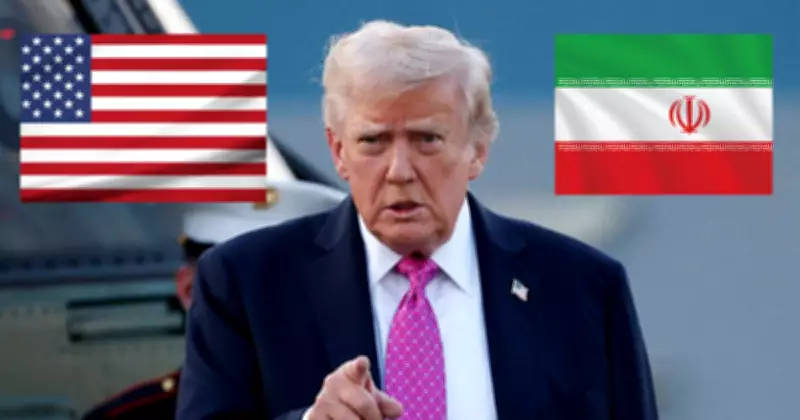
Trump Confirms US Navy Attack on Iranian Cargo Ship
President Donald Trump has confirmed that American naval forces fired a missile at and subsequently seized an Iranian-flagged cargo ship in the Gulf of Oman, marking a significant escalation in the ongoing conflict between the United States and Iran.
Details of the Naval Confrontation
In a post on his Truth Social account, President Trump shared that the US Navy intercepted the cargo ship named TOUSKA, which he described as being nearly 900 feet long and comparable in size to an aircraft carrier. According to Trump, the vessel attempted to bypass the US Navy ship USS SPRUANCE, which issued a "fair warning to stop."
When the crew refused to comply with the order to halt, American naval forces responded by firing a missile that struck the ship's engine room, effectively immobilizing it. This action allowed the US Navy to take control of the vessel. The incident was also detailed in a post on X by Secretary of War Peter Hegseth, who confirmed the military operation.
Background and Justification
President Trump stated that the cargo ship was under sanctions by the US Treasury due to its prior history of illegal activities. He emphasized that the United States now has custody of the ship, reinforcing American enforcement of international sanctions and maritime security protocols.
This development occurs amidst a complex backdrop of diplomatic negotiations and military posturing. Just last week, both nations agreed to a two-week ceasefire as they appeared close to reaching a peace deal. However, Trump had previously warned that if Iran did not agree to terms, America might resume military actions, including bombing campaigns.
Strategic Implications for the Strait of Hormuz
The seizure of the Iranian ship is closely tied to the ongoing battle for control of the Strait of Hormuz, a critical global shipping lane for oil transport. Iran recently announced it was closing the strait, contradicting Trump's earlier claim that Iran had agreed to "unconditionally reopen" it as part of negotiations.
According to Trump, Iran had also committed not to pursue nuclear weapons and to hand over its underground uranium enrichment facilities to the United States. The brief news of free passage through the Strait of Hormuz had positively impacted US stock prices and lowered crude oil prices below $90, as optimism grew about easing the global energy crisis.
However, Iran continues to exercise control over the strait, insisting on restricting passage for ships affiliated with America and Israel. In response, President Trump deployed a naval ship to enforce a blockade aimed at stopping all oil tankers from Iran following the collapse of peace talks.
Escalating Conflict and Future Talks
The conflict now appears to be entering a critical phase, with a second round of talks scheduled in Islamabad, Pakistan, after earlier negotiations failed to yield a compromise. US Vice President JD Vance stated that America has presented its final offer, indicating limited room for further diplomatic maneuvering.
This naval confrontation underscores the fragile nature of US-Iran relations and highlights the potential for further military engagements as both sides assert their strategic interests in the region. The seizure of the TOUSKA serves as a stark reminder of the ongoing tensions and the high stakes involved in controlling vital maritime routes.




