
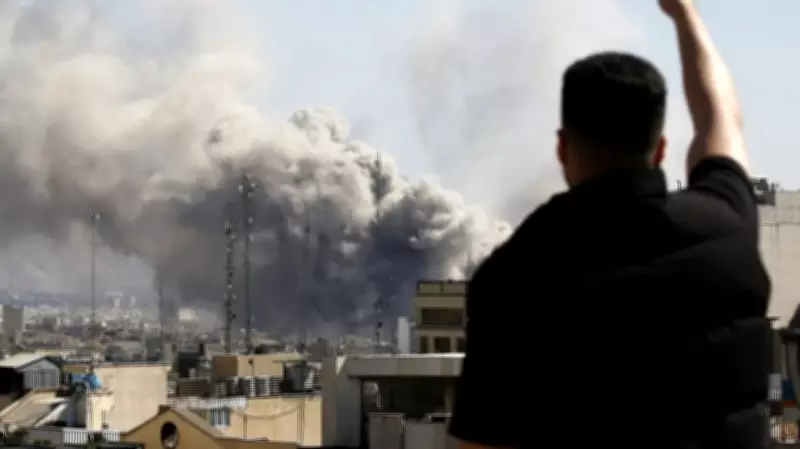
Strategic Analysis: Who Truly Benefits from a Potential U.S.-Iran War?
War without a clear strategy often leads to endless escalation with no viable exit plan. Is engaging in a conflict with Iran truly in the best interests of the United States? This is not merely a rhetorical question but a critical strategic inquiry. If we prioritize American interests—such as national security, economic stability, and global leadership—the answer demands more than mere slogans or patriotic fervor.
War is far more than a tweet, a press briefing, or a cable news graphic. It involves bloodshed, panicked markets, oil shocks, diplomatic isolation, and consequences that can outlast multiple administrations. Therefore, we must ask plainly: Why pursue war? If Iran recently offered a deal stronger than the previous nuclear agreement negotiated under President Obama, why abandon diplomacy? When containment and verification are feasible options, why resort to missiles?
States do not initiate wars due to a lack of alternatives; they choose war deliberately. The argument for war with Iran typically rests on three pillars: the nuclear threat, regional destabilization, and deterrence credibility. These are all serious concerns. Iran's nuclear ambitions are not fictional, and its regional activities through proxies in Lebanon, Iraq, Syria, and Yemen are very real. The fear that a nuclear-armed Iran could reshape Middle Eastern power dynamics overnight is also legitimate.
The Counterpoint: War May Accelerate Problems
However, here is the uncomfortable counterpoint: war does not automatically solve these issues. In fact, it might accelerate them. A military strike could damage nuclear facilities, but it cannot erase nuclear knowledge or extinguish national resolve. History shows that external attacks often strengthen hardliners and radicalize public opinion. In Tehran, a war would likely consolidate the very factions that Washington claims to oppose.
Then there is the economic shockwave. If the Strait of Hormuz is shut—even temporarily—the global consequences would be immediate and severe. Approximately one-fifth of the world's oil supply passes through this narrow corridor. A blockage would send energy prices soaring, spike shipping insurance, convulse supply chains, surge inflation, and stagger developing economies. Even the United States, now more energy-independent than in past decades, cannot fully insulate itself from global price shocks. A war destabilizing energy markets is not just a Middle Eastern issue; it could trigger a global recession.
Diplomatic Vulnerability and Global Perception
What about the closure of U.S. embassies across the region? This is not a sign of strategic dominance but of vulnerability. When diplomatic outposts close, influence shrinks. True power is not merely the ability to strike; it is the ability to shape outcomes without resorting to force.
So, who benefits from such a conflict? Some argue that Israel stands to gain. From Israel's perspective, Iran represents an existential threat due to Tehran's rhetoric, missile programs, and support for anti-Israel militias. For Israeli policymakers, preventing Iran from achieving nuclear capability is a survival strategy, making aggressive measures rational. However, what is rational for Israel is not automatically identical to what is rational for the United States.
Allies share interests, but not identical ones. The U.S. is a global power with obligations stretching from Europe to Asia, needing to balance China, manage Russia, maintain NATO cohesion, and protect global trade routes. A large-scale Middle Eastern war would divert attention, resources, and diplomatic capital from these priorities.
Influence Versus Control in Foreign Policy
This raises a politically sensitive question: Is Israel determining U.S. foreign policy direction? The honest answer is more nuanced than conspiracy or denial. Israel is a close ally with influence in Washington, similar to other strategic partners like Saudi Arabia, Ukraine, Taiwan, and NATO allies. Influence, however, is not control.
American foreign policy ultimately reflects U.S. institutional decision-making involving Congress, the executive branch, the Pentagon, and intelligence agencies. These bodies may align with Israeli assessments, but alignment is not the same as subordination. Yet, perception matters. If large segments of the global south—and even parts of the American public—believe Washington is fighting someone else's war, U.S. credibility erodes. Superpowers cannot afford reputational fragility.
War Duration and Regional Complexity
Another critical dimension is war duration. Modern wars rarely unfold as planned. The conflicts in Iraq and Afghanistan, intended to be swift and finite, became protracted and expensive. A war with Iran would likely be more complex, given Iran's large geography, military capability, and strategic position. Iran can retaliate asymmetrically through cyberattacks, regional proxies, missile strikes, and maritime disruption.
A prolonged conflict would stretch U.S. forces and deepen global uncertainty. The Middle East is already volatile with ongoing issues in Gaza, Lebanon, Syria, and Yemen. Adding a full-scale U.S.-Iran war risks turning localized fires into a regional inferno.
Geopolitical Causality and Restraint
Then there is the central accusation: The U.S. started the war! In geopolitics, causality is rarely simple. Escalations typically follow chains of actions and reactions—such as sanctions, covert operations, proxy conflicts, and retaliatory strikes. Each side frames itself as responding to aggression, insisting it had no choice. But for a global power, the threshold for "no choice" must be higher.
The United States possesses unmatched military capability and extensive diplomatic leverage. The world expects restraint proportionate to that power. When Washington chooses war, it does so not as a regional actor but as the central node of the global system.
Returning to First Principles: American Interests
This brings us back to first principles: What is in America's best interest? If the objective is preventing nuclear proliferation, diplomacy with enforcement mechanisms may be more durable than open conflict. If the goal is deterring regional aggression, calibrated pressure combined with alliances might be more sustainable than invasion. If demonstrating strength is the aim, strategic patience can sometimes project more strength than impulsive escalation.
None of this implies appeasement. Deterrence and credibility matter, but credibility is not measured solely by willingness to bomb. It is measured by coherence, consistency, and long-term strategic clarity. War with Iran could temporarily degrade capabilities, but it might also ignite wider instability, spike global energy prices, weaken U.S. alliances outside the region, and entrench anti-American sentiment for a generation. This is not a trivial trade-off.
Philosophical Questions and Strategic Judgments
The deeper question is philosophical: Is America's role to manage instability through calibrated engagement, or to attempt decisive military solutions to complex political problems? Two decades of post-9/11 wars suggest that military superiority does not automatically translate into political success.
A great power must distinguish between urgent threats and manageable ones, differentiate between existential risks and strategic irritants, and know when escalation serves others more than itself. The Middle East is already on edge. If the Strait of Hormuz is blocked and embassies close, the world economy will shudder, necessitating serious reflection.
War should be the last instrument, not the first reflex. If a stronger diplomatic deal was indeed available, abandoning it for conflict demands rigorous justification. If such a deal was flawed or unverifiable, that case must be transparently made. Democracies owe their citizens clarity before committing them to war.
In the end, the measure of foreign policy is not emotional satisfaction but outcome. Does war make the United States safer, stronger, and more prosperous? Or does it multiply enemies, strain alliances, and destabilize markets? These are not partisan questions; they are strategic ones. And strategy, unlike rhetoric, is judged by its consequences.




