Federal High Court Judge Orders Sowore's Lawyer to Kneel in Court, Counsel Refuses
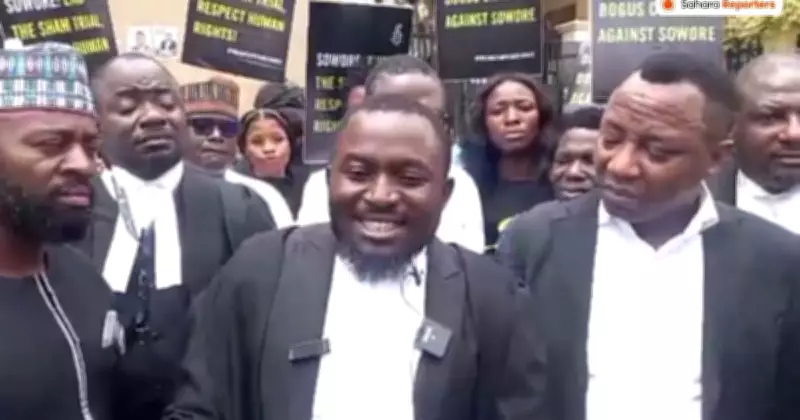
A dramatic confrontation unfolded at the Federal High Court in Abuja on Monday when Justice Mohammed Umar ordered a lawyer representing activist Omoyele Sowore to kneel in court as punishment for contempt. The counsel, Marshal Abubakar, firmly refused the directive, stating that such a punishment is unknown to Nigerian law and violates established legal procedures.
Courtroom Tension Escalates During Sowore's Trial
The incident occurred during proceedings in the ongoing case involving Sowore, the publisher of Sahara Reporters and former presidential candidate, who is being prosecuted by the Department of State Services (DSS). The tension began when Sowore's legal team requested a longer adjournment after the prosecution announced it had closed its case, which appeared to irritate Justice Umar.
The situation escalated further when Sowore addressed the court and declared his intention to continue traveling across Nigeria to mobilize citizens against President Bola Ahmed Tinubu ahead of the 2027 general election. This comment prompted lead prosecutor Adeolu Kehinde, SAN, to interrupt and attempt to stop Sowore from continuing his remarks.
Lawyer's Refusal and Judicial Reaction
At this point, Sowore's lead counsel Marshal Abubakar stood up to intervene, delivering what witnesses described as a passionate and forceful argument. Abubakar suggested that the Federal Government was determined to silence Sowore and possibly send him to prison to prevent his participation in the political process before the next election cycle.
Despite Justice Umar having signaled that he did not want further arguments from the defense, Abubakar continued speaking, prompting the judge to lose his temper. In a stunning moment that shocked courtroom observers, Justice Umar ordered the lawyer to step forward and kneel as punishment for what he described as contempt of court.
Abubakar refused the order in what witnesses described as a muffled but firm voice, telling the judge that kneeling before a judge was not recognized as a lawful punishment under Nigerian law and that he could not comply with such an instruction.
Legal Framework and Contempt Procedures
Contempt of court proceedings are recognized under Nigerian law, but they typically involve formal procedures and established penalties such as fines or detention. Physical acts of submission like kneeling are not listed as standard judicial sanctions in the country's legal framework, making Justice Umar's order particularly unusual.
Several senior members of the bar quickly rose from their seats and began appealing to the judge to calm down, warning that the situation was becoming unnecessarily tense. With the courtroom atmosphere growing increasingly strained, Justice Umar eventually decided to halt the proceedings and adjourned the case to April 13, 2026, though the defense team protested the date as inconvenient and too distant given the trial's stage.
Nigerian Bar Association Responds
The Nigerian Bar Association (NBA) has since weighed in on the incident, expressing deep concern about reports from the courtroom. In a statement signed by NBA President Mazi Afam Osigwe, SAN, the association emphasized that no judge has the power under Nigerian law to order a lawyer to kneel in court.
The courtroom is a temple of justice, governed by law, procedure and decorum, the NBA stated, noting that while judges have authority to maintain discipline during proceedings, such powers must be exercised strictly within established legal limits.
The association acknowledged that courts possess the power to punish contempt but emphasized that such powers are guided by clearly defined legal procedures designed to protect fairness and the dignity of everyone involved. According to the NBA, directing a lawyer or any person to kneel in court is not a recognized judicial sanction and does not align with accepted standards of judicial conduct.
Broader Context and Public Reaction
Legal observers and civil society have closely watched Sowore's trial for years. The activist has faced multiple legal battles with the Nigerian government since 2019, stemming from his political activism and public criticism of government officials. Monday's incident has attracted significant attention within legal circles because courtroom decorum and judicial authority are usually handled through formal contempt procedures rather than spontaneous disciplinary orders.
The dramatic exchange has also sparked conversation online, where Nigerians are debating the limits of judicial authority, courtroom conduct, and the rights of lawyers to challenge orders they believe violate the law. Many social media users have expressed concern about what they perceive as overreach by judicial authorities, while others have emphasized the importance of maintaining proper courtroom decorum.
The NBA reminded lawyers of their own responsibility to maintain professionalism in court, even when disagreements arise. The legal profession thrives on a delicate but essential balance between the Bar and the Bench, the statement said, urging calm while encouraging that any grievances be handled through proper institutional and disciplinary channels.