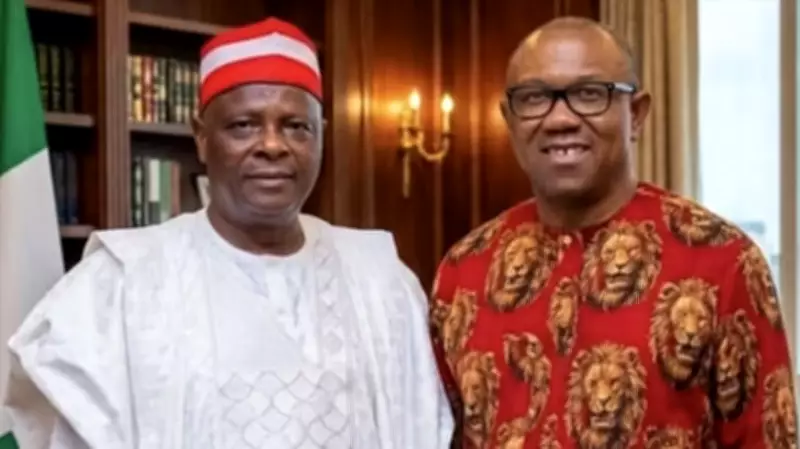
With the political realignments that have occurred in Kano in recent months, the Obi/Kwankwaso alliance faces a tough hurdle in the state despite the grassroots appeal of the Kwankwasiyya Movement, MURTALA ADEWALE writes.
The emergence of the Obi/Kwankwaso political movement has revived national conversations about the possibility of a formidable opposition coalition capable of challenging the ruling All Progressives Congress (APC) ahead of the 2027 general election. For many Nigerians who had gradually become disillusioned with the prospects of a credible alternative platform, the alliance between former governor of Anambra State, Peter Obi, and former governor of Kano State Rabiu Musa Kwankwaso represents a fresh attempt to reshape the country's political landscape.
In recent months, supporters of the two political heavyweights have intensified efforts to build a broad-based movement aimed at mobilising Nigerians across regional, ethnic and religious lines. The political mobilisation group, popularly referred to as the OK Movement, emerged shortly after Obi and Kwankwaso abandoned the opposition coalition under the African Democratic Congress (ADC) and embraced the National Democratic Congress (NDC) as their new political platform. Since then, the movement has gained visibility across several states and local councils through grassroots mobilisation, political meetings and social media campaigns aimed at promoting a possible Obi/Kwankwaso presidential ticket for the 2027 elections.
Although the Independent National Electoral Commission (INEC) has yet to officially lift the embargo on political campaigns, the movement has continued to consolidate support around the idea of a united opposition capable of confronting the APC in the next general election. Supporters of the alliance believe the partnership between Obi and Kwankwaso presents a rare opportunity to bridge the long-standing political divide between Southern and Northern Nigeria. To them, the alliance reflects a growing national consensus that competence, accountability and good governance should take precedence over regional considerations.
The Kano Factor
The debate surrounding the Obi/Kwankwaso alliance is particularly intense in Kano State, where Kwankwaso's enduring influence through the Kwankwasiyya Movement remains a major political factor. For more than two decades, Kwankwaso has built a strong political structure in Kano that enjoys widespread grassroots support across the state's 44 local councils. The Kwankwasiyya Movement, known for its red cap symbolism and populist appeal among ordinary citizens, especially the talakawa, has remained one of the most organised political movements in Northern Nigeria. The movement has consistently demonstrated its ability to mobilise voters, particularly during elections.
Kwankwaso's supporters interpreted his recent declaration that he was prepared to serve as Obi's running mate under the NDC platform as a sign of political maturity and willingness to place national interest above personal ambition. Speaking during a live television interview, Kwankwaso argued that Nigeria's immediate priority should be competent leadership rather than endless debates over whether power should remain in the North or South. “What is key now is not whether the Presidency comes from the North or the South. What is key is having quality leadership; people who are determined and committed to giving the country the leadership it deserves,” he said.
He further explained that leaders within the opposition alliance had agreed that the South should complete another term in office before power returns to the North. According to Kwankwaso, such an arrangement was necessary to stabilise the political atmosphere and strengthen opposition unity ahead of the next general election.
Challenges Ahead
Political observers, however, believe Kano may become the ultimate test of the viability of the Obi/Kwankwaso alliance. While Kwankwaso's political dexterity in Kano is widely acknowledged, analysts argue that the political environment heading into 2027 differs significantly from the circumstances that shaped the 2023 elections. One of the biggest challenges confronting the alliance is the growing strength of the ruling APC in Kano following the defection of Governor Abba Kabir Yusuf and several influential Kwankwasiyya loyalists to the ruling party. The development dramatically altered the political balance in Kano and weakened the once cohesive opposition structure that powered Kwankwaso's dominance during the 2023 presidential election.
During the election, Kwankwaso secured 997,279 votes in Kano State, winning 36 local councils, while President Bola Ahmed Tinubu of the APC polled 517,341 votes across six local councils. Peter Obi, who contested under the Labour Party, received 28,513 votes in the state. Supporters of the OK Movement insist that combining Obi's growing national appeal with Kwankwaso's grassroots structure in Kano and parts of the North could produce a formidable opposition capable of upsetting the APC in 2027.
But the political space has changed considerably since then. For instance, the Labour Party, which served as the platform for Obi's meteoric rise in 2023, has been weakened by prolonged internal crises that forced several prominent members, including Obi himself, to leave the party. Likewise, Kwankwaso's political grip on Kano is believed to have weakened following the defection of Governor Abba Yusuf and other influential loyalists to the APC. Supporters of the APC therefore maintain that the ruling party has become stronger in Kano through strategic political realignments and consolidation of power structures.
The APC currently controls the Kano State House of Assembly with 38 out of 40 members, all 44 local council chairmanship positions, 23 of the 24 House of Representatives seats from Kano State and two of the three senatorial seats. Analysts are also questioning whether Kwankwaso's support base is still as solid as it was during the 2023 election, even as they believe that the power of incumbency may heavily favour the APC at both the federal and state levels. “With access to government structures, political appointees and established networks across the country, the ruling party is expected to deploy significant resources towards retaining power in 2027,” an analyst said.
Kwankwasiyya Movement Responds
Despite these obvious advantages, the spokesperson for the Kwankwasiyya Movement, Dr. Habibu Mohammad, believes the Obi/Kwankwaso ticket will send President Bola Ahmed Tinubu packing from the Presidential Villa. He also dismissed claims that the recent defections would negatively impact the Obi/Kwankwaso ticket. According to him, Kwankwaso's political strength transcends party platforms because his relationship with the people is rooted in grassroots mobilisation and social connection. “If you examine what played out during the 2023 elections and how we won, you will not doubt Kwankwaso's capacity to return in 2027. We joined the NNPP within six months and were able to take over the state. That tells you that in Kano, it is not just about the party; it is about the people,” Mohammad said.
He argued that the Kwankwasiyya ideology remains deeply connected to the aspirations of ordinary citizens, particularly the talakawa, insisting that the movement's appeal lies in its perceived commitment to social transformation rather than party labels. He further pointed out that political coalitions and party mergers have historically shaped Nigeria's political evolution. Mohammad said the formation of the APC itself was the product of a coalition of political interests aimed at challenging the then ruling Peoples Democratic Party (PDP). He noted that Kwankwaso played a significant role in strengthening the APC during its formative years and argued that similar political realignments should not be interpreted as signs of weakness.
Academic Perspectives
However, a political analyst at Bayero University Kano, Dr. Saidu Dukawa, said Kwankwaso's frequent migration between political parties may have damaged his credibility among sections of the electorate. Dukawa said many Nigerians are becoming increasingly frustrated with politicians who frequently change political parties in pursuit of personal ambition. “Well, actually, I don't think the NDC or Kwankwaso will be the determining factor in the next election. I think if the APC has anything to worry about, it is the general dissatisfaction among ordinary Nigerians regarding economic hardship and insecurity,” he said.
Dukawa maintained that while public frustration with governance could affect the APC, Kwankwaso's repeated defections might have alienated some of his supporters. “Perhaps if he had remained in the NNPP and continued the struggle there, he would have made a greater impact. Leaving the NNPP caused him to lose a section of his followers, and moving again from ADC to NDC created further uncertainty,” he said. The university don added that many supporters now perceive Kwankwaso's decisions as increasingly driven by personal political calculations rather than collective consultation with his followers.
According to him, the perception that politicians frequently switch parties without adequately carrying supporters along could weaken public trust in opposition movements. He also warned that repeated political migrations might create uncertainty among voters who desire ideological stability and consistency.
Economic Factors and Government Performance
Beyond the issue of defections, analysts believe the economic situation in the country could become a major factor in determining the outcome of the 2027 elections. Unemployment, insecurity and the high cost of living have generated frustration among many Nigerians, particularly young people and low-income earners. Political analysts said that opposition parties might capitalise on the growing public dissatisfaction to build momentum against the APC. But supporters of the ruling party argued that the ongoing economic reforms and governance initiatives by the Tinubu administration would eventually yield positive results before the next election.
A political aide to Governor Yusuf, Kabiru Dakata, posited that the administration's performance in infrastructure development, human capital investment and governance reforms would guarantee the re-election of President Tinubu, Governor Yusuf and other APC candidates. Dakata stated that APC remains politically formidable in Kano despite the growing opposition alliance. He said: “Nothing can affect Abba Kabir Yusuf's chances of winning the 2027 election. His performance is unprecedented and the people of Kano are with him.”
Dakata further argued that the defection of the governor and several influential stakeholders to the APC has significantly weakened the Kwankwasiyya Movement. He maintained that many of the grassroots structures previously associated with Kwankwaso are now aligned with the APC government in Kano. “Kwankwaso is not working alone. His strength lies in structures such as CRC, Kano Proper, Lafiya Jari and Kwankwasiyya. Most of those structures are now with Governor Abba Kabir Yusuf,” Dakata stated. He also predicted that internal rivalry within the opposition parties could undermine the Obi/Kwankwaso alliance before the 2027 elections.
Thus, whether the Obi/Kwankwaso alliance can successfully rebuild opposition momentum in Kano and upset the ruling party, or the APC's growing consolidation of political structures will result in victory for the party, remains to be seen.