Niger Delta Protesters Storm NASS, Oppose Calls to Decentralize Pipeline Surveillance Contract
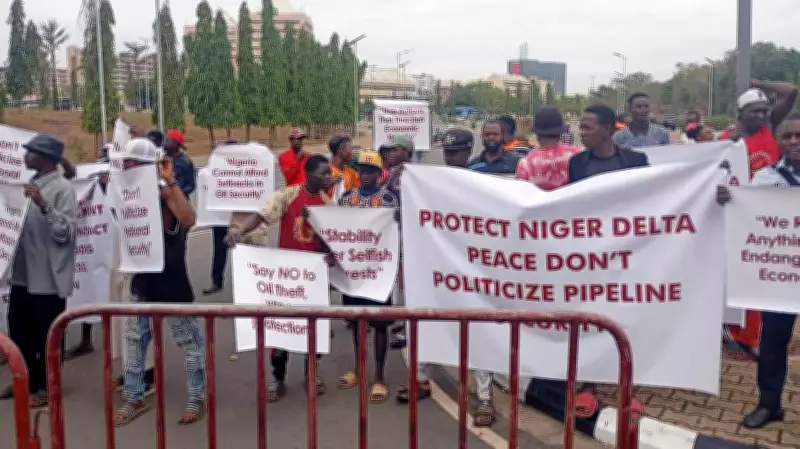
Protesters under the banner of concerned Niger Delta stakeholders on Tuesday stormed the National Assembly, vehemently opposing calls to decentralize the pipeline surveillance contract currently managed by Tantita Security Services Nigeria Limited. The demonstrators labeled the agitation for a review of the contract framework as self-serving, issuing a stark warning that any attempt to alter the existing arrangement could reverse the significant security gains achieved in the region.
Placards and Public Outcry
During the protest, the demonstrators displayed a series of placards with powerful inscriptions, including "Nigeria cannot afford setbacks in oil security," "Don’t destroy Niger Delta peace for self-interest," "Nobody can threaten 2027 election based on pipeline contract," and "say no to disruption of national security efforts." These messages underscored their deep concerns about potential disruptions to national stability and economic security.
Historical Context and Security Gains
Speaking on behalf of the protesters, Hon. Duduke Ebitimi provided a detailed historical context, recalling that before Tantita's engagement, the Niger Delta was plagued by widespread criminal activities. These included rampant pipeline vandalism, extensive oil theft, frequent kidnappings, and pervasive sea piracy, which collectively slashed crude oil output and severely undermined the national economy.
Ebitimi elaborated, "The national economy collapsed following increasing unchecked activities of oil thieves and pipeline vandals. In fact, production vices were reported to be high, making daily production output hover within 800,000 to 900,000 barrels per day. These local and international oil thieves almost shut down the country, whose survival depends solely on oil flowing from the Niger Delta."
He further described the environmental devastation, noting that illegal oil bunkering and numerous illegal refineries turned the region into a hub of pollution, with thick smokes causing environmental hazards and health issues like cancer. Social unrest was rampant, with frequent protests disrupting major roads such as the East-West Road.
Benefits of the Current Contract
However, Ebitimi emphasized that the surveillance contract has been instrumental in restoring stability. It has improved oil production to over two million barrels per day and significantly curtailed illegal bunkering activities across the region. According to the group, this initiative has also created employment opportunities for thousands of youths, strengthened collaboration with security agencies, and enhanced the protection of critical oil infrastructure.
Rejection of Decentralization Calls
The group firmly rejected calls for decentralization, asserting that those advocating for this move lack the necessary capacity and are driven by personal interests rather than the collective good of the Niger Delta. They cautioned against politicizing the contract or linking it to the 2027 general elections, urging the Federal Government and the Nigerian National Petroleum Company Limited (NNPCL) to sustain and expand the current arrangement.
"We want to state unequivocally that the individuals agitating to alter the framework of the contract are motivated by greed and jealousy and do not represent the interest of the Niger Delta. Nobody changes a working system. As stakeholders in the Niger Delta and Nigeria, we have seen the benefits of the existing framework to peace, security, and economy of the Niger Delta and Nigeria, and we want the same system to continue unhindered," the group declared.
Capacity and Merit-Based Arguments
They added, "We have also evaluated the characters of people demanding decentralization of the contract and we make bold to say that they lack the capacity, the discipline, qualities, and the organisation required to manage any part of the contract. We want to remind these individuals that the pipeline surveillance contract is not a gift to Tantita and Tompolo. It is a serious security contract that goes through a bidding process. Tantita and Tompolo won it on merit having displayed the capacity, discipline, and organisation to handle it. Those who need contracts should put themselves together and bid for others in various sectors of the economy."