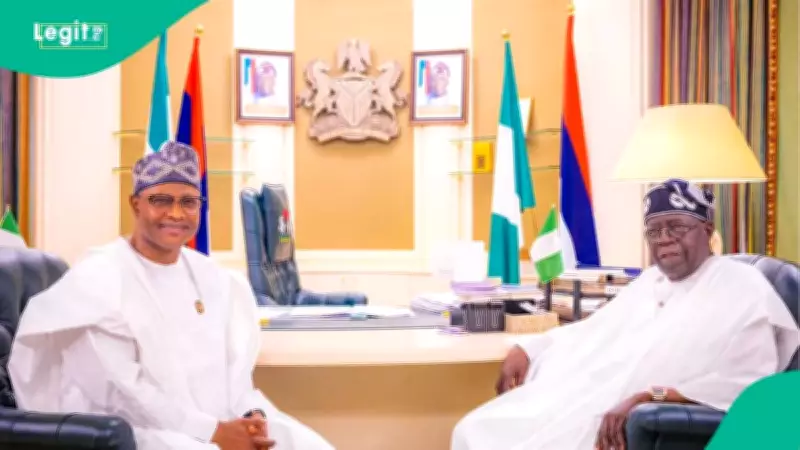
Former Presidential Aide Reveals Protocol Breach During Governor's Visit
Bashir Ahmad, who served as an aide to the late President Muhammadu Buhari, has brought attention to what he describes as a significant protocol breach by President Bola Tinubu during a meeting with Kaduna State Governor Uba Sani. The former presidential aide shared photographic evidence showing President Tinubu seated in the visitor's chair rather than his customary presidential seat, a departure from established presidential protocol that has ignited widespread discussion across Nigeria's political landscape.
Symbolic Gesture or Protocol Violation?
According to Ahmad's detailed explanation, President Tinubu deliberately chose to sit in the visitor's chair positioned directly across from Governor Uba Sani during their official meeting at the presidential office. This arrangement represents a notable deviation from standard presidential protocol, where the president typically occupies the primary seat while visitors sit opposite. Ahmad interpreted this unconventional seating arrangement as a deliberate symbolic gesture intended to demonstrate the governor's special status as a personal confidant and trusted political ally within the president's inner circle.
The former aide elaborated on his interpretation through social media, stating: "The President broke the normal protocol by sitting together with his guest in the visitor's chair. I believe the President broke the tradition in such a symbolic way to show that Governor Uba Sani is truly his personal person." This statement has prompted extensive analysis regarding the underlying political implications and the nature of relationships within Nigeria's current administration.
Nigerians Divided Over Presidential Action
The revelation has triggered diverse reactions across Nigerian social media platforms, with commentators expressing polarized views about the protocol breach and its potential significance:
- Hon Nuhu Sada emphasized substantive governance over symbolic gestures: "Leadership is measured less by seating arrangements and more by the outcomes that affect citizens' lives."
- Christophe praised the presidential gesture as meaningful: "By breaking protocol and sitting in the visitor's chair, President Tinubu wasn't just being informal; he was sending a message of trust, unity, and personal endorsement."
- Aliyu Abubakr expressed skepticism about political motivations: "The moment you become a sellout just to impress someone that will later leave you hanging out to dry, then ultimately you have no focus in life."
- Ozo highlighted historical connections: "Their friendship was forged in the trenches of democratic struggle. Shared history explains the ease. He calls him 'The Comrade Governor'."
- Mister AY speculated about succession implications: "That man sitting with Jagaban may be the next president of Nigeria. I'm sure PBAT will not be passive when it comes to picking his successor, unlike Buhari."
- Ohis noted enduring political bonds: "Democracy was built shoulder to shoulder. That bond doesn't disappear with the office. It remains evident. Tinubu acknowledges this every time he is with Uba Sani."
Historical Context and Political Relationships
Observers have noted that the relationship between President Tinubu and Governor Uba Sani extends beyond current political alignments, with roots in Nigeria's democratic development. Their shared history during political struggles has created a bond that appears to transcend conventional political formalities. This context helps explain why President Tinubu might deliberately break protocol to acknowledge their longstanding connection, though the action has nevertheless generated controversy regarding appropriate presidential conduct.
The protocol breach discussion emerges alongside other notable developments in Nigeria-US relations, including recent acknowledgments of First Lady Oluremi Tinubu's participation in international events and ongoing collaborations addressing security challenges in northern Nigeria. These parallel developments contribute to a broader understanding of the current administration's diplomatic engagements and domestic political dynamics.
As the debate continues, political analysts are closely monitoring how such symbolic gestures might influence perceptions of political loyalty, leadership style, and relationship dynamics within Nigeria's complex political ecosystem. The incident raises important questions about when protocol serves national interest versus when personal relationships might appropriately influence official conduct in Nigeria's political arena.