The year 2025 marked a definitive turning point in Nigerian politics, as a new generation of leaders stepped out of the shadows to challenge entrenched systems. Moving beyond the label of "leaders of tomorrow," these five young politicians confronted godfatherism, systemic rot, and intense political warfare to become some of the most powerful voices in the country.
The Vanguard of a New Political Era
As 2025 draws to a close, the landscape of power in Nigeria has been fundamentally altered. A surge of young, dynamic figures has successfully navigated high-stakes legal battles and governance crises, proving that influence is no longer solely the preserve of political veterans. Their stories of resilience and strategic maneuvering have captivated the nation.
1. Siminalayi Fubara: The Defiant Governor
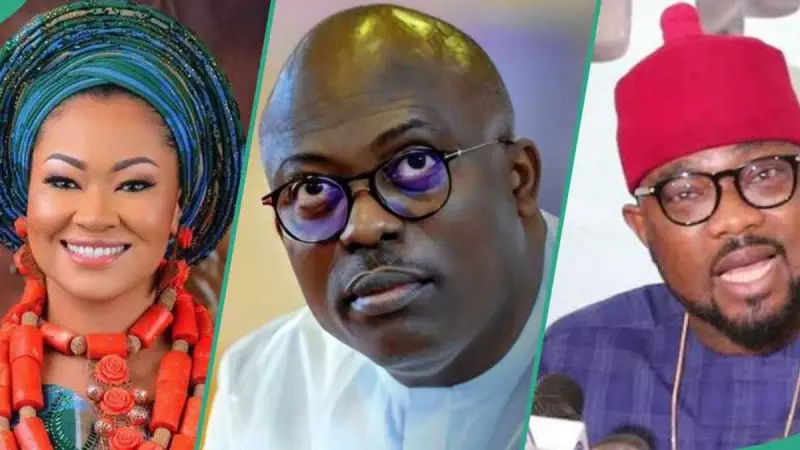
At 43, Governor Siminalayi Fubara of Rivers State became the ultimate symbol of political autonomy in 2025. His year was defined by an epic struggle that began as a local rift with his predecessor, Nyesom Wike, and escalated into a national referendum on the corrosive "godfather" system in Nigerian politics.
Fubara's administration faced unprecedented hurdles, including a fractured State Assembly and attempts to cripple his government by withholding statutory funds. The political drama reached a climax in late 2025 when Fubara executed a stunning defection from the Peoples Democratic Party (PDP) to the All Progressives Congress (APC). This strategic pivot followed his return from a controversial suspension, a period during which President Bola Tinubu declared a state of emergency in Rivers State due to severe governance deadlocks and security concerns.
Despite immense pressure, Fubara consolidated power by aligning with grassroots movements and pushing forward massive infrastructure projects. His "People First" mantra and his success in challenging the very machinery that brought him to power have made him a hero to many Nigerian youths.
2. Natasha Akpoti-Uduaghan: The Unbowed Senator
Senator Natasha Akpoti-Uduaghan, 42, solidified her status as Nigeria's most formidable female politician in 2025, but her path was fraught with conflict. Her year was dominated by a historic and explosive clash with Senate President Godswill Akpabio.
The friction, which started with a seating arrangement dispute in February 2025, intensified after she accused the Senate leadership of deliberate victimization. In March 2025, the Senate suspended her for six months based on an Ethics Committee report, citing alleged misconduct and insubordination. The suspension, which included the withdrawal of her salaries and security detail, sparked international outrage over the treatment of women in politics.
Although a Federal High Court later ruled the suspension "excessive and unconstitutional," the Senate appealed, leading to a protracted legal battle that reached the Supreme Court by December 2025. Barred from the chambers for much of the year, her influence paradoxically grew, transforming her into a global symbol of resistance against legislative intimidation.
3. Olubunmi Tunji-Ojo: The 'Star Boy' Minister
Widely hailed as the "Star Boy" of President Tinubu’s cabinet, 42-year-old Olubunmi Tunji-Ojo, the Minister of Interior, turned his ministry into a beacon of efficiency in 2025. His signature achievements included the complete digitization of the passport application process and a radical overhaul of the Nigerian Correctional Service.
His influence, however, faced tests through intense scrutiny over contract transparency and the monumental task of securing Nigeria’s vast borders amid regional instability. By delivering tangible results like slashing visa processing times, Tunji-Ojo demonstrated that youthful energy could overcome deep-seated bureaucratic inertia.
4. Monday Okpebholo: The Edo Bridge-Builder
Governor Monday Okpebholo entered 2025 as the man who returned the APC to power in Edo State after a contentious 2024 election. His first full year in office was a trial by fire, requiring him to prove his administration was more than a return to old guard politics.
He faced significant criticism, including viral social media clips questioning his oratory and policy depth. Unfazed by the digital noise, Okpebholo focused on a "silent revolution" of rural electrification and road construction. His influence stems from his ability to bridge the traditional APC structures with the pragmatic needs of Edo voters, positioning him as a key figure in the emerging calculations for the 2027 general elections.
5. Mohammed Bello El-Rufai: The Policy Influencer
At 37, Mohammed Bello El-Rufai, the first-term APC Representative for Kaduna North, established himself as a thoughtful voice in the House. As Chairman of the House Committee on Banking, he sponsored key bills and participated in critical hearings.
Beyond legislation, he shaped policy discourse through public forums. In a notable address at the CBN Legal Services Retreat in late 2024 (reported in January 2025), he championed the Central Bank’s independence, describing it as a "cornerstone of economic stability." He urged transparent communication on policies like currency redesign and called for collaboration to safeguard the institution's autonomy.
A Landscape Transformed
The collective impact of these five politicians in 2025 has undeniably reshaped Nigeria's political terrain. They have demonstrated that with strategic grit, a connection to the grassroots, and a willingness to confront powerful systems, a new generation can claim its seat at the table of national influence. Their journeys through defections, suspensions, legal wars, and policy reforms have set a new template for political engagement in the Fourth Republic.