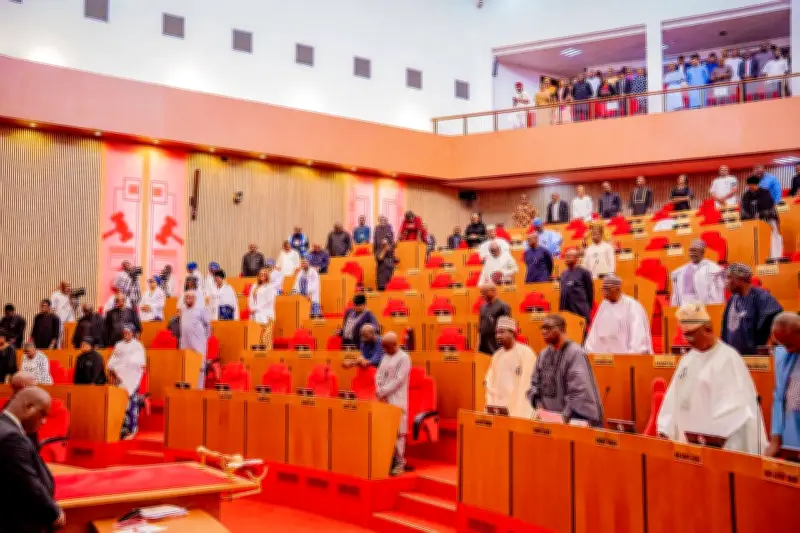
Senate Minority Leader Abba Moro has expressed strong opposition to the proposed establishment of state police in Nigeria, arguing that the initiative would not effectively address the country's security challenges. Speaking to journalists at the National Assembly on Wednesday after plenary, the lawmaker representing Benue South Senatorial District asserted that governors advocating for state police are driven by personal interests rather than a genuine desire to improve security.
Concerns Over Funding and Potential Abuse
Moro, a member of the Peoples Democratic Party (PDP), raised concerns about the financial sustainability of state police forces. He noted that many state governments already struggle to fund existing informal security outfits, casting doubt on their ability to finance a full-fledged police force. He warned that state police could be compromised in the same manner as state independent electoral commissions, which he said have been used to endanger democracy.
“How are we sure, like I used to say, that the state police will not be put to use the way the state independent electoral commission has been put in recent times, endangering our democracy? I think at the moment, those asking for state police are asking for it as an institution to put to whatever use they want, not necessarily as an institution to confront the menace of insecurity,” Moro stated.
Benue State Example: Unpaid Stipends and Lack of Equipment
To illustrate his point, Moro referenced the situation in Benue State, where he alleged that the government had failed to consistently pay a monthly stipend of ₦15,000 to members of local security outfits. He also highlighted the lack of necessary logistics and equipment to combat armed attacks.
“In my state, we have those of you from Benue State, you know about the existence of Operation Zenda, which is a coming together of all the security forces to form one unit of operation. We also have in Benue State the volunteer guards, and from the part of the state that I come from, we have the homeland security. I stand to be corrected, but at the last time I checked, the N15,000 for personnel of the operation Vanguard in Benue State had not been paid, and they lack the necessary logistics and equipment to confront the menace of armed attacks,” Moro said.
He questioned how governors who cannot fund existing informal outfits would manage a state police force. “The question that begs for an answer is this. If you are unable to equip these informal security outfits to pay a stipend of N15,000 every month to personnel of these outfits, where are you going to get the money to fund the state police? I just pray that in the face of this menace, all of us are alive going forward to see what the state police will do, because in these states that have been clamouring for state police, they have informal security outfits,” he added.
State Police Bill Progress and Provisions
The Senate passed the state police bill in June after more than two-thirds of senators voted in support during a manual voting process. The House of Representatives, which had earlier passed its version of the bill, withdrew it on Tuesday and has commenced consideration of the Senate's version. After passage by both chambers, the bill will be transmitted to the 36 state Houses of Assembly. At least 24 state legislatures must approve it before it can be sent to the president for assent.
Proponents of the bill argue that state policing would bring security closer to the people, improve intelligence gathering, and strengthen local responses to crime. Section 17 of the bill provides that while the Inspector-General of Police shall head the Federal Police Service, the State Police Service shall be headed by a Commissioner of Police appointed by the governor of the state, subject to confirmation by the state's House of Assembly. Section 17(6) states that a state governor may give lawful written directives of a general policy nature to the Commissioner of Police on matters relating to public safety and public order.
The bill also establishes a State Police Service Commission under Section 22, with powers to recruit personnel and oversee promotions and discipline within the state police structure. The state government would bear substantial responsibility for funding and administering the state police, effectively giving governors considerable influence over the appointment and supervision of commissioners of police in their respective states. This redistribution of security powers could have profound electoral consequences.