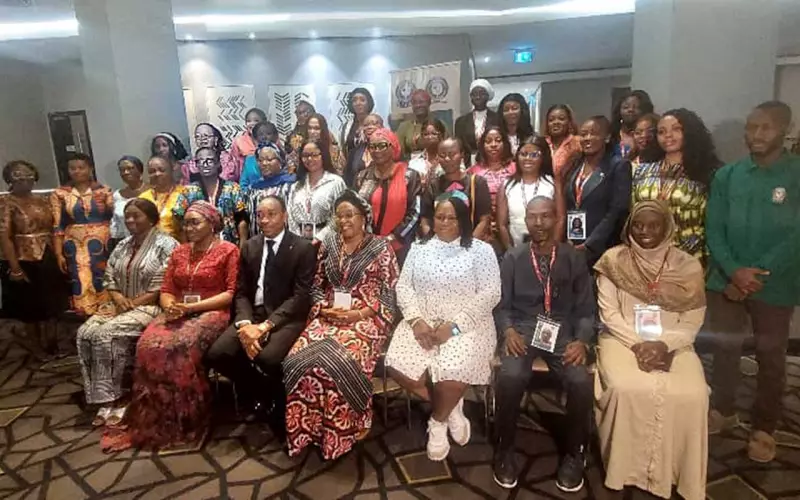
Policymakers, financial experts, and security officials from across West Africa have issued a powerful demand for immediate, intelligence-driven cooperation to dismantle the region's human trafficking networks. The urgent call was made during a major regional forum held in Lagos from December 17 to 19, 2025.
A Crime Fueled by Vulnerability and Profit
The Joint GIABA-EGDC Regional Forum on Women and Transnational Organised Crime brought together a wide range of stakeholders. They highlighted the grim reality of trafficking in West Africa, which remains a global hotspot for this crime. Edwin Harris Jr., Director-General of the Inter-Governmental Action Group Against Money Laundering in West Africa (GIABA), set a sobering tone. He described human trafficking as a pervasive evil that steals development, rights, and stability.
Citing United Nations data, Harris revealed a shocking statistic: children make up more than 75% of trafficking victims in West Africa. He stressed that poverty, gender inequality, conflict, and porous borders create the perfect conditions for criminal networks to thrive. "These are not just statistics; they represent thousands of lives, often children, stolen from a future of dignity and opportunity," Harris stated.
Following the Money Trail
A central theme of the forum was the critical link between trafficking and illicit finance. Ms. Hafsat Abubakar Bakari, Director of the Nigerian Financial Intelligence Unit (NFIU), underscored that human trafficking is a massively profitable business. She quoted estimates showing it generates over $150 billion annually worldwide, with women and girls comprising over 60% of victims.
"Behind every trafficking victim lies a financial trail," Bakari explained. She detailed how traffickers launder money through bank accounts, mobile money platforms, shell companies, and even cryptocurrency. In West Africa, networks often use low-value, high-volume transactions and exploit third-party accounts to avoid detection.
Bakari outlined the NFIU's role in fighting back through financial intelligence. By analysing Suspicious Transaction Reports and collaborating with agencies like the National Agency for the Prohibition of Trafficking in Persons (NAPTIP), they help identify networks, trace assets, and freeze criminal profits. International cooperation through groups like the Egmont Group is also vital for tracking cross-border funds.
A Unified, Victim-Centered Strategy for West Africa
Both leaders agreed that defeating traffickers requires breaking down silos. The partnership between GIABA, which strengthens anti-money laundering laws, and the ECOWAS Gender Development Centre (EGDC), which tackles social vulnerabilities, was highlighted as a model. The forum itself aimed to integrate gender-sensitive analysis with financial investigation across ECOWAS states.
Harris urged stakeholders to move beyond talk and adopt holistic strategies focused on prevention, community empowerment, and creating livelihoods. Bakari echoed this, stating that every disrupted money flow weakens a criminal network and protects a human life.
The three-day event in Ikeja, Lagos, served as a crucial platform for building trust and crafting actionable plans. GIABA and the NFIU reaffirmed their commitment to ensuring human trafficking finds "no refuge, no safe profit and no place" in West Africa.