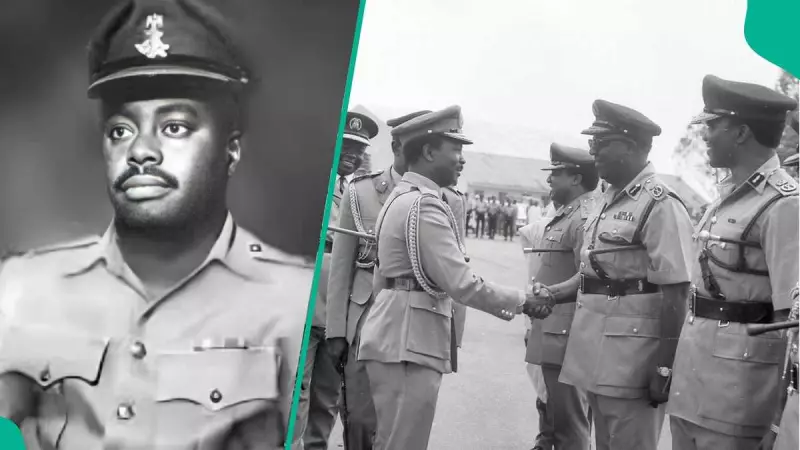
Six decades after the event that dramatically altered Nigeria's political trajectory, a chilling personal account has emerged, shedding new light on the human cost of the January 15, 1966, military coup.
A Midnight Raid by Trusted Comrades
Professor Ishaya Pam, a former Chief Medical Director of the Jos University Teaching Hospital (JUTH), has provided a detailed narrative of his father's final hours. Lieutenant Colonel James Yakubu Gyang Pam, the Adjutant-General of the Nigerian Army and an indigene of Plateau State, was abducted from his family home in Ikoyi Crescent, Lagos, in the early hours of that fateful day.
"I was one year and nine months old when the coup happened," Prof Pam recalled. "At about 2:00 am, soldiers broke into our house. The leader of the team was my father’s deputy and close confidant, Major Humphrey Chukwuka." This betrayal by a trusted subordinate marked the beginning of a tragic sequence of events for the senior officer, who was among key figures targeted in the uprising that also claimed the life of the Sardauna of Sokoto, Sir Ahmadu Bello.
A Mother's Desperate Plea and a Final Goodbye
In the midst of the terrifying intrusion, Professor Pam's mother appealed directly to Major Chukwuka for her husband's life. "My mother begged him, and he promised that my father would be brought back safely," he stated. However, Lt Col Pam seemed to sense his grim fate. He turned to his wife and, speaking in Hausa, instructed her to take care of their children, assuring her that God would be with her.
The officer was then taken to the Federal Guards headquarters in Lagos, where other coup plotters had assembled with their victims. An argument subsequently erupted among the leaders of the putsch regarding why Lt Col Pam was still alive. Prof Pam identified Major Christian Anufuru as the officer who questioned his father's survival, seized him, and drove him to a secluded area along the Lagos–Abeokuta road.
"He asked him to say his last prayers, and then killed him," the professor said, closing a chapter on the debate that briefly spared his father's life.
Unanswered Questions and a Family's Resilience
The aftermath of the killing left the Pam family with profound grief and unresolved questions. The bodies of those executed during the coup, including Prime Minister Tafawa Balewa and Finance Minister Festus Okotie-Eboh, were buried in shallow graves and later exhumed. "On January 17, 1966, the bodies were discovered and taken to Yaba Military Hospital for autopsy," Prof Pam explained. "But till today, we are still searching for my father’s remains. We were told they were given a mass burial at night without military honours."
Fearing for their safety, the family fled Lagos for Jos. They found initial refuge at the palace of the Gbong Gwom Jos before relocating to their village in Kwang. The Nigerian Army supported the education of Lt Col Pam's six children until 1975. Thereafter, their mother single-handedly shouldered the responsibility, training all of them through university. Prof Pam described his late mother as a highly educated and resilient woman whose strength held the family together until her death in 2011.
He also paid tribute to his father's distinguished career, noting he was the first Nigerian artillery officer and the first military officer from the Middle Belt. Lt Col Pam trained at the Royal Military Academy Sandhurst, commanded key units, served in United Nations peacekeeping missions, and assisted in re-training the Tanganyika Army. He was awarded the national honour of Member of the Order of the Federal Republic (MFR) in 1965 but was killed before the formal presentation. The honour was later conferred posthumously.
This poignant testimony, shared on the 60th anniversary of the coup, serves as a powerful reminder of the personal tragedies embedded within Nigeria's complex historical narrative, where the quest for answers and closure continues across generations.