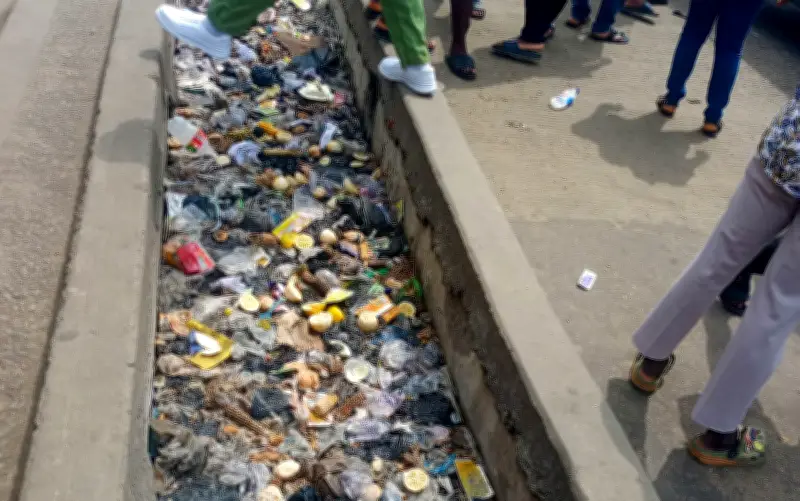
Drainage channels along the Apapa-Oworonshoki Expressway, one of Lagos’ busiest transport corridors, are clogged with plastic bottles, nylon bags, food packs and human excreta, posing environmental and public health risks, a PREMIUM TIMES investigation has found.
Daily scenes of waste and filth
During visits on Friday and Monday, PREMIUM TIMES observed that large portions of the drainage system are buried under refuse, with stagnant water trapped beneath. Human excreta were visible in several sections. Naomi Eke, a roadside corn seller, told PREMIUM TIMES in Pidgin: “This is not new. We’ve been seeing it for years. At night, some drivers and other people defecate inside the drainage because nobody is watching or arresting anyone.” She said traders have learned to live with the offensive odour and unsanitary conditions.
A commercial bus driver who identified himself as Suraj alleged that some residents and street urchins, known as agberos, also use the drainage as an open toilet after dark. “Some people living around here and some agberos see the gutter as their toilet. When they are pressed, especially at night, they come here. It’s been happening for a long time, so people have become used to seeing it,” he said.
Health and flood risks
Environmental experts warn that clogged drains impede rainwater flow, increase flooding risk, and create breeding grounds for mosquitoes and disease-carrying pests. The Apapa-Oworonshoki Expressway links Apapa, home to Nigeria’s busiest ports, with other parts of Lagos. The blocked drains remain largely hidden from the thousands of daily commuters.
LAWMA responds
Reacting to the findings, the Managing Director of the Lagos Waste Management Authority (LAWMA), Muyiwa Gbadegesin, said the agency was not immediately aware of the condition. He suggested waste might be washing out from nearby communities and requested the exact location. After PREMIUM TIMES identified the affected stretch near the Bono fuel depot in Apapa and reported the presence of human faeces, Gbadegesin said: “We’ll send a team to go and investigate and do enforcement there. Open defecation is against the law in Lagos.”
The commitment follows a June apology from the Commissioner for the Environment and Water Resources, Tokunbo Wahab, who acknowledged worsening waste management challenges after a PREMIUM TIMES special report on refuse accumulation across Lagos. “We had a challenge and we are fixing it,” Wahab said.
Persistent waste crisis
Lagos, with over 22 million people, generates an estimated 13,000 tonnes of waste daily. A 2024 World Bank assessment found that only about 54% is formally disposed of, leaving the rest in drains, roadsides, waterways and illegal dumpsites. The World Bank warns that blocked drains increase flooding risk, while the World Health Organisation links poor waste management to diseases like cholera and mosquito-borne infections.
Despite government directives for intensified waste evacuation, the Apapa-Oworonshoki drains remain clogged, suggesting the challenge requires more than periodic clean-ups. For commuters, the hidden drains are a reminder that Lagos’ waste crisis extends beyond overflowing dumpsites.