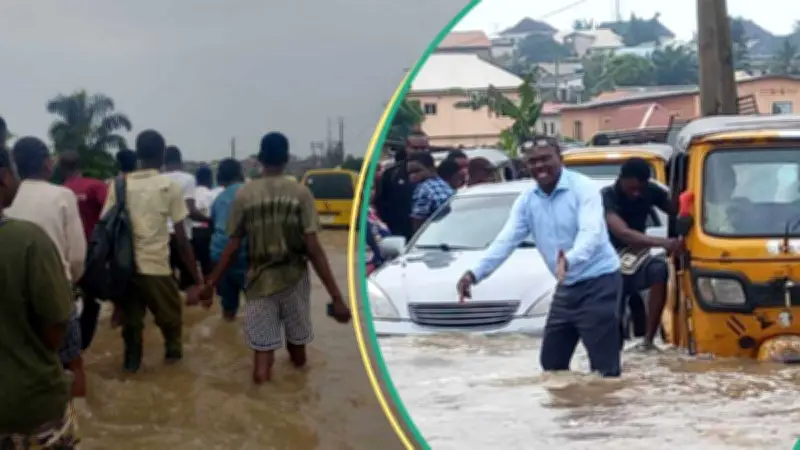
Several communities across Lagos were left under water on Tuesday after prolonged heavy rainfall triggered widespread flooding that cut off roads, entered homes and disrupted electricity supply in parts of the state.
Residents in areas including FESTAC, Gbagada, Ikeja, Ajah, Evans, Olushi, Anikantamo and Adeniji Adele battled rising floodwaters as vehicles stalled on submerged roads and pedestrians waded through waterlogged streets.
Flooding Disrupts Daily Life and Electricity Supply
The flooding also forced some families to leave their homes temporarily as water spread into residential buildings and business premises. Eyewitness accounts and videos from affected neighbourhoods showed major roads covered by floodwater, making movement difficult for commuters and motorists. In several locations, water levels reached knee height after drainage systems struggled to cope with the volume of rainfall.
The downpour also interrupted power supply after floodwaters affected equipment at the Oworo 132/33kV Transmission Station. Ikeja Electric said flooding at the facility damaged two power transformers and several 33kV feeders serving communities including Ladilak, Bariga, Araromi, Oworo, Pedro, Alapere, Agboyi, Araba, Hospital and Gbagada. The distribution company said restoration work was ongoing in collaboration with the Transmission Company of Nigeria.
Residents Blame Blocked Drains and Poor Road Design
Residents attributed the situation to blocked drains, poor road design and inadequate drainage infrastructure. A resident of Ikeja, Abidemi Raji, blamed the flooding on the poor road design and blocked drainage channels, Punch reports.
“The way the road was constructed contributes to the flooding. Although there is a drainage channel, it usually takes between 30 minutes and one hour after the rain stops before the water recedes because of the volume of water,” he said. Raji alleged that a drainage channel linking the area to another street had been blocked after a hotel was built. “There is supposed to be a channel connecting this compound to the next street, but the back passage was blocked after the hotel was built. That has worsened the flooding,” he added.
In FESTAC, residents described the flooding as a recurring problem that resurfaces whenever rainfall is particularly heavy. “Anytime it rains heavily, this place gets flooded. It is usually after the rain stops that the water begins to clear. My shoes were soaked this morning on my way to work,” said resident Okeke Mmesoma. She said many motorists avoided flooded roads to prevent damage to their vehicles, while some commuters delayed their journeys until water levels dropped.
Government Announces Drainage Dredging Plan
Lagos State Government announced plans to expand flood control efforts through the dredging of 28 additional primary drainage channels. Commissioner for the Environment and Water Resources, Tokunbo Wahab, described Tuesday's rainfall as an extreme weather event that temporarily overwhelmed existing drainage systems in several parts of the state, including Victoria Island, Lekki, Ikeja, Gbagada, Mushin and Mafoluku.
He said Lagos' coastal location, combined with tidal conditions, often slows the discharge of stormwater into the sea during periods of intense rainfall. Wahab added that emergency response teams were monitoring vulnerable communities and urged residents to stop dumping refuse into drainage channels, avoid illegal reclamation of wetlands and comply with flood safety advisories.
Impact Extends to Ogun State
The impact of the rainfall extended into neighbouring Ogun State, where residents of Gloryland Estate in Ibafo appealed for urgent government intervention after floodwater damaged homes and disrupted daily activities.