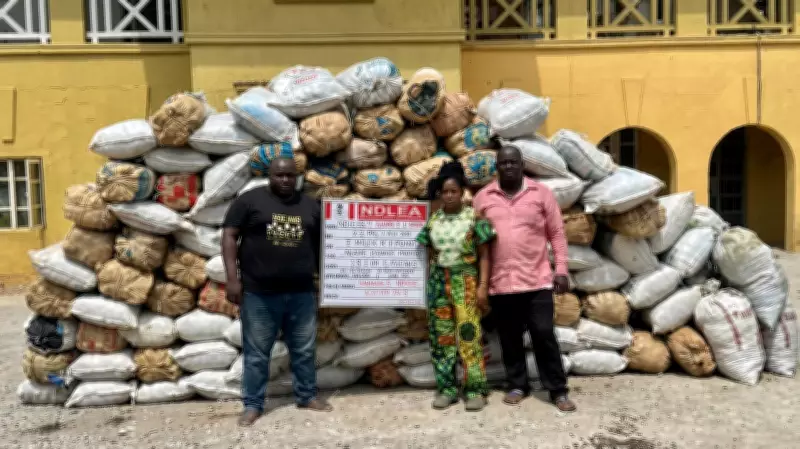
The National Drug Law Enforcement Agency (NDLEA) recently announced the dismantling of a Nigerian-Mexican methamphetamine syndicate in Ogun State, a landmark achievement that serves as both a victory and a warning. The operation uncovered a clandestine, industrial-scale laboratory in a remote forest in Ijebu East Local Government Area, where 2,419.48 kilogrammes of methamphetamine and precursor chemicals were seized. This represents the largest single meth seizure in Nigeria's history, with an international street value of $362,922,000 (over N480 billion). The operation followed months of intelligence by the NDLEA's Special Operations Unit and was executed across Ogun and Lagos states within 48 hours, leading to the arrest of the cartel kingpin, three Mexican 'cooks' imported to manufacture the drug, and six Nigerian collaborators.
Scale of the Threat
This bust comes barely two weeks after the agency dismantled another multi-billion-naira transnational criminal network in collaboration with the US Drug Enforcement Administration and law enforcement agencies from Switzerland, France, and Greece. Seizures of methamphetamine in Nigeria reportedly increased by 300 per cent between 2020 and 2023, reflecting the growing sophistication of local and international drug syndicates. The Ogun laboratory's undetected operation from inception to full-scale production raises serious questions: How long had it been operational? What institutional failures allowed it to flourish? How did three Mexican experts enter the country and disappear into a forest without attracting scrutiny from immigration, intelligence, or local security? How many more such operations remain hidden?
Commendation and Caution
The NDLEA deserves unreserved commendation for its professionalism and intelligence work, and President Tinubu's recognition of its 'bravery, resilience, and dedication' is merited. Under Brig Gen Marwa's leadership, the agency has confiscated at least 750 tonnes of illicit drugs over the last three years. In April 2025, it destroyed the largest volume of assorted illicit substances in its four-decade history—about 1.6 million kilogrammes seized across Lagos, Ogun, and Oyo states. However, no room must be given to complacency. There is an urgent need for deep collaboration with relevant security and intelligence agencies to nip illicit drug operations in the bud.
Nigeria: From Transit to Production Hub
Nigeria is no longer merely a transit country; it has become a production hub. The importation of Mexican specialists signals that foreign cartels have studied Nigeria and concluded it is viable for large-scale production. The NDLEA must immediately intensify surveillance of rural, forested, and agricultural land across the country. Cartels will adapt after this exposure. The urgency to curtail such syndicates comes with significant national security stakes. Methamphetamine induces psychosis, aggression, and paranoia, and in a struggling economy, it can fuel violence. Research has linked drug use to violent attacks across the country. At least 10,217 people have been killed in attacks by gunmen in Benue, Edo, Katsina, Kebbi, Plateau, Sokoto, and Zamfara states in the two years since the current government came to power.
Captagon and Broader Implications
The first-ever seizure of Captagon in West and Central Africa occurred in Lagos in September 2021. A 10,000-pill consignment of this amphetamine-type stimulant, known for producing prolonged alertness and euphoria while inhibiting fear and fatigue, was again intercepted in April 2026 in Kwara State. Primarily produced in Syria, Captagon has been blamed for funding conflict in the Middle East and giving near-superhuman strength to armed militias. Its presence in Nigeria, alongside the Ogun drug enterprise, confirms that the country is becoming more entangled in the infrastructure of transnational synthetic narcotics.
Way Forward
The Federal Government should boost intelligence-sharing with Mexico, the United States, and other Latin American nations. The National Assembly should ensure the NDLEA is well supported; a seizure worth N480 billion should indicate what adequate funding looks like. There must be a commensurate increase in prosecutions and a review of judicial processes to ensure swift and severe consequences for drug traffickers. Citizens and communities must become active participants. The Ogun meth lab operated for months because local communities were either unaware or uninvolved. Every Nigerian has a civic responsibility to report suspicious activities. Dismantling a syndicate will achieve little if the wider culture glamorises narcotics. The NDLEA's Clean Beat 91.5FM initiative is a useful intervention, but schools, religious institutions, media, and families must join in intensifying prevention efforts.
Nigeria is at a crossroads. It can invest in prevention, enforcement, and intelligence now, or confront far more dangerous criminal turf later, with deeper violence, corruption, and institutional decay. The choice is clear.