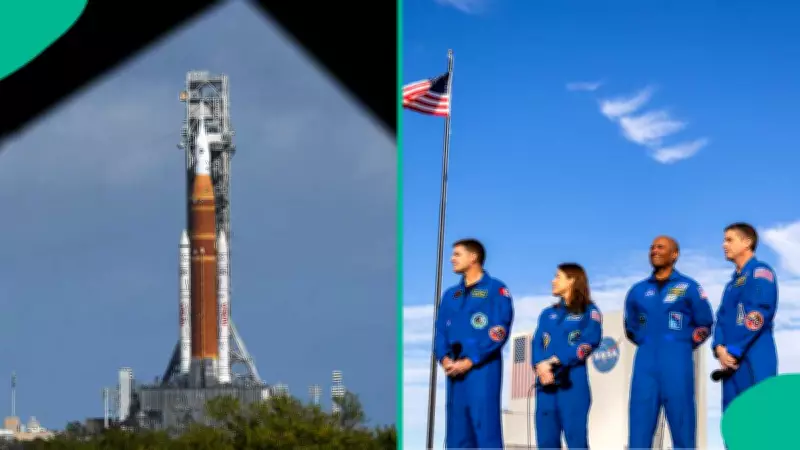
NASA's Artemis II Mission: First Human Moon Flight in 50 Years Set for Launch
NASA is preparing to make history by sending astronauts back towards the Moon for the first time in more than five decades. The Artemis II mission represents a major milestone in human spaceflight, marking the return of crewed lunar exploration after a long hiatus since the Apollo era.
Mission Timeline and Launch Details
The Artemis II mission is expected to lift off in the coming weeks, though the exact launch date remains uncertain. As of late January, the crew had already entered quarantine while engineers conducted final checks on the rocket and its systems. The earliest launch window was scheduled for February 7 at 2:41 AM GMT, but officials have cautioned that delays remain possible due to technical considerations and weather conditions.
Artemis II Flight Profile and Trajectory
Unlike landing missions, Artemis II will not touch down on the lunar surface. Instead, the Orion capsule will follow a free-return trajectory, looping around the Moon in a figure-eight pattern before returning to Earth. This approach was specifically chosen to reduce mission risk by avoiding the complex maneuvers required for lunar orbit insertion and subsequent engine firings for Earth return.

The mission profile includes several critical phases:
- Low-Earth orbit insertion approximately 49 minutes after launch
- System checks lasting about one hour
- A boost to a high orbit reaching 70,000 kilometers from Earth
- Engine firing to set course for the Moon
- A flyby of the far side of the Moon on flight day six, taking the crew further from Earth than any humans have traveled before
The spacecraft is scheduled to splash down on flight day ten, completing this historic journey.
Safety Concerns and Technical Challenges
Artemis II will mark only the third flight of an Orion capsule, raising significant safety considerations. The uncrewed Artemis I mission in 2022 revealed several technical problems, including electrical glitches and communication losses. Most notably, Orion's heat shield suffered unexpected damage during re-entry, though it ultimately did not fail.
Former astronaut Charles Camarda described the shield as presenting a serious risk in a public letter to NASA's administration. In response, NASA engineers decided to adjust the capsule's re-entry trajectory rather than redesign the shield entirely, a decision that delayed Artemis II by more than a year.
Future Artemis Missions and Lunar Landing Plans
The next mission in the series, Artemis III, is tentatively scheduled for 2027 with the ambitious goal of landing astronauts on the Moon. However, few observers believe this deadline will be met given current technical challenges. Unlike the Apollo program which managed lunar landings with a single rocket, Artemis requires two separate launches.
The Human Landing System, contracted to SpaceX, must first be placed in lunar orbit, followed by the crewed Orion capsule. SpaceX plans to adapt its Starship upper stage for the lander, but progress has been slow, with key technologies like in-orbit refueling yet to be demonstrated. Analysts suggest a crewed landing before 2028 appears unlikely even if tests succeed this year.
International Competition: China's Lunar Ambitions
The Artemis program unfolds amid growing international competition, particularly from China. The China Manned Space Agency has announced plans to land astronauts on the Moon by 2030, establishing itself as a serious competitor in the new space race.
In August, Chinese engineers tested the Lanyue lander in Hebei province with simulated landing and take-off procedures. China's mission architecture involves two Long March 10 rockets: one carrying the Mengzhou crew capsule and the other transporting the Lanyue lander. While these rockets have yet to fly, experts note that China's approach appears less risky than NASA's, with the Lanyue lander resembling Apollo's lunar module and avoiding the complexities of SpaceX's refuelling plan.

Political Debate and Program Criticism
The Artemis program faces significant criticism within the United States. Former NASA administrator Michael Griffin told Congress in December that we have lost a lot of time, and we may not be able to return to the Moon before the Chinese execute their own first landing. He argued that Artemis represents a plan that does not make sense and suggested starting again with a simpler design.
Others believe the program is driven more by political considerations than efficiency. Casey Dreier of the Planetary Society observed that Artemis is not optimised for cost or efficiency, it is optimised for political survival.
Long-Term Lunar Exploration Goals
Both NASA and China have articulated ambitious long-term goals for lunar exploration. NASA plans to launch components for the Lunar Gateway, a Moon-orbiting station, in 2027, with a permanent surface base targeted for 2030. On January 13, the agency announced plans to develop a nuclear reactor to power such an outpost.
Space historians remain cautious about these ambitions, recalling that similar goals during the Apollo era never materialized. However, analysts suggest China might prove a more persistent rival than the Soviet Union was during the original space race. As Dr. Patrick Besha observed, I think China is in this for the long term.
The Artemis II mission represents not just a return to lunar exploration but the beginning of a new era in space competition and cooperation, with multiple nations now setting their sights on establishing a permanent human presence beyond Earth.