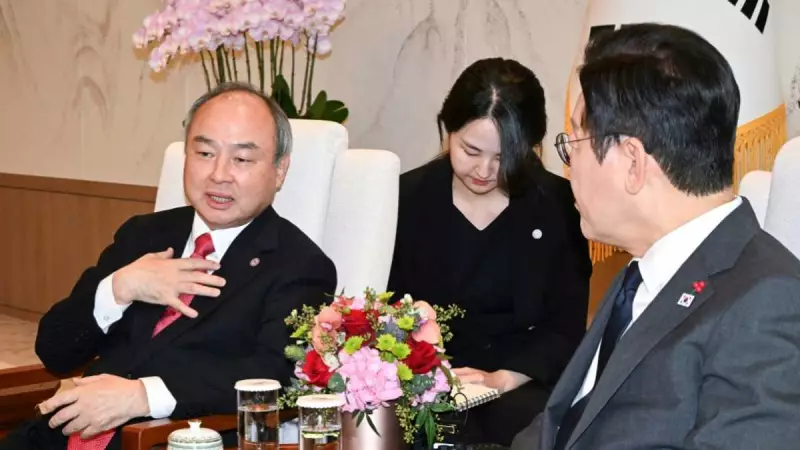
In a startling prediction that has sparked global conversation, SoftBank Group's founder and CEO, Masayoshi Son, has declared that the rise of advanced artificial intelligence could render human intelligence comparatively feeble, likening our future status to that of "fish." He even suggested such AI could win the Nobel Prize in Literature.
A Meeting of Minds in Seoul
The bold statements were made on Friday, December 5, 2025, during a meeting with South Korean President Lee Jae Myung at the Presidential House in Seoul. Son, whose investment conglomerate is a major backer of ChatGPT creator OpenAI, painted a vivid picture of a future dominated by Artificial Super Intelligence (ASI).
He described a potential intelligence gap of monumental proportions. "The difference between the human brain and the... goldfish in the pot -- the difference is 10,000 times," Son stated. He then turned this analogy on its head, warning, "But it's going to be different -- we will become fish, they (the AI) become like humans." He firmly believes these future AI systems "will be 10,000 times smarter than us."

Pets, Prizes, and Protein: Son's Vision of an AI Future
Masayoshi Son further elaborated by comparing the future dynamic between ASI and humanity to the relationship people have with their pets today. "We try to make them happy... we try to live in peace with them," he explained, attempting to allay fears of a hostile takeover. In a somewhat humorous note, he added, "We don't need to eat them... ASI does not eat protein. They don't need to eat us -- don't worry."
President Lee, who has vowed to transform South Korea into a global AI powerhouse, responded with laughter, noting he was "a bit concerned now." He then posed a poignant question to the tech visionary, asking if such an advanced AI could win a Nobel Prize in Literature—an honor won just last year by South Korean author Han Kang. Lee expressed skepticism, saying, "I do not believe this is a desirable situation." Son, however, was unequivocal in his reply: "I think it will."
South Korea's Ambitious AI Push and Global Context
This high-level discussion comes on the heels of Seoul's aggressive strategy to lead in the AI arena. Last month, President Lee announced plans to triple government spending on AI in the coming year. This massive investment is explicitly "aimed at propelling South Korea into the ranks of the world's top three AI powers," trailing only the United States and China.
In a related development also announced on Friday, Lee's office revealed a new partnership with Arm, the British semiconductor design unit owned by SoftBank. The collaboration aims to train 1,400 chip professionals in South Korea. Presidential policy adviser Kim Yong-beom stated the initiative would provide crucial help in "strengthening areas where South Korea's semiconductor industry is relatively weak," directly supporting the nation's AI ambitions.
While scientists generally consider the arrival of ASI to be a distant, hypothetical scenario, many agree that a critical precursor—Artificial General Intelligence (AGI), which would outperform humans across a wide range of tasks—could become a reality within the next decade. The dialogue between a global tech investor and a national leader underscores the profound economic and existential questions that AI development is now forcing onto the world's agenda.