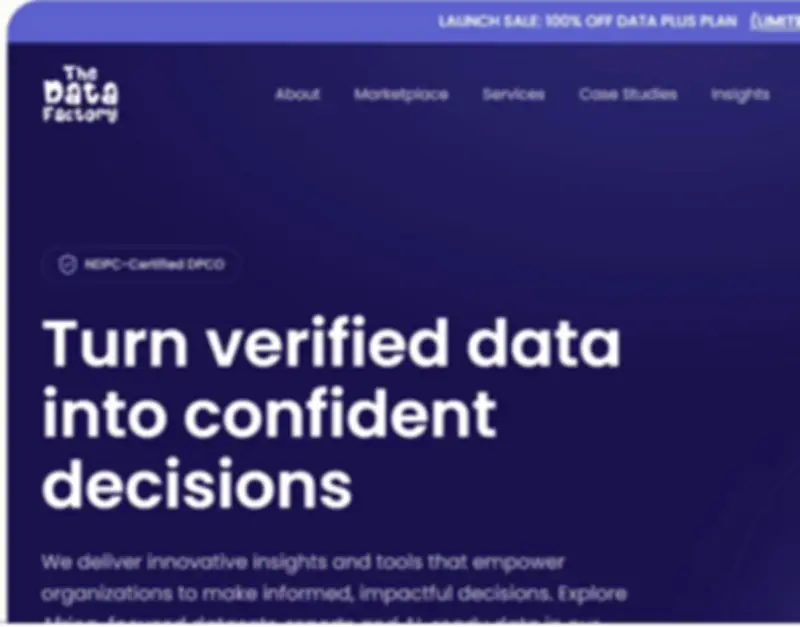
Data Factory Global, a leading data solutions provider, has officially launched Nigeria's first data marketplace, a platform designed to expand access to high-quality public datasets. The initiative aims to democratize data availability, empowering researchers, businesses, and policymakers with reliable information to drive decision-making.
What is the Data Marketplace?
The marketplace serves as a centralized hub where public datasets from various Nigerian government agencies, research institutions, and private organizations are aggregated and made accessible to the public. It offers a user-friendly interface that allows users to search, download, and analyze datasets on topics ranging from demographics and health to agriculture and economic indicators.
According to the company, the platform addresses a long-standing challenge in Nigeria: the difficulty in accessing accurate and timely public data. Previously, researchers and analysts often had to navigate fragmented sources or rely on outdated information. The marketplace consolidates these datasets into one reliable source, ensuring data integrity and transparency.
Key Features and Benefits
The marketplace includes several key features designed to enhance user experience. It provides real-time updates, ensuring that datasets are current and relevant. Users can also access data visualization tools that make it easier to interpret complex information. Additionally, the platform supports CSV, Excel, and API formats, catering to both technical and non-technical users.
One of the standout benefits is its potential to foster innovation. With easy access to high-quality data, startups and entrepreneurs can develop solutions tailored to local needs, while academics can conduct more robust research. The marketplace also supports evidence-based policymaking, as government officials can rely on comprehensive data to craft effective programs.
Impact on Research and Development
The launch is expected to have a significant impact on Nigeria's research and development landscape. By providing a single point of access to public data, the platform reduces the time and cost associated with data collection. This is particularly crucial for early-career researchers who often lack the resources to gather extensive datasets independently.
Furthermore, the marketplace encourages collaboration between different sectors. For instance, a public health researcher could combine health data with economic data to study the social determinants of disease. Such interdisciplinary approaches are vital for addressing complex societal challenges.
According to industry analysts, the move aligns with global trends where data is increasingly viewed as a critical asset for economic growth. Countries like Kenya and South Africa have already seen the benefits of similar platforms, and Nigeria is now poised to catch up.
Government and Private Sector Collaboration
The success of the marketplace hinges on collaboration between the public and private sectors. Data Factory Global has partnered with several federal ministries and agencies to ensure a steady flow of high-quality data. These partnerships are built on trust and a shared commitment to transparency.
Speaking at the launch event, the CEO of Data Factory Global, Mr. Chukwuma Okeke, stated, "Our goal is to break down the barriers to data access in Nigeria. We believe that when data is freely available, it can transform industries and improve lives. This marketplace is a testament to our dedication to that vision."
The company also plans to train data users through workshops and online tutorials, ensuring that Nigerians can fully leverage the platform's capabilities.
Challenges and Future Prospects
Despite its promise, the marketplace faces challenges, including data privacy concerns and the need for continuous data updates. Data Factory Global assures users that all data is anonymized and complies with Nigeria's data protection regulations.
Looking ahead, the company intends to expand the marketplace to include more datasets from local governments and the private sector. It also plans to introduce machine learning tools that can help users uncover patterns and insights from the data.
The launch of Nigeria's data marketplace marks a pivotal moment in the country's digital transformation journey. As more stakeholders embrace this resource, the potential for data-driven growth is immense, positioning Nigeria as a leader in data accessibility in Africa.