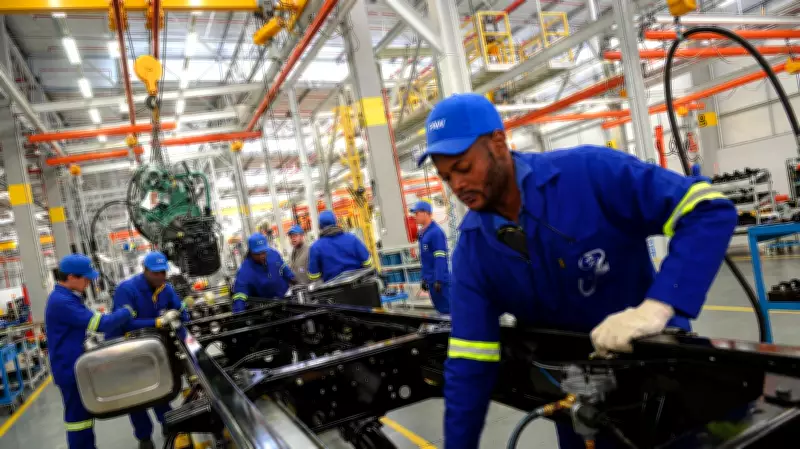
When a new industry enters a developing economy, the headline numbers often look impressive: foreign investment inflows rise, output expands, and exports grow. Yet too often, these gains rest on a fragile foundation. Capital arrives, value is created, and profits depart, leaving behind limited skills, shallow supply chains, and little lasting transformation. The difference between an industry that merely operates within a country and one that changes its developmental trajectory lies in a single question: who actually participates?
Local Content Requirements (LCRs)—policies that encourage or require firms to develop a domestic workforce and source locally where feasible—are frequently portrayed as burdensome or anti-market. In reality, they are among the most powerful tools available to developing countries seeking to turn infant industries into durable pillars of growth. When designed intelligently, LCRs are not constraints on efficiency; they are mechanisms for embedding value, capability, and legitimacy within the domestic economy.
Capturing Growth Rather Than Hosting It
A core challenge for developing economies is economic leakage. When firms rely heavily on imported labour, foreign consultants, and overseas suppliers, much of the income generated by new industrial activity flows straight back out of the country. Wages are remitted abroad, profits are repatriated, and imported inputs dominate expenditure. The host economy records activity but captures little prosperity.
Local content policies address this problem directly by anchoring expenditure domestically. Training local workers and engaging local firms ensures that income circulates through housing, food, transport, and services. Each round of spending amplifies the initial investment through the multiplier effect, raising employment, supporting small businesses, and expanding the tax base. This is not an abstract theory. In labour-intensive or skill-intensive sectors alike, the scale of domestic economic impact depends less on the size of headline investment and more on who earns the income. Without deliberate localisation, even capital-heavy industries risk becoming enclaves—efficient, profitable, and economically thin.
Human Capital: The Lasting Output of Industrial Policy
Physical infrastructure depreciates, and firms may relocate when conditions change. Skills do neither. One of the strongest arguments for local content lies in human capital accumulation: the permanent upgrading of a country’s skills base through learning by doing. Infant industries are uniquely well suited to this process. They introduce new technologies, management practices, and operational standards that, once learned, spill over into the broader economy. Workers move between firms, establish new enterprises, and adapt knowledge to adjacent sectors. Over time, what began as sector-specific expertise becomes a general productivity boost.
Without local content provisions, this learning opportunity is lost. Foreign experts may deliver projects efficiently, but their knowledge departs with them. LCRs, by contrast, turn industrial entry into a capacity-building exercise. Early reliance on foreign expertise is not eliminated, but it is explicitly temporary, with clear pathways for skills transfer and localisation as domestic capability develops.
Reducing Dependency and Strengthening Economic Resilience
Many developing countries struggle with chronic balance of payments pressures. Persistent reliance on imported expertise, spare parts, and technical services creates long-term foreign exchange outflows that undermine resilience, even in industries that appear domestically successful. Local content policies reduce this vulnerability by substituting imports with domestic capability over time. Training local technicians, engineers, and managers lowers operating costs, improves responsiveness, and reduces exposure to external shocks. Domestic suppliers, once established, are more likely to reinvest locally and adapt to local conditions than overseas counterparts servicing multiple markets.
This dynamic is particularly important for industries that require continuous operation and maintenance, rather than one-off construction. In such cases, the cost of dependency compounds year after year. LCRs help convert recurring expenses into domestic incomes, reinforcing structural transformation rather than eroding it.
Beyond Economics: Political Buy-In and Social Stability
Industrial strategies succeed or fail not only on economic grounds, but on political ones. Communities that experience disruption, whether environmental, spatial, or social, are unlikely to support industries from which they feel excluded. This disconnect is a common source of resistance, project delays, and policy reversal. Local content mitigates this risk by ensuring visibly shared benefits. When local residents are employed, local firms are contracted, and local institutions gain expertise, industries acquire social legitimacy. Economic participation translates into political support.
Inclusive participation also matters at the national level. Industries with broadly distributed benefits are harder to dismantle and easier to defend during downturns or political transitions. From an investor perspective, this embeddedness reduces policy uncertainty and lowers risk premiums. In this way, local content does not scare off capital—it can actually stabilise it.
Green Energy as an Illustration, Not an Exception
These dynamics are clearly visible in emerging green industries, but they are not unique to them. Renewable energy investments, for instance, can mobilise large volumes of private capital, yet their domestic economic impact depends heavily on whether turbines, skills, and maintenance services are localised or imported. Where local content strategies are absent, the environmental gains may be real, but developmental gains remain limited. The lesson generalises. Whether the sector is clean energy, advanced manufacturing, digital infrastructure, or transport, the challenge is the same: industrial policy without local participation delivers shallow growth.
Designing Smart, Flexible Local Content Policies
Critics of local content policies are right to caution against excess. Poorly designed requirements can inflate costs, create bottlenecks, or deter investment, especially in countries with limited initial capacity. The solution is not abandonment, but intelligent calibration. Effective local content strategies share several features:
- Phasing: Requirements increase gradually as capability develops, rather than imposing unrealistic targets from the outset.
- Flexibility: Firms are given options—training local workers, partnering with domestic suppliers, or investing in education infrastructure—rather than rigid quotas.
- Monitoring and adjustment: Policies are evaluated regularly, with scope for correction if bottlenecks or inefficiencies emerge.
- Sunset provisions: Requirements evolve or expire once objectives are met, preventing permanent protectionism.
Under these conditions, local content acts as a learning accelerator, not a barrier.
The Strategic Choice Facing Developing Economies
For developing countries, infant industries represent rare moments of leverage. Governments can shape market entry conditions to align private investment with national development objectives. Choosing not to do so is not neutrality—it is a decision to allow value creation without value retention.
Local content implementation is about more than jobs. It is about: capturing multipliers rather than leaking them; building skills rather than renting them; reducing dependency rather than entrenching it; and securing legitimacy rather than courting backlash. In a world of mobile capital and intense competition, developing countries cannot rely on hope that benefits will trickle down. They must design policies that ensure benefits take root.
Infant industries either grow into domestic engines of productivity, or they remain foreign-operated platforms with limited spillovers. Local content requirements—carefully designed, proportionate, and dynamic—are what make the difference.
Iyengunmwena, PhD, is a fellow of the Institution of Mechanical Engineers (UK) with several decades of experience in the global oil and gas and renewable energy industry.