
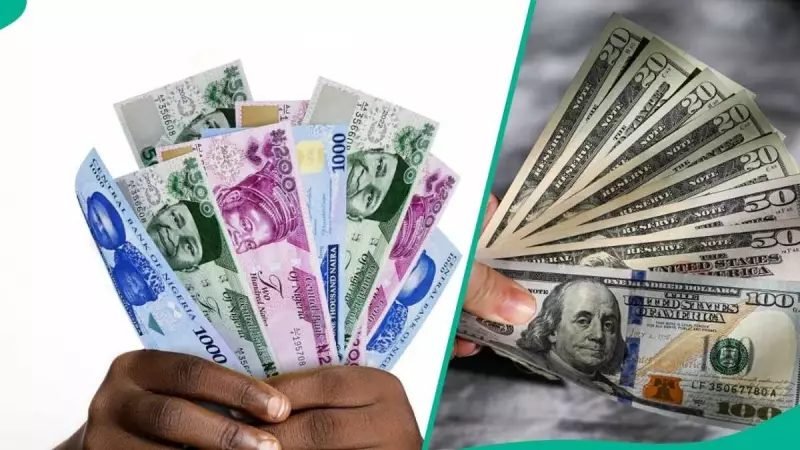
The Nigerian Naira has commenced the month of December on a robust footing, appreciating significantly against the United States Dollar at the official foreign exchange market. This positive performance extends the currency's recent upward trend, marking a strong recovery after a period of notable volatility.
CBN Interventions and Market Performance
Data from the official trading window shows the Naira closed the first week of December at N1,446.74 per dollar. This represents an appreciation of 0.69% from the previous week's close of N1,456.72. The recovery was bolstered by strategic interventions from the Central Bank of Nigeria (CBN), which sold $36.60 million to authorised dealers, including major banks like Access Bank and United Bank for Africa (UBA).
In the parallel market, the currency demonstrated stability, closing at N1,476 per dollar with only marginal changes. Analysts attribute the calmer market mood to renewed liquidity and higher foreign exchange availability. This improvement is partly driven by increased foreign capital inflows and a consistent policy direction from the apex bank.
Record Foreign Inflows and Investor Confidence
The Governor of the CBN, Olayemi Cardoso, provided compelling data on investor confidence. He revealed that foreign capital inflows into Nigeria hit $20.98 billion between January and October 2025. This figure signifies a dramatic 70% increase over the total inflows recorded in the entire year of 2024 and a staggering 428% surge compared to the $3.9 billion seen in 2023.
Cardoso shared these statistics at the 60th Annual Bankers' Dinner in Lagos, highlighting the growing trust in the Nigerian economy. Furthermore, the CBN's Deputy Governor, Mohammed Sani Abdullahi, announced that the country's monthly FX turnover has risen to a new high of $8.6 billion in 2025.
Analysts Point to Reforms and Stable Pricing
Financial experts link the Naira's stronger performance to key reforms and more balanced market conditions. According to Cowry Asset Management, liquidity has improved, bid/offer spreads have narrowed, and pricing in the FX market has become more stable.
Analysts from AIICO Capital noted that the appreciation was supported by foreign portfolio investors who increased dollar sales, creating a scenario where dollar availability exceeded demand. Their report stated the Naira appreciated by N9.98 during the week under review.
Structural Reforms Anchor Market Stability
The CBN Governor outlined several transformative reforms implemented over the past year. The unification of multiple exchange windows helped clear a significant backlog of FX obligations, restoring confidence among international investors and local businesses.
The introduction of the Nigerian Foreign Exchange Code and the Electronic Foreign Exchange Management System (e-FEMS) has enforced strict rules for transparency and real-time price discovery. Cardoso emphasized that these measures have successfully narrowed the gap between the official and parallel market rates to below 2%, a drastic reduction from over 60% in the recent past.
The central bank's reinforcement of the willing-buyer, willing-seller model has also reduced uncertainty, signaling that exchange rates will continue to reflect genuine market conditions rather than speculation.
Outlook: Stability with Mild Pressures Expected
While the current indicators are positive, market analysts caution that the Naira may face mild pressures in the coming days due to persistent FX demand and broader economic imbalances. However, they expect that rising external reserves and anticipated month-end inflows from sectors like oil and gas will provide a sufficient buffer.
The overall expectation is for market conditions to remain driven by true price discovery. The foundational reforms are seen as anchoring long-term confidence across the financial system, setting the stage for a more stable foreign exchange market as the year concludes.




