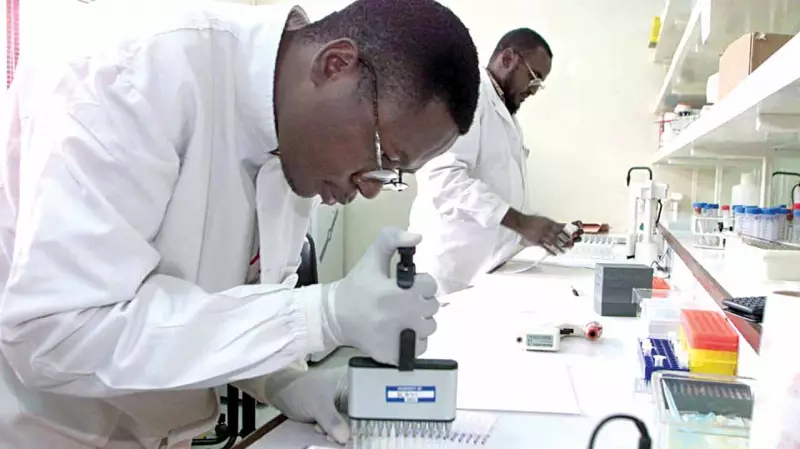
An international research team featuring Nigerian scientist Amarachi Confidence Nweke has successfully developed an advanced biological biosensor capable of detecting explosive residues in contaminated soil. This breakthrough technology offers a cost-effective and field-ready alternative to traditional detection methods that have long posed challenges for environmental monitoring.
How the Biosensor Technology Works
The research team, which includes Nchebe-Jah Raymond Iloanusi from the College of Staten Island in the United States, Nzube-Jah Ukah from the University of Western Ontario in Canada, and Amarachi Confidence Nweke from Elizade University in Nigeria, engineered their innovative solution using Pseudomonas putida. This non-pathogenic soil bacterium was selected for its remarkable resilience and metabolic versatility in various environmental conditions.
According to their study published in the Journal of Chemical Health Risks, the biosensor specifically targets explosive residues including 2,4-dinitrotoluene (2,4-DNT) and TNT – compounds commonly associated with warfare and industrial activities that pose significant long-term environmental and public health risks.
The researchers explained that current detection methods like gas chromatography and mass spectrometry, while accurate, present several practical limitations:
- High operational costs
- Time-consuming processes
- Unsuitability for continuous field monitoring
Technical Innovation and Laboratory Performance
The newly developed biosensor operates by activating specific genes – PxylA, PaccD and P3027 – whose expression levels increase dramatically upon exposure to explosive compounds. The research team employed CRISPR-Cas9 techniques to connect these genes to fluorescent reporter systems, enabling rapid visual detection or instrument-assisted analysis.
Laboratory testing demonstrated impressive results, with the biosensor showing:
- High sensitivity even at low contaminant concentrations
- Strong performance under varying environmental conditions
- Reliable signal output through fluorescence assays and qRT-PCR analyses
- Consistent behavior across different temperature and humidity ranges
Field Applications and Future Potential
To enhance practical field applications, the researchers incorporated several advanced features including synthetic promoters, dual UTR systems, and encapsulation technologies. These improvements allow the biosensor to function effectively in actual soil matrices or portable testing kits.
The engineered system can be integrated into handheld optical devices or smartphone-based platforms for real-time monitoring, making it particularly valuable for post-conflict environmental assessment and ecological restoration efforts.
This technology represents a significant advancement in global efforts to develop low-cost, sustainable tools for hazardous contaminant detection. The study also establishes a foundation for future innovations that could combine microbial biosensing with artificial intelligence, digital mapping, and autonomous detection systems.
The research conducted by the international team, including the notable contribution from Nigeria's Elizade University, opens new possibilities for environmental protection and public safety in regions affected by industrial contamination or historical conflict.