Prominent stakeholders in Nigeria's electoral process and civil society leaders have issued a strong call for comprehensive reforms to strengthen the country's democracy and ensure it delivers tangible benefits to citizens beyond periodic elections.
National Conference on Democratic Future
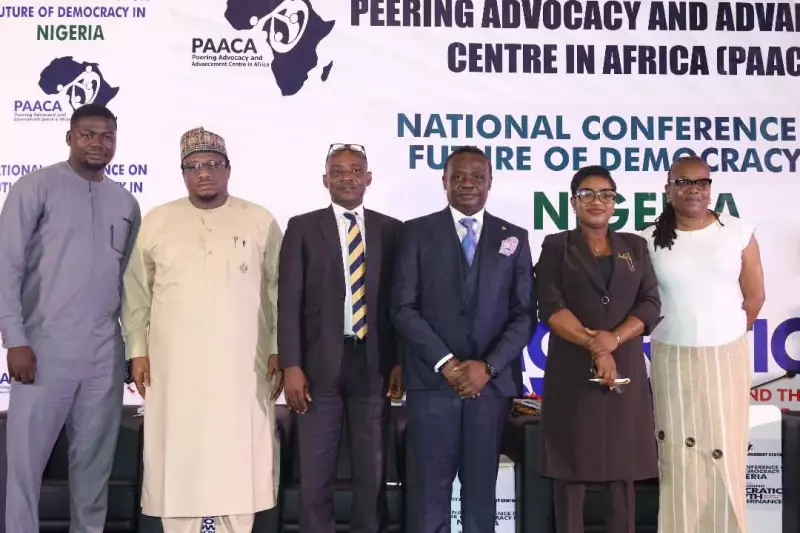
The urgent appeal was made during the National Conference on the Future of Democracy in Nigeria, organized by the Peering Advocacy and Advancement Centre in Africa (PAACA) in Abuja on Wednesday. The event brought together key players to discuss sustaining democratic reforms for effective governance.
In his opening remarks, Mr. Ezenwa Nwagwu, Executive Director of PAACA, emphasized the critical timing of the conference, describing it as an essential platform for reflection on making Nigeria's democratic reforms lasting and citizen-focused.
"Nigeria has made important strides in strengthening electoral integrity and broadening citizen participation, yet the journey toward a democracy that truly delivers for all its citizens is far from complete," Nwagwu stated.
He highlighted PAACA's consistent efforts in amplifying citizen voices and bridging the gap between policy and the people. Through town hall meetings across 19 states, the organization has engaged traditional rulers, youth, women, persons with disabilities, security agencies, and political actors to develop policy recommendations submitted to INEC and the National Assembly.
Critical Assessment of Democratic Challenges
Dr. Husseini Abdu, Country Director of CARE International and chairman of the occasion, criticized the narrow perception that equates periodic elections with democracy. He identified the failure to connect democracy with accountability and citizen participation as a fundamental problem.
"The perception is that once you have periodic elections, then you have democracy. Unfortunately, that is not true," Dr. Abdu asserted. "The failure to actually connect democracy, accountability and citizens participation is what led us to where we are today."
He pointed to economic hardship, insecurity, and loss of public trust as significant challenges facing Nigerian democracy since 1999. Dr. Abdu particularly criticized political practitioners who he said only believe in democracy to the extent that it serves their interests.
"Every election season, we work really hard to get a new Electoral Act to support our elections, but that Act works only for one election season. By the next elections, they have perfected ways of undermining it," he lamented.
Institutional Reforms and Constitutional Compliance
In his keynote address, Prof. Sam Egwu, Benue Resident Electoral Commissioner, spoke on "The Future of Democracy in Nigeria: Building Institutions that Outlast Elections." He noted the paradox of Nigerian democracy showing signs of consolidation while failing to meet citizens' needs.
Prof. Egwu emphasized that democracy and good governance are inseparable, pointing to the World Bank's evolution from skepticism to support for democracy as evidence of this global truth. He stressed that Nigeria must enlarge the frontier of effective governance by rethinking liberal democracy and adapting it to local realities.
The INEC official made a striking revelation about constitutional breaches by successive administrations since 1999. "If you read the 1999 constitution, which is lifted from the 1979 constitution, chapter two commits to the doctrine of democracy. It talks about the responsibility of government in terms of the welfare of citizens," he explained.
"All the presidents that have come since 1999 never obey the constitution. The 1999 Constitution commits Nigeria to a social democracy. What they have been doing is in breach of the constitution," Prof. Egwu declared.
He criticized the excessive centralization of power in the executive, which undermines Nigeria's federal system and leaves local governments powerless. The professor also lamented that Nigeria's domestic policy space has been hijacked by international financial institutions like the World Bank and IMF.
Civil Society and Political Party Reforms
Former presidential candidate Dr. Gbenga Olawepo-Hashim expressed concern about Nigerians losing faith in democracy due to its failure to improve their lives. He revealed that during recent protests, some young people carried flags of Russia and China because they believe democracy has failed them.
Dr. Olawepo-Hashim criticized Nigeria's political parties for becoming mere vehicles for personal ambition rather than platforms for ideas or social reform. He called for a truly independent electoral body and political system that guarantees credible elections and accountable governance.
Prof. Egwu also addressed the state of civil society, describing it as the true hero of Nigeria's democratic journey but currently weakened by lack of membership structure and dwindling funding. He advocated for transforming local government administration into a system that directly connects authorities with citizens to decide development priorities.
The conference concluded with a consensus that Nigeria's democracy requires fundamental institutional reforms, stronger accountability mechanisms, and greater citizen participation to deliver the promised benefits of good governance and development to all Nigerians.