
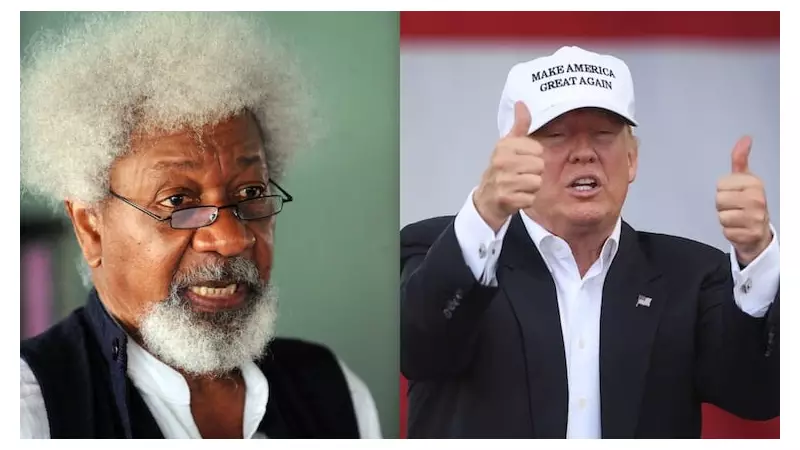
Nobel laureate Professor Wole Soyinka has issued a sharp critique of former US President Donald Trump's recent inflammatory statements concerning Nigeria, cautioning that such sweeping claims dangerously misrepresent the nation's complex security crisis.
Distorting Reality and Inflaming Tensions
The controversy erupted after Donald Trump ordered the US Department of Defence to prepare for "possible action" in Nigeria, demanding that the Abuja government act swiftly to halt the alleged "killing of Christians." Nigeria's federal government was quick to push back, asserting that the country's pervasive insecurity affects all citizens, regardless of faith, and that Trump's narrative is fundamentally misleading.
Weighing in on the program Democracy Now, Soyinka argued that Trump's remarks distort the complex reality on the ground. "We must separate Nigeria's long-standing internal problems from President Trump's recent response," Soyinka stated. He expressed deep concern that framing the multifaceted conflict as a simple battle between Christians and Muslims is not only inaccurate but also risks inflaming the deep-seated religious tensions that have plagued the nation for decades.
The Weaponization of Religion and Culture of Impunity
Soyinka delved into the historical roots of the problem, explaining that the Christian-Islam dichotomy has existed for a long time but became truly horrendous when politics became entangled with religious differences. He accused Nigerian politicians of having long weaponised religion as a tool for gaining and maintaining power, all while systematically failing to hold extremists accountable for their actions.
To illustrate this culture of impunity, Soyinka pointed to the brutal lynching of a female student, Deborah Yakubu, who was accused of blasphemy. He noted with dismay that her killers were filmed boasting about their crime, yet they still walked free. "When perpetrators of such horrors go free, it strengthens the perception that a brutal war is going on between Christians and Muslims," he lamented.
The playwright clarified that the real adversaries are not ordinary Muslims, but specific extremist factions. "In truth, we are dealing with extremists, political Islamists, known sometimes as ISWAP or Boko Haram, not with Muslims as a people," he asserted. He added that these groups have forged connections with global terror networks, granting them access to advanced weaponry that often surpasses the capabilities of Nigeria's own security forces.
Personal Repercussions and a Scathing Comparison
The conversation also took a personal turn when Soyinka revealed that his US visa was revoked, an action he attributes to his consistent criticism of the Trump administration. "I have a feeling that I haven't been flattering Donald Trump, and I see no reason to do that," he remarked wryly.
He went a step further, drawing a stark parallel between the former US president and a notorious African dictator. Soyinka stated that Trump should feel "flattered" by the comparison to Idi Amin, the former Ugandan ruler known for his brutality. "Trump has said he likes war, I'm quoting him. Idi Amin was a man of war and brutality," Soyinka said, highlighting what he sees as a disturbing similarity in their rhetoric and disposition towards conflict.
Ultimately, Soyinka's central warning is that external commentary, especially of the kind offered by Trump, only serves to complicate an already dire situation. "When we have sweeping statements like Trump's, it doesn't make things easier. It expands the regions of hostility and makes peaceful resolution even more difficult," he concluded, urging for a more nuanced understanding of Nigeria's internal strife.




